admin
admin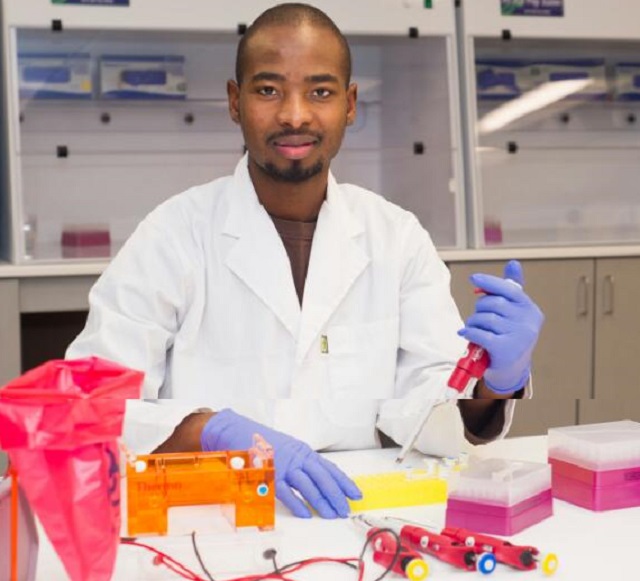

Robin Muchetu,Senior Reporter
THE mention of the organisation, Federal Bureau of Investigations (FBI) takes one’s mind to a movie scene of a murder case where detectives investigate how a person may have been killed, any possible leads that have been left by the killer on the scene and so on.
One lucky man from Zimbabwe has had the opportunity to rub shoulders with the FBI and work with them in real life. His life revolves around solving cases involving dead people and also teaching others how to solve such cases with biological evidence.
Mr Pardon Masarirambi is a former National University of Science and Technology (Nust) student who has earned himself various scholarships in the United States of America owing to his hard work and persistence in the field of Forensic Science and is raring to go. Born in Masvingo in 1989 Mr Masarirambi said he never imagined being what he is today.
“I was born in Masvingo and did all my primary education in rural schools, I never thought one day I would be where I am today but hard work and persistence has taken me to this stage,” he said from is base in the US.
Mr Masarirambi, whose mother is a teacher said he attended four different primary schools all in rural Masvingo but he did not let his mothers “nomadic” career affect his school work, he remained focused. During his early years his grandparents took care of him until his mother completed her studies at Mutare Teachers College while his father was an education officer for Zvimba District in Mashonaland West Province.
Asked on why he pursued forensic science he said it dated back to when he was just 12 years old and he was given a green bicycle as a present but it was stolen from their garage without a trace. Mr Masarirambi said he feared for the worst that could have happened but did not want to rush into conclusions.
“Mum reported the case to the police and it took about a week for them to respond. This experience has contributed so much to my dream career as a forensic scientist,” he said.
His parents later sent him to Daramombe High School in Chivhu for Ordinary and Advanced Level. When he was in high school his goals changed and he wanted to join the medical field only because of his subject combination Mathematics, Biology and Chemistry.
“Studying medicine was the logical decision I could foresee. Unfortunately, I did not get a chance to do that. My world crumbled since I barely had career guidance. I later on pursued a degree in Applied Biology and Biochemistry at Nust then graduated in 2013. After graduating I applied to several companies, nothing tangible materialised. So I decided to assist high school students in science as a relief teacher at Mpopoma High School,” he said.
In March 2015, Mr Masarirambi was fortunate to land employment at the Forensic Science Department in the Ministry of Home Affairs. He said he values the time he attended some high and low profile crime scenes. It was during those days when the zeal to know more about forensics got the better of him.
“The complexity of crime scenes made me realise that I needed in-depth knowledge in order to be effective. I then consulted Ms Rebecca Mano who was the adviser for the US Educational Advisory Centre in Harare.
“A breakthrough came in September 2015 when she mentioned Emporia State University (ESU) could be the best institution for me. I learnt that ESU had a new Master’s Programme for Forensic Science, I then applied and resigned from my job as a trainee forensic scientist to pursue my two-year Masters in Forensic Science in the USA. I have had the privilege to work at Kansas City Police Department Crime Laboratory in Missouri USA,” he said.
Presently, Mr Masarirambi is a graduate teaching assistant in Molecular Techniques for Forensic Scientists module at ESU.“I completed my research project which has attracted so much attention at forensic conferences around USA.
The research titled: ‘Recovery and individualisation of species specific vertebrate DNA from the GI-tract of flesh eating insects, Dermestis maculatus’.
“Dermestis maculatus is the scientific name for the beetles used in the research that was based on using flesh eating beetles to aid the identification of a missing person(s) during a forensic science investigation. At a crime scene, it is inevitable that the local insect population (e.g. beetles) will feed upon a corpse and or body parts. So the recovery and analysis of human DNA from a beetle’s gut can identify what the insect had been feeding on and link the body to the missing person.
He went on: “My research has recovered human DNA that is of sufficient quality to generate a Combined DNA Index System (CODIS) profile, a criminal database used in USA. CODIS blends forensic science and computer technology together to generate investigative leads in cases when a DNA match is obtained, thereby assisting in identification.
“This research can be applied in situations where the beetles or flesh eating insects are present while a corpse or carcass is absent at a suspected crime scene. If a body has been moved, beetles may fall off during transportation and the presence of DNA in beetles would be evidence that the body has been removed from the original location,” he said.
He presented this research at different conferences that include the Kansas Bureau of Investigation (KBI) which is part of the FBI. In Zimbabwe Mr Masarirambi said he is proud to have worked on a high profile case involving the break in at President Emmerson Mnangagwa’s offices when he was still Vice-President and also on the case where a dead body was found in a plane at the then Harare International Airport in a cargo plane destined for South Africa.
He, however, lamented the fact that forensic science in Zimbabwe needs to be greatly improved in order to assist affected people get closure and to help those who are arrested wrongfully.
“Some people are behind bars for crimes that they did not commit as there is no DNA evidence in some cases. If our scientists get to have this some people will walk free out of courts and some prosecuted. Government needs to prioritise funding to forensic sciences,” said Mr Masarirambi.
He said a well established forensic science unit can reduce crime rate as perpetrators will be aware that any biological evidence found can lead to them being arrested for crimes they commit. He further said such departments need to be constantly maintained and upgraded as science is ever developing.
Furthermore, he said Zimbabwe needs regional forensic science laboratories and others in provinces such that the scientists can deal with cases more efficiently rather than having centralised laboratories where cases can stall.
Asked on his future plans, Mr Masarirambi said he would like to pursue a PhD in Forensic Science and ultimately establish a forensic consultancy firm in Zimbabwe that will also serve Southern Africa. He said there is also a need to partner with attorneys to help people behind bars being “accused of crimes they never committed”. It is also his desire to introduce the DNA criminal database to bring justice on several cases. He further said he wants to work even harder and then raise a family in a conducive environment.
“I am single but I want to raise a family when I have established myself well enough so that I give my children a better life style than what I experienced. I also want to uplift my parents first as they made me who I am today so I want to make their lives much better that is why I am working hard where I am,” he said.


 Online Reporter