
Latwell Nyangu
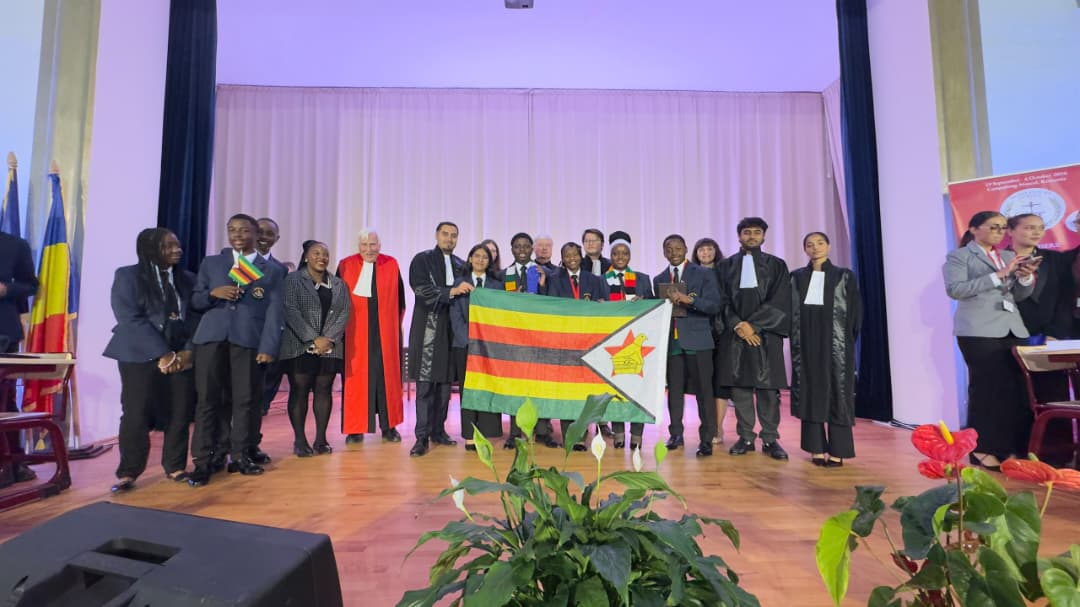
EIGHT Zimbabwean teenagers have overcome financial constraints and intense competition to emerge as European Moot Court Champions held in Câmpulung Muscel, Romania.
Among the triumphant team were two 13-year-olds who held their own against students considerably older and, in some cases, more experienced than them.
The Zimbabwean teenagers were required to defend complex legal positions they had spent weeks researching and preparing for.
They faced a panel of judges who tested their knowledge with challenging questions and could interrupt their submissions at any point.
Under the pressure of the courtroom, however, the young Zimbabweans remained composed, demonstrating confidence, discipline and a remarkable understanding of the law.
By the end of the competition, the eight students had achieved something extraordinary: they had been crowned European Moot Court Champions.
Among them were 13-year-olds Mukudzei Collen Junior Mharadzano and Sarah Arielle Msipa, whose performances highlighted the depth of talent emerging from Zimbabwe’s young generation.
Founder and Head Coach of the Zimbabwe National Moot Court Team, Advocate Nqobile Dube, said the victory represented another major milestone for competitive moot court in Zimbabwe.
He said the achievement was particularly significant given that the same team had previously won the World Championship and, in 2022, became the first African team to win the European Moot Court Championship.
Adv Dube said the latest victory demonstrated the potential of Zimbabwean students when given opportunities to develop their legal skills.
“Approximately 200 students from across Zimbabwe, from Form 1 to Form 6, applied.
“The students were introduced to the fundamentals of international humanitarian law and moot court before undergoing national selection trials.
“The trials were conducted both virtually and in person, with the in-person component hosted at Dominican Convent.
“The selection process brought together students from across the country and was judged by members of the legal profession and law students from the University of Zimbabwe and Herbert Chitepo Law School.
“From that national pool, a group of students was selected for the Zimbabwe National Moot Court Team.”
The final Romania squad consisted of eight students: Tinodaishe Cole Makwiranzou, 15, of St John’s College and team captain; Amyra Jain, 15, of Hellenic Academy and deputy team captain; Ziyanda Inzwirashe Madison Zawe, 15, of Tynwald High School; Giovanni Tawananyasha Nyatsambo, 16, of Tynwald High School; Tafadzwa Samuel Mwagura, 15, of Milestone College; Mukudzei Collen Junior Mharadzano, 13, of Milestone College; Courtney Falees Joseph, 15, of Bulawayo Adventist School; and Sarah Arielle Msipa, 13, of Celebration International School.
The delegation comprised four boys and four girls from six different schools, making it more than a school team.
It was a national team drawn from different parts of Zimbabwe and united by a shared passion for law and intellectual competition.
Adv Dube said the achievement belonged primarily to the students, who represented the country with distinction.
“This victory belongs first and foremost to the eight students.
“They represented Zimbabwe with extraordinary discipline, courage and intellectual maturity.
“What makes the achievement particularly special is that they were not simply competing against other teenagers, but they were competing against students who were, in many cases, older and more experienced.
“Two members of our team are only 13 years old.”
While the victory may have culminated in a trophy and international recognition, Adv Dube said it was the result of months of demanding preparation.
He said much of the work took place away from the spotlight, with students balancing intensive moot court training with their schoolwork and examinations.
“What people see is the trophy, but they don’t always see the months of work behind it.
“This team emerged from a national selection process involving approximately 200 students from across Zimbabwe.
“They went through training, trials and intensive preparation before the final eight were selected to travel to Romania.
“Because the students are based in different parts of Zimbabwe and have demanding school schedules, much of our preparation happened online.
“There were many evenings when we trained from around 6pm until 10pm, sometimes while the students were also preparing for school examinations.
“That level of commitment is a major part of why they succeeded.”
He further said, for the teenagers, the championship was therefore not simply about winning a competition.
“It was the culmination of months of research, late-night training, public speaking, legal analysis and learning how to remain calm when confronted with difficult questions.
“The success also placed Zimbabwe firmly on the international moot court map, demonstrating that age and financial limitations do not necessarily have to stand in the way of excellence when young people are given the right support and opportunities.”
On the intellectual challenge, Advocate Dube, said, students simply memorised speeches.
“They had to understand a complex simulated International Criminal Court case, develop prosecution and defence arguments, research difficult questions of international criminal and humanitarian law, and then defend their reasoning when judges interrupted them with difficult questions.
“They had to think on their feet under intense time pressure.
“For me, the most important message is that world-class intellectual talent exists in Zimbabwe. We don’t have to go overseas to find it.
“We can identify it in our classrooms, develop it systematically and give it the opportunity to compete on the international stage.
“This victory is bigger than a moot court. The skills these students have developed research, critical thinking, communication, advocacy, confidence and the ability to perform under pressure are skills that Zimbabwe needs across law, diplomacy, business, academia, public administration and leadership.”
On the students themselves, he said:
“I have been particularly impressed by their resilience. These are still schoolchildren. They had classes, examinations, family responsibilities and all the normal pressures that come with being teenagers, yet they committed themselves to an extraordinarily demanding programme.
“They learned how to accept criticism, recover from mistakes and keep performing under pressure.”
“Whenever these students walked into the courtroom, they knew they were carrying more than their individual names.
“They were representing their schools, their families, their coaches and Zimbabwe.
“They also understood that they were demonstrating what young African students are capable of when they are given access to serious intellectual training and international opportunities.”
“We didn’t discover talent in Europe. We discovered it in Zimbabwe and gave it the training and platform to compete with the world.
“This championship is proof of what is possible when young Zimbabwean talent is taken seriously.”
While, Amyra Jain who is the deputy captain for the Zimbabwe National Moot Court team that travelled to Romania this year., said, it was an honour.
“It’s a true honour that we got this opportunity to represent our country at the world stage. It was truly an unforgettable experience and our ability to take every round as it came until we eventually won helped us prove to ourselves that we deserved to be there and deserved to achieve everything that we did.”