admin
admin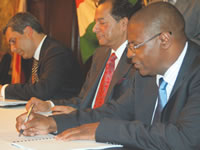
Holdings represents a quantum leap towards the revival of the firm that will have innumerable spin-offs for Zimbabwe.
The conclusion of protracted discussions between the Government and Essar Africa was the signing of the shareholding transfer in Harare on Wednesday.
Industry and Commerce Minister Welshman Ncube and Essar Group vice chairman Mr Ravi Ruia signed the deal to pave way for the resuscitation of Ziscosteel.
Prior to its signing, the deal had received the blessing of President Mugabe and Prime Minister Morgan Tsvangirai.
“We believe that this transaction (Ziscosteel deal) will serve as a catalyst for significant future foreign direct investment into Zimbabwe,” said Minister Ncube.
Mr Ruia said Zisco presented an investment opportunity to bolster the economic recovery.
Essar outsmarted seasoned players in steel making such as South Africa’s Arcelor Mittal and fellow Indian steel giant Jindhal Steel and Power for the Zisco deal.
And that went far in proving its seriousness to revive Zisco, albeit a number of factors created the premonition it was not a wise investment decision.
The immediate benefit from the disposal of Zisco will be the lifting of a US$340 million debt burden from a Government struggling to fund its fiscus.
Under the terms of the contract Essar will assume all of Government’s external liabilities, revive Zisco, replace old equipment and inject fresh capital.
The investment would also result in capacitating of key enablers, such as the National Railways of Zimbabwe, Hwange Colliery Company and Zesa Holdings.
Essar pledged initial investment in the project of US$750 million. This comes for a company buckling under debts. Zisco was valued at US$45 million.
For its part, Essar Africa will assume a 54 percent stake from Government’s 89 percent. Minorities hold the remainder.
The firm, owned by India’s Essar Global, will also get an 80 percent stake in an iron ore joint venture and Government would own the remaining 20 percent.
The two parties have also agreed to pool together financial resources for the retirement of the firm’s US$22 million salary-related arrears.
It also means no more headaches for Treasury, which since the early 1990s had to take the taxpayers’ money to fund the firm’s capital deficiencies.
But it will be the expected economic and social impact the revival of Ziscosteel will have that will be felt across the country.
The company’s collapse a few years ago was reportedly a result of poor financial planning, management failure, structural bottlenecks, erratic supply of key inputs such as coal, lack of forward-looking strategies and poor staff morale.
But Essar said it was determined to close this sad chapter by looking into the future. It expects the first pour of steel in the next 15 months.
Undoubtedly, the impact on industry will be huge. Industry has had to import virtually most of its steel products, as there was no local steel producer.
There were also firms dependent on Ziscosteel – such as Sable Chemicals – which supplied the firm with liquid oxygen from its ammonia electrolysis plant.
Revival of Ziscosteel will be a major milestone considering local industry was built at the peak of production, using steel products from the Redcliff based firm.
At the peak of its operations, Zisco had capacity to earn more US$105 million worth of exports. If resuscitated the firm would earn more than this amount, considering that it would first have to satisfy the huge local demand for steel.
Considering Essar’s track record in operating Brownfield and Greenfield steel projects, the development provides an opportunity for the modernisation of Ziscosteel’s plant, blast furnaces and coke oven batteries.
Essar have capacity to transform Zisco into the most sophisticated steel-making giant in Africa, considering experiences in India, Canada, the UK and Indonesia.
Mr Firdhose Coovadia, resident director of Essar (Middle East and Africa) said the firm was set to become a low-cost steel producer positioned to meet growing demand and capitalise on growth in sub-Saharan Africa.
“The Essar group will bring investments and expertise in steel-making, beneficiation, project management, construction, power generation and logistics,” he said.
It is expected that the revival of Ziscosteel will result in the creation of more jobs, considering that at peak production the firm employed over 4 000 people. Due to operational difficulties, this figure had fallen well below 1 500 workers.
Ziscosteel’s current workers will welcome the latest development that will result in a better welfare. Essar said that it was committed to community development.
The Essar Group is a multi-national conglomerate with interests in steel, oil and gas, power, communications, shipping and logistics, projects, and minerals.
The firm is a leading steel company with a target of producing 14 million tonnes of steel per annum.
Essar Group said it was looking for attractive opportunities in many other sectors of the economy. This should augur well for Zimbabwe’s quest for FDI.



 Online Reporter