Online Reporter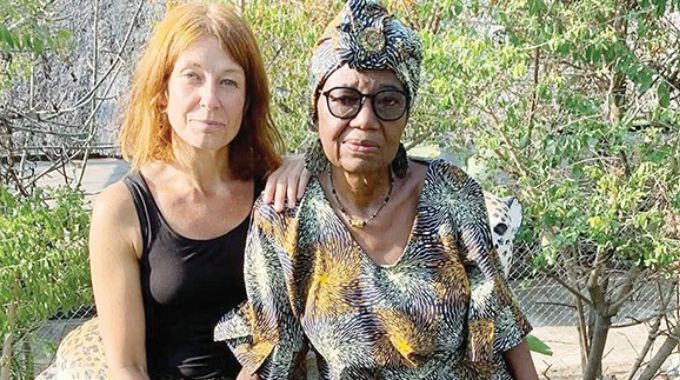
Mbulelo Mpofu, [email protected]
The death of literary matriarch and former teacher Ericah Gwetai has left a void that stretches beyond Bulawayo, with her influence reaching as far as Sweden through the literary friendships she cultivated during her lifetime.
Gwetai, who died last Friday, was laid to rest at Umvutsha Park Cemetery on Monday, with family, friends, former colleagues and members of the literary community gathering to bid farewell to a woman whose life was closely linked to education, literature and storytelling.
Among those mourning from afar is Swedish writer, culture journalist, editor and librarian Karolina Jeppson, who developed a close literary and personal relationship with Gwetai during her visits to Bulawayo.
For Jeppson, Gwetai’s death was not simply the loss of a literary acquaintance, but that of a warm and generous woman whose laughter and storytelling left a lasting impression.
In a tribute titled In Loving Memory of Ericah Gwetai, Jeppson recalled her final meeting with Gwetai last year.
“The last time I met Ericah Gwetai was last year, she took me to her friend’s beautiful garden a couple of blocks away from her own house. There, she took my hand and I felt as if we walked down the aisle,” Jeppson said.
The walk through the garden became a memorable moment for Jeppson as the two women talked beneath the trees, crossed a small bridge and eventually sat on a bench in the shade.
It was during that meeting that Gwetai spoke about her life as a teacher and mother, as well as her desire to tell stories.
Despite discussing difficult experiences and personal losses, Jeppson said Gwetai’s sense of humour remained infectious.
“She told me about her life as a teacher, mother and about her longing to tell stories. As she spoke, her sense of humour lightened the heaviness and difficult times of loss she shared from her life,” she said.
“It was difficult not to laugh together with Ericah. Her laughter was heard in the whole garden.”
Jeppson said Gwetai’s warmth was also evident when she spoke about her children and granddaughter.
“I felt her joy inside of me, as I felt her warmth through the tight grip of her hand when she was talking about her daughter, her son, and her granddaughter,” she said.
Jeppson’s relationship with Gwetai began a few years ago through literature and her interest in understanding the woman behind the autobiography Petal Thoughts: Yvonne Vera.
Having read the book, Jeppson wanted to meet Gwetai and hear more about her writing and experiences.
At the time, she was working on an article for Swedish literary magazine Karavan, focusing on world literature under the theme “Fabrics and Literature”.
Their meeting, however, developed into more than an interview.
Jeppson recalled arriving on a warm afternoon to meet Gwetai, who welcomed her dressed in a striking red-and-yellow outfit and a colourful fabric hat.
Gwetai told her about her passion for making her own dresses and also shared how Yvonne Vera
enjoyed sewing and designing clothes.
She later showed Jeppson her wardrobe, displaying different outfits she had made for various occasions.
What began as a discussion about Gwetai’s love for fabric evolved into an exploration of the role textiles and clothing played in Vera’s literary imagination.
Jeppson drew a connection between Gwetai’s relationship with fabric and Vera’s writing, including the imagery of weaving in Under the Tongue and the white apron in Without a Name, where the character Mazvita uses it to carry her dead baby during a long journey on a bus.
For Jeppson, fabric became more than material. It became a way of exploring memory, identity, grief and love.
The connection became particularly personal after the death of her own father the year before she wrote the Karavan article.
She recalled the clothes her family had kept after his death, particularly one shirt that held special emotional significance.
“There was one specific long-sleeved shirt, in orange and black, that I had loved him wearing. I wanted very much to keep it from his wardrobe. It still carried his smell,” she said.
“I felt at home wearing it and I wrote a piece for the radio about it, my father’s shirt, where I also mentioned both Ericah and Yvonne and how their use and meanings of fabric came to inspire and strengthen me.”
The connection between Jeppson, Gwetai and Vera therefore extended beyond a conventional literary interview, becoming an exchange about memory, grief and storytelling, with literature serving as a bridge between people and cultures.
Gwetai’s story found an audience in Sweden through Jeppson’s writing, while Jeppson’s own experience of grief became intertwined with the lessons she drew from her encounters with the Gwetai family.
Now, with Gwetai gone, Jeppson is preparing to return to Bulawayo, a city she has visited several times, knowing that the familiar surroundings will carry a new sense of absence.
“I will return to Bulawayo shortly, but it will not be quite the same. A colourful personality with a warm laughter will be missing,” she said.
Jeppson acknowledged that although she did not spend as much time with Gwetai as she would
have liked, the moments they shared left a lasting impression.
“I will remember Ericah Gwetai vividly and sincerely for the longest time, although I did not have the opportunity to enjoy her company as much as I would have liked,” she said.
She extended her condolences to Gwetai’s family and friends.
Jeppson is no stranger to Zimbabwe’s literary landscape and has developed relationships with writers and cultural practitioners in Bulawayo and beyond.
Her connection with the city’s literary fraternity also saw her collaborate with Bulawayo-based author Philani Amadéus Nyoni last year in Nairobi, Kenya, where the pair worked on a tribute to late Kenyan literary giant Ngugi wa Thiong’o.
Supported by the Swedish Authors’ Foundation, the collaboration brought together writers from different cultural backgrounds to honour Ngugi’s contribution to world literature.
For Jeppson, however, the death of Gwetai has made those literary connections deeply personal.
She remembers Gwetai not only as the mother of internationally celebrated writer Yvonne Vera or a former teacher, but as a woman who loved fabric, made her own clothes, cherished her family, wanted to tell stories and possessed a powerful sense of humour.
As Bulawayo continues to mourn Gwetai, her memory is also being kept alive by friends and literary collaborators thousands of kilometres away.
For Jeppson, the garden, the colourful clothes and, above all, Gwetai’s unmistakable laughter will remain lasting memories.
Gwetai may have died, but through the stories she shared and the lives she touched, her legacy continues to resonate.