Online Reporter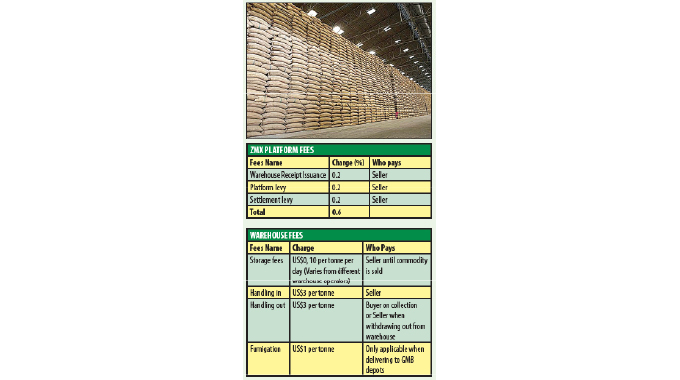
Edgar Vhera
Specialist Writer – Agribusiness
THE Zimbabwe Mercantile Exchange (ZMX) has announced warehouse and trading platform fees to bolster its central warehouse receipt system (WRS) and a spot market trading platform for agricultural commodities ahead of the 2025 marketing season.
This follows Government’s announcement that the Grain Marketing Board (GMB) would purchase all strategic commodities financed under the Presidential Input Scheme (PIS) and serve as the buyer of last resort with ZMX as buyer of choice, which allows price discovery.
The WRS is essentially a network of certified warehouses that take commodity deposits and issue warehouse receipts that serve as proof of title to a specified quantity and quality of a commodity.
The Ministry of Finance, Economic Development and Investment Promotion’s 2025 Budget Strategy Paper introduced new marketing modalities of agriculture crops saying: “Government will promote the use of the ZMX in the marketing of agriculture produce, in order to enhance farmer income and reduce post-harvest loses. In this regard, the GMB will be focusing only on procuring grain for the strategic grain reserve (SGR), with the rest of the produce being sold to private players through the ZMX.
“Broadening market options for farmers reduces fiscal burden and over-reliance on the GMB. This will allow market access for farmers, price discovery and convenient trading of agricultural commodities.”
Lands, Agriculture, Fisheries, Water and Rural Development permanent secretary, Professor Obert Jiri recently urged self-financed farmers to explore the ZMX trading platform for better pricing, storage and market access.
The ZMX said the seller would pay 0,2 percent as fees for warehouse receipts issuance, another 0,2 percent as platform levy and a further 0,2 percent as settlement levy to make 0,6 percent in total.
“The charge is on the value of the product. Platform and settlement levies are applicable only if the client chooses to store the product before selling,” said ZMX.
ZMX said warehouse receipts were optional and would only be applied if the client chose to store the product before selling.
ZMX added horticulture and livestock on the initial list of 49 commodities allowed for trade on the platform.
Meanwhile, ZMX chief executive officer Mr Collen Tapfumaneyi said they were ready for the 2025 agricultural marketing season and were working with financiers in banking, insurance and pension fund industries to ensure sufficient liquidity to support commodity trading.
“With liquidity having been a major hindrance to trading activities, ZMX is working with financiers in the banking, insurance and pension fund industries to ensure there is sufficient liquidity to support commodity trading.
“This will ensure farmers are paid expeditiously while buyers such as agro-processors will be capacitated to offtake the commodities to their maximum requirements,” he said.
Government authorised the trade of soya beans on ZMX as part of a trial scheme to liquidate the remaining 2022 harvest.
It then added maize weekly auctions in 2023, whose debut delighted farmers when 93 tonnes of crop worth US$24 050 went under the hammer.
The June 21, 2023, auction results showed that buyers had submitted maize bids for 342 tonnes at an average price of US$259, 97 per kilogramme for a total value of US$88 910.
Sellers were willing to trade 2 093 tonnes of maize at an average price of US$331,68 per tonne and a gross amount of US$694 050.
At the end of the auction, 93 tonnes were sold at an average price of US$260 per tonne and a value of US$24 050.
A total of 2 250 bids and offers with an average price of US$326,68 were unsuccessful.
Wheat weekly auctions were also added in 2023 and convergence of wheat bid and offer prices resulted in buyers purchasing all the crop that farmers offered at US$420 per tonne at second week of trade on the platform.
Farmers offered 156,28 tonnes of wheat at an average price of US$420 per tonne valued at US$65 637,60. All the bids were successful.