admin
admin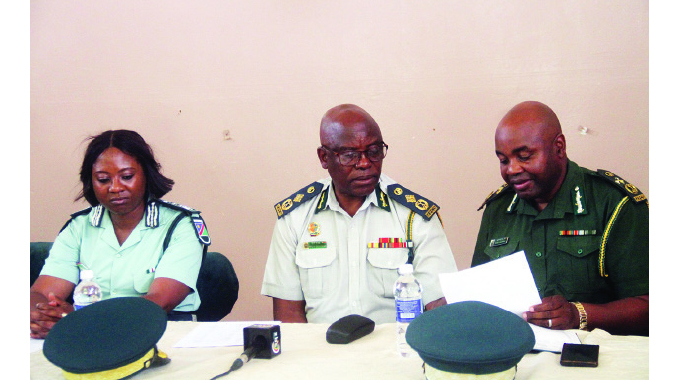
Precious Manomano-Herald Reporter
PRISON authorities in Zimbabwe and Namibia are exchanging notes on improving the rehabilitation of prisoners as both countries are determined to learn from each other’s successes.
A Namibian Prison Services delegation is in the country on a five-day visit to engage the Zimbabwe Prisons and Correctional Service following the signing of a Memorandum of Understanding to improve the standard of services at correctional facilities.
Speaking during the rehabilitation and reintegration workshop by the ZPCS and the Namibian Correctional Service in Harare yesterday, ZPCS Commissioner-General Dr Moses Chihobvu said they were specifically looking at improving areas of risk assessment of inmates and information technology.

Zimbabwe Prisons and Correctional Services (ZPCS) Commissioner-General Moses Chihobvu (right) and Namibia Correctional Services Deputy Commissioner General Mariana Martin (left) salute during Zimbabwe and Namibia Correctional Services rehab and reintegration training workshop in Harare yesterday.
“Namibia and Zimbabwe signed a memorandum of understanding whereby they agreed to exchange programmes and today we have received a delegation from Namibia.
“They came to teach us a case management system which is not being practised in Zimbabwe.
“We are doing it the other way round, but the Namibians have been doing case management very well,” he said.
Dr Chihobvu said in terms of rehabilitation of inmates, Namibia was well advanced, adding that the workshop would help Zimbabwe improve its rehabilitation system.
Namibian Correctional Service Deputy Commissioner General Mariana Martin said the workshop would improve case management in her country.

Zimbabwe Prisons and Correctional Services (ZPCS) Commissioner-General Moses Chihobvu (right) shares a lighter moment with Namibia Correctional Services Deputy Commissioner General Mariana Martin (left) during Zimbabwe and Namibia Correctional Services rehab and reintegration training workshop in Harare yesterday.
“We now move on to an action plan and put the MoU into practice, so today marks the first step to do that. We are here to see how we can move on as correctional services and look at rehabilitation activities.
“The idea here is to share our rehabilitation activities. We have come to share how we capture our information electronically.
“We do not have open prison systems in Namibia like here in Zimbabwe but we have open farms so we are going to learn from each other,” she said.
Partnerships were critical in empowering inmates to get skills which would sustain their families after their release from prison.
Zimbabwe has a good record of prisoners learning skills that will help them upon release.
On the other hand, Namibian prisons are doing well in bakery projects which have seen them supplying shops and supermarkets.
Namibian inmates are also involved in different projects such as shoes and leather belts, and manufacturing, while in Zimbabwe prisoners are engaged in farming, market gardening, carpentry, building, and tailoring among other trades.



 Online Reporter