admin
admin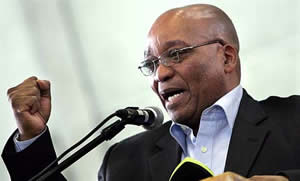
Tripoli yesterday to try to start peace talks between the two sides.
First in was President Zuma and when he walked down the steps of his South African Air Force plane at Mitiga airport, he was greeted by a crowd of supporters of Libyan leader Muammar Gaddafi holding banners which read: “No to foreign intervention!” President Zuma acknowledged the crowd, then climbed into his car and was driven off into the city, a Reuters reporter at the airport said.
Presidents Mohamed Ould Abdel Aziz of Mauritania, Amadou Toumani Toure of Mali, and Denis Sassou Nguesso of Congo along with the South African leader had left Nouakchott mid-morning and travelled separately to Tripoli.
Earlier yesterday, the mediators reiterated their appeal for “an immediate end to all hostilities” and proposed a transition period to adopt reforms in the insurrection-hit country.
The delegation also includes Ugandan Foreign Minister Henry Oryem Okello, representing President Yoweri Museveni, the fifth head of state making up the AU panel.
During their two-day stay, the leaders will meet representatives of President Gaddafi in Tripoli and those of the rebels in their stronghold of Benghazi in the east, President Zuma’s office said.
Western officials have assessed that their air power will not be enough to help the rag-tag rebels overthrow Colonel Gaddafi by force and they are now emphasising a political solution.
But a rebel spokesman rejected a negotiated outcome in the conflict, the bloodiest in a series of revolts across the Arab world that have already dethroned the autocratic leaders of Tunisia and Egypt.
Analysts predict a drawn-out, low-level conflict possibly leading to partition between east and west in the sprawling North African Arab state, a major oil and natural gas producer.
While the negotiators were flying in, NATO continued its air strikes which helped stop a major assault by Libyan forces on the rebel-held town of Ajdabiyah yesterday.
NATO said it had hit 11 tanks outside the eastern town and six burned-out hulks could be seen on its western approaches. Fifteen charred bodies were scattered around two sites about 300 metres apart.
NATO said it also destroyed 14 government tanks on the outskirts of Misrata, a lone rebel bastion in western Libya which has been under siege for six weeks and where conditions for civilians are said to be desperate.
Earlier yesterday the rebels seemed to be losing control of Ajdabiyah after the heaviest government assault for at least a week. The attack, which began on Saturday, included a fierce artillery and rocket bombardment while some of government forces, including snipers, penetrated the town.
Rebels had for several hours cowered in alleyways in the town, which is gateway to their stronghold city of Benghazi 150km up the Mediterranean coast to the north.
But by afternoon rebels looked back in control of Ajdabiyah, commanding key intersections, and the artillery and small arms fire had died down.
Ajdabiyah had been the launch point for insurgents during a week-long fight for the oil port of Brega 70km further west, and its fall would be a serious loss.
Col Gaddafi’s government sought to showcase a reform-friendly face yesterday, gathering foreign journalists in the early hours of the morning to unveil a “Libyan version” of democracy. Details were vague and officials could not explain what Col Gaddafi’s role would be, but it was clear he would continue to play a leading role. Insurgents say they want democracy in Libya without Col Gaddafi, who has ruled for 41 years.
The fight for Ajdabiyah yesterday followed pitched battles on Saturday when rebels fought off a heavy assault by government forces on Misrata.
One insurgent there said 30 fighters were killed but another said there were eight confirmed dead and 10 unconfirmed.
Col Gaddafi’s forces appear bent on seizing Misrata and crucially its port, which some analysts say is vital if Col Gaddafi is to survive because it supplies the capital Tripoli.
As fighting raged on, a buoyant Col Gaddafi made his first television appearance for five days on Saturday.
Wearing his trademark brown robes and dark glasses, he was shown smiling and pumping his fists in the air at a school where he was welcomed ecstatically. Women ululated, one wept with emotion and pupils chanted anti-western slogans. Col Gaddafi looked relaxed, confirming the impression among analysts that his administration has emerged from a period of paralysis and is hunkering down for a long campaign.
NATO’s commander of Libyan operations said the alliance, which took over air strikes against Col Gaddafi from three Western powers on March 31, had destroyed “a significant percentage” of Col Gaddafi’s armour and ammunition stockpiles east of Tripoli. – Reuters/AFP.


 Online Reporter