Lovemore Kadzura
Post Reporter
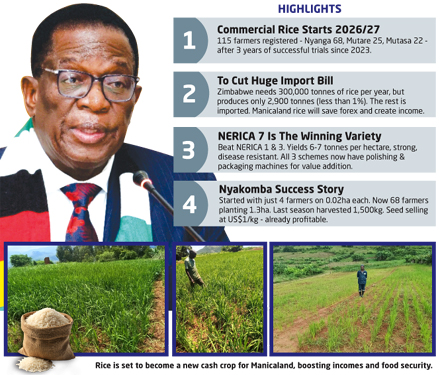
MANICALAND will embark on commercial rice production during the 2026/27 agricultural season, with 115 farmers from Nyanga, Mutasa and Mutare districts already registered to grow the crop following three years of successful trials and seed multiplication, The Manica Post can exclusively reveal.
The initiative is expected to boost local rice production, create new income streams for farmers and help reduce Zimbabwe’s heavy reliance on imported rice, thereby saving valuable foreign currency for other strategic sectors of the economy.
Provincial deputy director in the Ministry of Agriculture, Mechanisation and Irrigation Development, Mrs Bessy Masvanhise, said 68 farmers from Nyanga, 25 from Mutare and 22 from Mutasa registered for the upcoming season.
She said the rice project was launched in Manicaland in 2023 under the leadership of the First Lady, Dr Auxillia Mnangagwa, with technical and training support from the Japan International Cooperation Agency (JICA).
JICA equipped farmers and agricultural extension officers with rice production skills, while the Department of Research and Specialist Services supplied seed and provided ongoing technical support.
The development comes as Government intensifies efforts to diversify agriculture, promote climate-smart farming and increase domestic food production to strengthen national food security.
Zimbabwe currently consumes about 300 000 tonnes of rice annually, but produces only 2 900 tonnes, forcing the country to import an estimated 297 000 tonnes each year.
Local production currently meets less than one percent of national demand.
Agricultural experts believe increased production in Manicaland could play a significant role in narrowing the deficit while creating a lucrative new market for farmers.
“Rice production in the province was spearheaded by the First Lady, Dr Auxillia Mnangagwa in 2023. The project was supported by JICA, which provided training and capacity building for farmers and agricultural officials. The Department of Research and Specialist Services supplied seed and technical support. The objective was to introduce rice as both a cash crop and food crop,” said Mrs Masvanhise.
Demonstration trials were conducted at Manunure Irrigation Scheme in Mutasa, Nyakomba Irrigation Scheme in Nyanga and the Njerere area in Mutare.
Three rice varieties, namely Nerica 1, Nerica 3 and Nerica 7, were assessed during the trials. Nerica 7 emerged as the top performer across all three districts due to its superior yields and resilience.
Mrs Masvanhise said the variety boasts strong vigour, high tillering capacity, excellent disease resistance and a yield potential of between six and seven tonnes per hectare when recommended agronomic practices are followed.
“Nerica 7 has desirable characteristics, including good vigour, high tillering capacity, high yields and disease resistance. Farmers used 200 kilogrammes of Compound D and 100 kilogrammes of ammonium nitrate per hectare. The variety can produce between six and seven tonnes per hectare if recommended agronomic practices are followed,” she said.
To support value addition and improve profitability, all three irrigation schemes have received rice polishing and packaging machines, enabling farmers to process and market rice as a finished product.
Mrs Masvanhise said the initiative aligns with Government’s Rural Development 8.0 model and has the potential to transform rural livelihoods.
However, she cautioned farmers against production challenges such as rodents, quelea birds and weed infestations.
“Rice production can transform livelihoods and we are encouraging farmers to embrace it. However, farmers should be aware that the crop attracts rodents and quelea birds. They must work closely with Agritex officers for technical guidance. Weed infestation can also significantly reduce yields, so fields must be kept weed-free,” she said.
At Nyakomba Irrigation Scheme, Agritex officer, Mrs Memory Mauya, said farmer interest in rice cultivation has grown rapidly following encouraging results from seed multiplication projects.
She said the scheme started with only four farmers during the 2024/25 season, each cultivating 0,02 hectares.
Those farmers successfully multiplied seed and sold it to seven additional growers, resulting in a steady increase in participation.
“We started with just four farmers, each cultivating 0,02 hectares during the 2024/25 season. They multiplied and sold seed to seven more farmers. Last season, farmers harvested 1 500 kilogrammes, and this year participation has risen to 68 farmers as seed availability continues to improve,” said Mrs Mauya.
Farmers at Nyakomba are expected to cultivate approximately 1,3 hectares this season.
Mrs Mauya said rice seed is currently selling for US$1 per kilogramme and that seed multiplication had already become a profitable enterprise.
“This season we are planting around 1,3 hectares. Seed is selling for US$1 per kilogramme. While we have not yet reached full commercial rice production, seed multiplication is already proving profitable,” she said.
She added that rice requires relatively modest water supplies, making it suitable for summer production under irrigation. Short-season varieties mature in about 120 days, while high-yielding varieties take between 135 and 140 days.
Mrs Mauya noted that Nyakomba’s clay-loam soils have proved ideal for rice cultivation, further strengthening prospects for the crop’s successful expansion across the province.
115 farmers answer rice call