admin
admin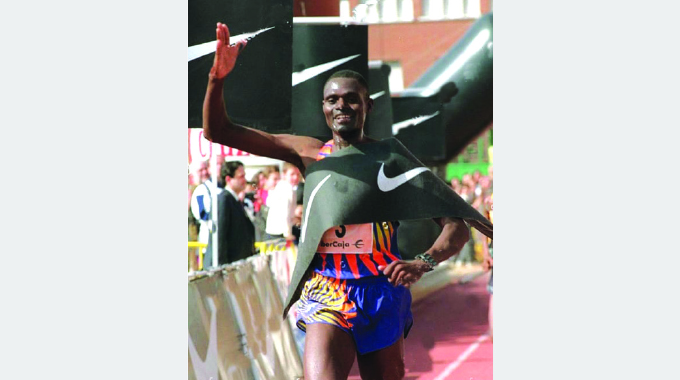
Tadious Manyepo-Sports Reporter
THE styled letters were bold.
Just like the message they carried.
A dream that sounded good but realistically improbable.
A dream pasted on a hard cover of a Mathematics exercise book.
A dream that invited sarcastic comments from his mates at the Murehwa-based Chimhau Secondary School and in his village of origin, tucked 12 kilometres away from the learning centre.
“I WANT TO RUN AT THE OLYMPIC GAMES,” it read.
Something must have been playing in his mind when he decided to pen that.
For a boy, who together with his colleagues were secluded in an isolated rural school, the dream seemed to at best, wishful thinking.
The iconic marathon runner Abel Chimukoko vividly recalls being mocked for daring to write those words.
“You know how it’s like in a rural school. I don’t even know what drove me into writing such a declaration.
“But I was mocked by my friends for just taking it too far. I was a good long-distance runner at school but I was not the only one, probably the reason why my colleagues questioned the sincerity of my written declaration.
“At Chimhau, just like in most rural learning institutions, sport is nothing but just a fulfilment of the curriculum and it was viewed exactly as such.”
His colleagues should have found some justification in labelling Chimukoko “too ambitious”.
Not only was Chimukoko a disadvantaged boy in terms of exposure to the required technical training and support that help broaden one’s chances of making it big.
He was also carrying a limiting injury on his left leg.
He even walked with a limp.
When he was only 15, Chimukoko had been unfortunate to come across rabid dogs in the village.
They chased after him and while he was running away, he suddenly bumped into an erect barbed wire he attempted to jump over.
He couldn’t complete the jump. The wire ripped across his left thigh, piercing his tendon in the process.
His screams turned into groans and even the dogs were touched and abandoned their mission.
“At that point, I was sure I would never get a chance to be a competitive runner again.
“It was painful. It took time for me to fully heal. So that injury always limited me in the track,” Chimukoko added.
The realistic path, as his colleagues saw it, was for him to pursue the academic route.
He was good in class and they actually nicknamed him “Pythagoras” due to his ingenuity in Mathematics.
Probably the reason why his dream was written on a Mathematics book.
Chimukoko’s old schoolmate and fellow Kasirori villager Christopher Musekiwa said they thought the legendary runner would not choose athletics as a career path.
“Sport was something that never really carried weight as far as choosing a career path was concerned. It was viewed as something to just top-up the academic side of things.
“No one really ever thought Abel (Chimukoko) would make it big in athletics, to be honest,” said Musekiwa.
“He was not the only good marathon runner at the school and they all lacked proper training so there wasn’t much we expected from all those who had potential in sports.”
Chimukoko carried his dream with him when he proceeded to Advanced Level at Ellis Robins in Harare.
And on his first day to enter the school library, he came across a newspaper article with a screaming headline: “Long-distance runner Chimusasa shines in Europe.”
It referred to another legend of the track, Tendai Chimusasa.
It got him thinking.
“I was like, Chimusasa sounds more like my name and that means I should also do the same” Chimukoko said.
“I took a pair of scissors and cut the headline. I cancelled the last four letters from Chimusasa and wrote “koko” with a pen on top of the cancelled “sasa” to leave it reading Chimu “koko” shines in Europe.
“I then placed the piece of paper in my book.”
That’s the first story Chimukoko told Chimusasa when he finally got to meet him.
Chimusasa laughed his lungs out when a call from this publication reminded him of the incident.
“That’s very true. Chimukoko told me about that the very first time I met him. I felt humbled knowing that there were people who I was inspiring…,” said Chimusasa.
“That’s the funniest story I have ever come across.”
At Ellis Robins, Chimukoko got the exposure which he was lacking while in Murehwa.
In no time, former Zimbabwe Olympic Committee chief executive, Robert Mutsauki, spotted his talent.
Then in 1995, Chimukoko went to Australia for the Fred Hollows marathon relays. It was his first international race, a 500km stretch to be covered in five days by six runners.
He was crowned the best athlete at the meet.
It changed his life. Completely.
He would win several accolades in his decade-long stay in Spain.
His best event remains the Madrid 10km race whose record of 28:01 was achieved in 2003 and it still stands.
And in 2004, the dream, which he had jotted down in 1991 came true with an Olympic Games participation in Athens, Greece.
Now, the retired athlete, who is a police officer in charge of sports for the Zimbabwe Republic Police, is a ZOC board member and chair for Zimbabwe Olympians Association.
His heart bleeds for development and athletes welfare.
“Athletes need support before, during and after their careers. I self-funded my stay in Spain, training, travelling and so on. Running and winning in Europe wasn’t easy as most people might think. It was hard throughout.
“National support from home was not that forthcoming. Everyone seemed interested in the results only. How many people could do that.
“As a country we had no access to good training facilities. The National Sports Stadium was commercialised by then and reserved for churches instead of sport. We generally don’t take sports seriously.
“We have a few qualified coaches. Corruption is killing our sport. People who are seconded for these positions are not qualified. We need teamwork. We need more physiotherapists, psychologists, nutritionists and antidoping educationists…”


 Online Reporter