admin
admin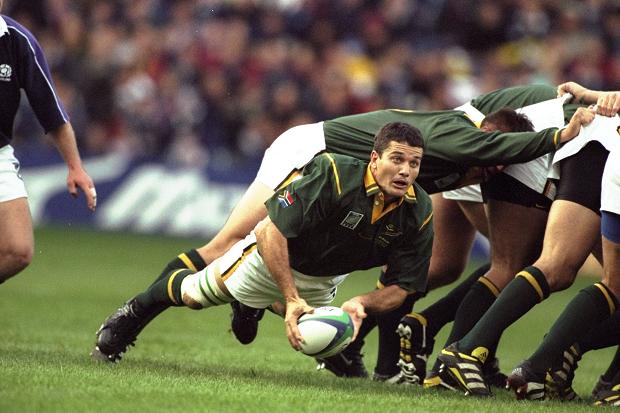

A true fighter, Springbok Joost van der Westhuizen lost the only fight he could never win yesterday, when he died in a hospital in Johannesburg at the age of 45.
Once South Africa’s most-capped Springbok, record try scorer and captain of the national team, there was little in his rugby career that Van der Westhuizen didn’t achieve, but it was a fight against a silent disease – MND (Motor Neuron Disease) – that he couldn’t overcome.
Van der Westhuizen’s career was glittering and stellar, with trophies galore as he was part of the historic 1995 Rugby World Cup winning team, captained the Blue Bulls to the Currie Cup title in 1998 and 2002 and led the Springboks into battle at the World Cup in 1999, retiring at the end of the Rugby World Cup in 2003 as South Africa’s most capped player.
His post-rugby career was littered with controversy, but it was dwarfed by the news in May 2011 that he was diagnosed with MND – which was picked up by close friend Dr Henry Kelbrick while they were swimming at a family outing.
A further investigation confirmed the worst, that Van der Westhuizen was diagnosed with Amyotrophic Lateral Sclerosis (ALS) – a tyd of MND. At the time, Dr Jody Pearl, van der Westhuizen’s neurologist, gave him an 80 percent chance of surviving for two to five years.
That Van der Westhuizen survived for more than the five year term was testament to the fight in him. Throughout his career he was written off time and again, often proving critics wrong as he bounced back from two knee operations and several other setbacks to achieve success that many would have thought was impossible.
If there was a word to describe Van der Westhuizen it is determined. If he set a goal there was very seldom a time he wouldn’t achieve it, no matter the odds, and his 89 test career is testament to this.
Unusually tall for a scrumhalf, standing 6ft 2in it was in Pretoria that Van der Westhuizen quickly made a name for himself, coming from Hoërskool FH Odendaal, a school that was not among Pretoria’s elite rugby sides. In 1987 he led FH Odendaal to their first Administrators Cup final, where they lost to Hugenote – playing against future team-mates Japie Mulder and Chris Rossouw in a game where he caught many an eye.
Van der Westhuizen made his debut for then Northern Transvaal against Eastern Transvaal, and played for the Junior Springboks against the All Blacks in the same year.
In 1993, he was part of the Springbok Sevens side that lost in the World Cup final in Hong Kong before making his Springbok debut in the same year on the tour of Australia.
A regular feature of Springbok teams, Van der Westhuizen played in 14 of the 17 match unbeaten run under Nick Mallett that saw the Springboks win the 1998 Tri Nations and cement their status as the best side in the world.
In 1999, he became captain of the Bok team, leading the side to third place in the World Cup after a heart-wrenching extra-time loss to Australia in the semifinal.
His Currie Cup victories in 1998 and 2002 as captain were inspirational to his team-mates, and while he was sometimes stern and unwavering as a captain, he was widely regarded with respect and spoken of fondly by his team-mates.
After 2003 he retired quietly, becoming a Supersport commentator and pundit while spending time with his second wife Amor, and two children who were born in this time.
It was only in 2011 when Dr Kelbrick noticed weakness in his arm that triggered an alarm bell, that Van der Westhuizen knew there was a much bigger fight to fight.
And fight he did, establishing his J9 Foundation to aid those struggling with MND while searching for a cure to help him win the battle against the disease.
By September that year he had trouble speaking but continued fighting. In April 2013 he became confined to a wheelchair as his body slowly was losing the battle.
While he fought on valiantly, in the end it was simply too great a task to continue. But in the process he inspired millions with his bravery and brought new found attention to a disease that still has no cure.
Yesterday Van der Westhuizen became the third player from the 1995 Rugby World Cup to die at a young age, following Ruben Kruger (brain cancer) and Jonah Lomu (kidney failure).
His achievements, fight and courage will be remembered inside the rugby world and among South Africans for a long time to come.— Supersport.


 Online Reporter