Online Reporter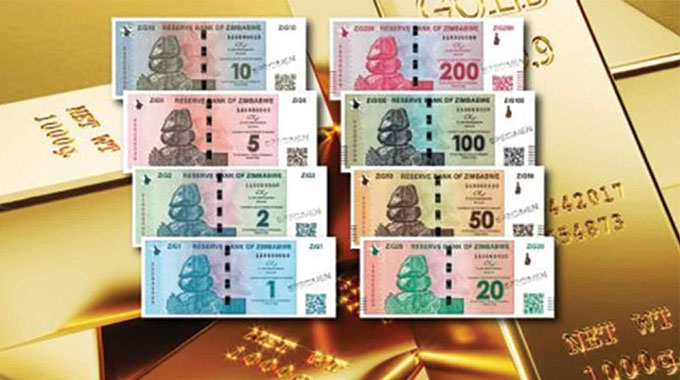
Harare Bureau
THE Government is set to expand the range of taxes payable exclusively in Zimbabwe Gold (ZiG) as it steps up efforts to increase demand for the local currency and promote its wider use, it has been learnt.
Finance, Economic Development and Investment Promotion Minister Professor Mthuli Ncube is expected to unveil the new policy measures when he presents the 2026 Mid-Term Budget and Economic Review Statement this week.
The reforms are intended to deepen the use of ZiG across the economy by requiring more tax obligations to be settled in the local currency.
The authorities view taxes as one of the most effective instruments for creating sustained demand for the local unit because they represent recurring financial obligations for businesses and individuals.
By increasing the number of taxes payable exclusively in ZiG, Treasury expects to boost circulation of the currency while reducing reliance on the United States dollar in domestic transactions.
Presently, most major taxes administered by the Zimbabwe Revenue Authority (Zimra) can be paid in United States dollars, where the underlying income, transaction or pricing is denominated in foreign currency.
Under Zimbabwe’s multi-currency framework, taxpayers generally settle their obligations in the currency in which their income or revenue is earned.
In an interview with our Harare Bureau, Prof Ncube confirmed that Treasury was broadening the range of taxes payable in the local currency as part of an ongoing programme to strengthen demand for ZiG.
“Oh yes, going forward, this is an ongoing programme,” he said.
“Treasury will expand the range of taxes that will be paid in ZiG in order to increase the demand for the local currency. We need to make sure we do that. It (ZiG) is now very stable, and we believe that in order to support the circulation of the currency within the economy, the demand ought to go up.”
While the Government has confirmed that the scope of ZiG-only tax payments will be expanded, it is currently unclear whether the measures will cover Pay As You Earn (PAYE), Value-Added Tax (VAT), customs duties, corporate income tax, capital gains tax or other statutory levies.
The latest measures form part of the Government’s broader road map towards restoring the local currency as the sole medium for domestic transactions.
Monetary authorities have identified eight key conditions that must be met before Zimbabwe can safely transition to a mono-currency regime.
These are durable macro-economic stability characterised by single-digit inflation, adequate foreign currency reserves equivalent to between three and six months of import cover, exchange rate stability, efficient foreign exchange management, increased demand for the local currency, financial sector stability, an efficient National Payments System and strong coordination between fiscal and monetary policy without monetisation of the Budget.
According to monetary authorities, six of the eight benchmarks have already been achieved, leaving only two outstanding — increasing demand for the local currency and building foreign currency reserves to the internationally recommended threshold.
The planned tax reforms come as confidence in ZiG continues to strengthen.
Reserve Bank of Zimbabwe data shows that the share of ZiG transactions processed through the National Payments System has risen from about 26 percent when the currency was introduced in April 2024 to between 35 and 40 percent of all electronic transactions.
The authorities have also reported declining incidences of discriminatory pricing and growing acceptance of the local currency by businesses across the economy.
The Government, Prof Ncube added, would continue introducing complementary measures to reinforce public confidence in the currency.
“Of course, we have to build other measures to build confidence.
“Sometimes it’s about confidence and we believe that confidence is going up if you put it every day around the currency, but we will also, in addition to that, be expanding use of the ZiG going forward,” he said.
Treasury has already rolled out several measures designed to stimulate demand for ZiG.
These include requiring companies to settle 50 percent of their Quarterly Payment Dates (QPDs) in the local currency, shifting payments to public sector suppliers into ZiG and reducing the
Intermediated Money Transfer Tax (IMTT) on ZiG transactions from two percent to 1,5 percent while maintaining the two percent rate on United States dollar transactions.
The Government is also increasing the availability of physical cash to support wider use of the currency.
Prof Ncube said ZiG had remained stable since its introduction and that higher denomination banknotes would soon be released to improve cash circulation and accessibility.
“I think if you just look at it now, since 2024 really, the ZiG has been stable and also the demand of the currency has been quite strong and stable, but also we are introducing other notes which will be introduced into the market to increase the circulation and access to the cash aspect of the currency,” he said.
President Mnangagwa was recently presented with the new ZiG100 and ZiG200 banknotes by Reserve Bank of Zimbabwe Governor Dr John Mushayavanhu.
The new denominations are expected to complement the ZiG10, ZiG20 and ZiG50 notes already in circulation and support increasing use of cash in the local currency.
At the same time, the Reserve Bank is strengthening the reserve backing of ZiG ahead of an eventual mono-currency transition.
The central bank plans to increase reserve cover to the equivalent of two months of imports by year-end, moving closer to the international benchmark of between three and six months required to underpin a stable domestic currency.
Gold holdings, which constitute about 40 percent of the country’s reserves, have increased from 1,5 tonnes when ZiG was introduced in April 2024 to 4,5 tonnes last month.
The Government ultimately plans to build the country’s gold reserves to about 11 tonnes before transitioning to a mono-currency system.
In a recent interview with The Sunday Mail, Dr Mushayavanhu indicated that broadening of public sector goods and services in local currency would increase demand for ZiG.
“As the largest economic agent, Government’s demand and supply have an economy-wide impact, transcending all sectors and markets. As a result, the recalibration of Government taxes and payments will steer the rest of the economy towards the increased use of ZiG,” he said.