admin
admin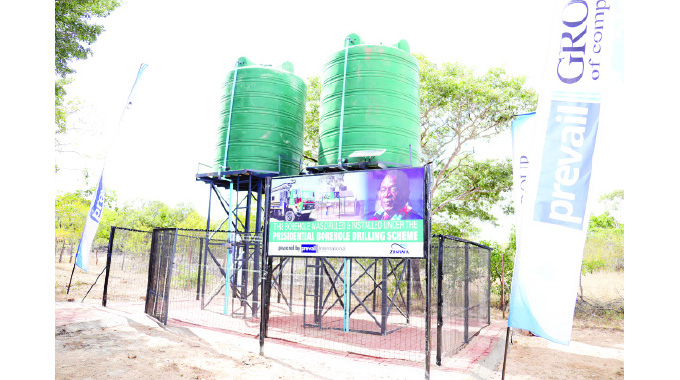
Precious Manomano Herald Reporter
So far a total of 2 890 boreholes have been drilled under the Presidential borehole scheme to ensure that Zimbabweans have access to clean and safe water, with another 20 740 sunk by the Rural Infrastructure Development Agency (RIDA) and developmental partners.
Families can now access clean water from solar-powered boreholes and start community gardens, that will take the majority of them from poverty, as they engage in horticultural farming.
According to statistics from the Ministry of Lands, Agriculture, Fisheries, Water and Rural Development, of the 2 890 boreholes, Manicaland has drilled 429, Mashonaland West 206, Mashonaland East 290, Midlands 300, Matabeleland South 172, Masvingo 535, Bulawayo 79, Harare Metropolitan 346, Matabeleland North 204 and Mashonaland Central 328.
About 157 village business units have been established, 42 school business units, 21 chief business units and nine youth business units.
Under the programme, ZINWA is set to drill and equip 35 000 boreholes across the country’s eight rural provinces, in a development that will see each of the country’s villages getting a borehole.
The boreholes will provide water for the establishment of horticulture gardens, domestic needs, fishery projects, orchards and dip-tanks.
People in different communities have already started benefiting from the gardens and harvesting and selling their produce.
The provision of water remains a cornerstone in the attainment of an upper middle-income economy by year 2030.
Zimbabweans have welcomed the Government’s decision of drilling boreholes in urban and rural areas, saying the move will minimise the spread of diseases that are caused by poor sanitation.
Muzarabani villagers who were interviewed by The Herald last week said the programme will eradicate water problems since the majority of them were travelling long distances in search of water.
Mr Gift Mubinyi said the programme was greatly appreciated as it gave villagers an opportunity to engage in life changing projects such as horticulture and gardening.
“The programme is greatly appreciated because it gives us the opportunity to grow crops which do not do well in this region. Our area does not receive enough rainfall, so with boreholes we can also grow maize to sustain our families. This programme is a welcome development, which will enable us to diversify,” he said.
Mr Martin Chiguma said the Government’s commitment was greatly appreciated and ensured communities get a decent living.
“Water is life. A decent way of living can be earned if there is sufficient water.
“We are glad that we can now introduce different projects that will sustain our families. Nothing meaningful can be done when people do not access clean water,” he said.
Mr Abraham Mushonga of Kambuzuma said drilling of boreholes had helped the majority to embark on projects to sustain families.
“With water, people can grow different types of crops throughout the year and this helps them to increase profits. The majority are doing horticultural projects using these boreholes,” he said.
“We are grateful to the Government for these useful initiatives which uplift the lives of the majority of people across the country,” he said.
Mr Taurai Mandaza of Epworth said the Government’s efforts needed to be appreciated as people used to fetch water from unprotected wells.
“We used to fetch water from unprotected wells but now we are getting fresh clean water. Everyone now has access to clean water at any time,”he said.
Another Epworth resident, Mrs Memory Mugoni echoed the same sentiments, saying the boreholes had brought relief to Epworth.
“We would like to thank our President for drilling boreholes in this area. We are very happy because when we used to visit wells to fetch water, we would spend the whole day queuing to fill up a 20-litre bucket,” she said.
Mrs Abigail Munetsi said the boreholes had brought convenience in Epworth since they had not been receiving water for a long period.
“We are grateful since we used to have a heavy burden of carrying buckets in wheel barrows and pushcarts to go and fetch water from unprotected sources, but now we have boreholes which provide clean and safe water,” she said.


 Online Reporter