admin
admin
Vincent Gono, Features Editor
A LOT of rural pupils from ECD still walk pitiable distances of ten or more kilometres to the nearest school as the construction of schools continues to move at a snail’s pace with Government saying it has limited fiscal space to provide adequate school infrastructure amid revelations that there is need for more than 2000 schools to be constructed.
The Ministry of Primary and Secondary Education says the country so far has more than 9000 schools and needs a total of 2056 primary and secondary schools if the distance travelled mostly by rural pupils is to be reduced while there is a deliberate policy to construct more in resettlement areas.
Government has also signed a loan agreement $20 million which will be used for the construction of 17 new schools, 12 primary schools and 5 secondary schools.
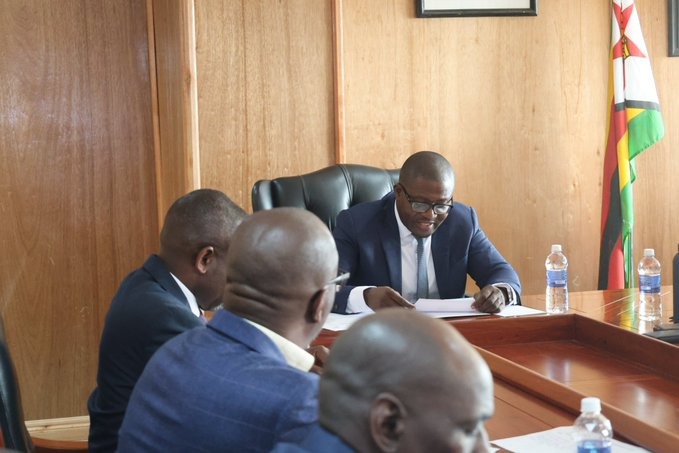
Sunday News Features Editor Vincent Gono (VG) interviewed the Deputy Minister in the Ministry of Primary and Secondary Education, Professor Paul Mavima (Prof PM), on what initiatives the Government was putting in place to close the educational infrastructure development gap between urban schools and their rural counterparts in line with the country’s economic blueprint Zim-Asset.
Excerpts of the interview are below.
VG: Professor Mavima, I understand there is a shortage of educational infrastructure in the country and Zim-Asset talks of improving this under the infrastructure and utilities pillar. What has the ministry done so far in fulfilling the spirit of Zim-Asset in as far as construction of schools is concerned?
Prof PM: The Ministry has been seized with this issue since 2013. We have used a number of approaches to deliver on schools infrastructure. Our Public Sector Investment Programme (PSIP) has been building schools in all provinces of the country.
However, this has been slow due to the limited fiscal space. Annually Government has been spending upwards of $5 million on the construction of new schools and expansion of existing ones as multiple-year projects. In some cases, PSIP has concentrated on delivering science laboratories. Government also has the School Improvement Grant (SIG) which goes mainly to primary schools and satellite secondary schools. Most of the satellite secondary schools use the SIG to further develop their infrastructure, while the more established schools use it to renew their infrastructure through repairs of buildings and enhancement of equipment.
VG: Are you happy with the progress that has so far been achieved in the development of educational infrastructure in the country?
Prof PM: We as a Ministry appreciate that this is not enough to meet the demand for infrastructure in our schools. So, we continue to appeal to communities to do everything within their power to contribute to the development of school infrastructure. Through levies and through their direct contribution of labour and other forms, communities make tremendous contributions to infrastructure development, especially in rural schools, most of which are council schools.
The Ministry also appeals to all Zimbabweans to contribute through donations of building material, equipment, furniture or financial resources to schools for the development of infrastructure. Recently, Government signed a loan agreement for $20 million which will be used for the contraction of 17 new schools- 12 primary schools and 5 secondary schools. This is a loan from the OPEC Fund for International Development (OFID).
The Ministry is also working on a framework for the use of Joint Venture Partnerships for the delivery of education infrastructure on a large scale. Partners will bring in financial resources that will allow for quick development of infrastructure of different kinds. The Ministry will centrally pull together funds to repay loans advanced by such partners. The repayment periods may take up to 25 years, making it more manageable for the Nation to meet the need for schools infrastructure. In many ways, this will make the delivery of infrastructure a multigenerational undertaking that it should be.
VG: A lot of rural pupils still walk long distances to school. Have you identified how many schools (primary and secondary) are needed in the country?
Prof PM: Yes, the Ministry has done a mapping of the school needs of the Nation. We are now clear of the fact that we need a total of 2056 primary and secondary schools to meet the current demand. These will certify demand in areas that have been settled following the land reform programme, new urban settlements and increased demand in existing rural communities.
The standard is to ensure that no child/learner in primary school walks more than 5 kilometres to school and no child in secondary school walks more than 10 kilometres to school.
VG: You may be aware Prof Mavima that pupils in resettlement areas are still learning in dilapidated farm houses where they are exposed to the vagaries of bad weather and risk the danger building collapsing on them. Is there any deliberate policy by the Ministry to start looking at those areas with regards to infrastructure development?
Prof PM: Our programme for infrastructure development through joint venture partnerships gives priority to these areas. The same for the OFID loan. Most of the schools targeted for construction are in these areas. Communities are also doing all they can to develop the schools in these areas.
VG: In the area of ICT, what measures are being put in place to close the gap between town schools and rural schools and what challenges are you facing if any?
Prof PM: We are happy to state that Government agencies are working collaboratively to deal with this issue. A lot of schools have now been electrified by the Rural Electrification Agency (REA). The Presidential computerisation programme continues to trudge along providing a comprehensive package of devices, connectivity and e-learning interventions all in one stroke.
We are now working with Zarnet and with Telone to develop programmes for rolling out connectivity to our schools. We foresee a situation where the majority of our 9000 schools will have ICT devices and will be connected in the next three or so years.



 Online Reporter