Online Reporter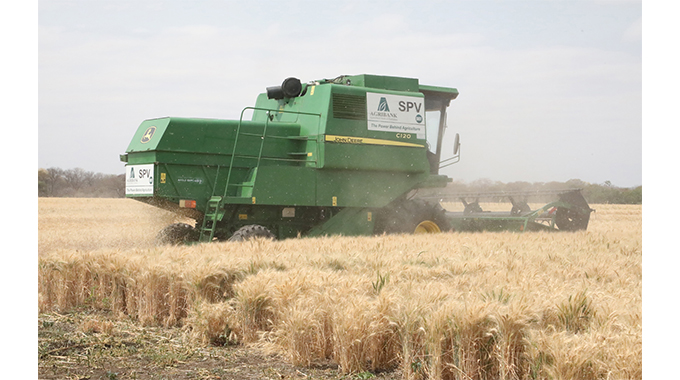
Theseus Shambare
THE Government has mobilised and deployed close to 300 combine harvesters and 15 000 tractors in preparation for what is projected to be Zimbabwe’s largest wheat harvest in history.
The equipment has already been dispatched to 21 mechanisation clusters across major wheat-producing regions to guarantee farmers easy access ahead of harvesting, which begins early next month.
The tractors are being used to create fireguards around fields, a critical safeguard as Zimbabwe enters the peak of its fire restriction season, which started on July 31.
In addition, drones and aircraft have been mobilised for aerial spraying of quelea bird roosting sites to protect the crop from the migratory pest, which has in past seasons caused devastating losses.
With the country targeting more than 600 000 tonnes (t) of wheat — far above the 360 000t required for national consumption — the authorities are pulling out all the stops to protect what could be a record haul of the cereal, reinforcing Zimbabwe’s position as one of only two African nations to attain wheat self-sufficiency.
Crucially, this year’s harvest will mark the third consecutive record-breaking season, with 375 000t having been harvested in 2022, while production in 2023 reached 467 000t.
Last’s year’s harvest stood at 560 000t. Permanent Secretary in the Ministry of Lands, Agriculture, Fisheries, Water and Rural Development Professor Obert Jiri said mechanisation clusters had been established to coordinate harvesting and crop protection.
“All clusters are receiving combine harvesters and farmers in those clusters should know where the harvester is and when they will get it,” he said.
“We are really prepared to ensure the harvesting goes on smoothly and no wheat is lost.
“The crop outlook is already strong. Nearly 80-84 percent of the wheat is at the soft dough stage, while the remaining 16 percent is at late vegetative stage, pointing to a promising yield.”
Harvesting for early planted wheat is expected to start in early to mid-September, with the bulk of the crop coming in October.
Farmers are being urged to harvest promptly to avoid post-maturity losses once rains begin.
President Mnangagwa recently provided 30 grain carriers — 20 for the Grain Marketing Board (GMB) and 10 for the Agricultural and Rural Development Authority (Arda) — to ease transport.
Farmers will also have the option to sell through contractors, the Zimbabwe Mercantile Exchange (ZMX) or warehouse receipt systems for better price discovery and financing.
Wheat produced under the Presidential Input Support Programme and Arda-managed schemes will go directly to the GMB, while private farmers are being encouraged to carefully store grain and release it strategically onto the market.
Positive outlook
Agricultural and Rural Development Advisory Services (ARDAS) provincial directors are optimistic of a very good harvest.
ARDAS Midlands provincial director Ms Busiso Mavankeni said all was on track for a bumper harvest.
“The wheat is looking good. We have had no cases of power cuts reported this whole season, no water shortages and the cold spell in early August actually benefitted the late-planted crop,” she said.
“The province planted 12 025 hectares (ha) against a target of 12 000 hectares and we are now targeting eight tonnes per hectare, up from seven tonnes last year.
“We urge farmers to remain vigilant against quelea birds and pests as temperatures rise, but combine harvesters are ready . . . .”
In Masvingo, provincial director Mr Caleb Mahoya said the province had achieved 96 percent of its 5 000ha target.
“Some of the crop is at booting stage while some is at milk stage. Electricity supplies have been stable, except for brief cuts last week. We anticipate yields of between four to five tonnes per hectare.
“We encountered quelea bird challenges but with enough chemical and equipment, we contained them.
“With good agronomic practices, we are on the right path to a better yield,” he said.
In Mashonaland Central, acting provincial director Mr Misheck Chitikomere said 80 percent of the crop was in excellent condition.
“The power situation has been exceptionally good from planting until now. God also blessed us with a cold spell that gave our crop a strong start. We are expecting an average yield of 5,5 tonnes per hectare, up from last year’s 5,1 tonnes,” he said.
AFC, he added, had put in place flexible terms for farmers to use combine harvesters first and pay upon delivery of grain to the market through stop orders.
“Combine harvesters are enough from Government, banks and private players. We are certain no grain will be lost or left to rot in the field,” said Mr Chitikomere.
In Matabeleland North, provincial director Mr Mkhunjulelwa Ndlovu said irrigation schemes had performed well.
“The crop is very good. We expect an average of 4,5 tonnes per hectare, with the upper limit hitting seven tonnes. Water and electricity supply have been consistent and quelea bird control has not been an issue,” he said.
Alongside fire prevention, pest control has intensified.
Aircraft, Agras T40 drones, vehicle-mounted sprayers and traditional scaring methods are being deployed to combat quelea birds, which can destroy entire fields within days if unchecked.
Farmers said the early deployment of machinery had boosted their confidence.
“We have never seen the machinery and support coming this early. It makes our work easier and ensures we do not lose a single bushel of wheat,” said Ms Esther Makwara, a farmer in Mazowe district.