

 Online Reporter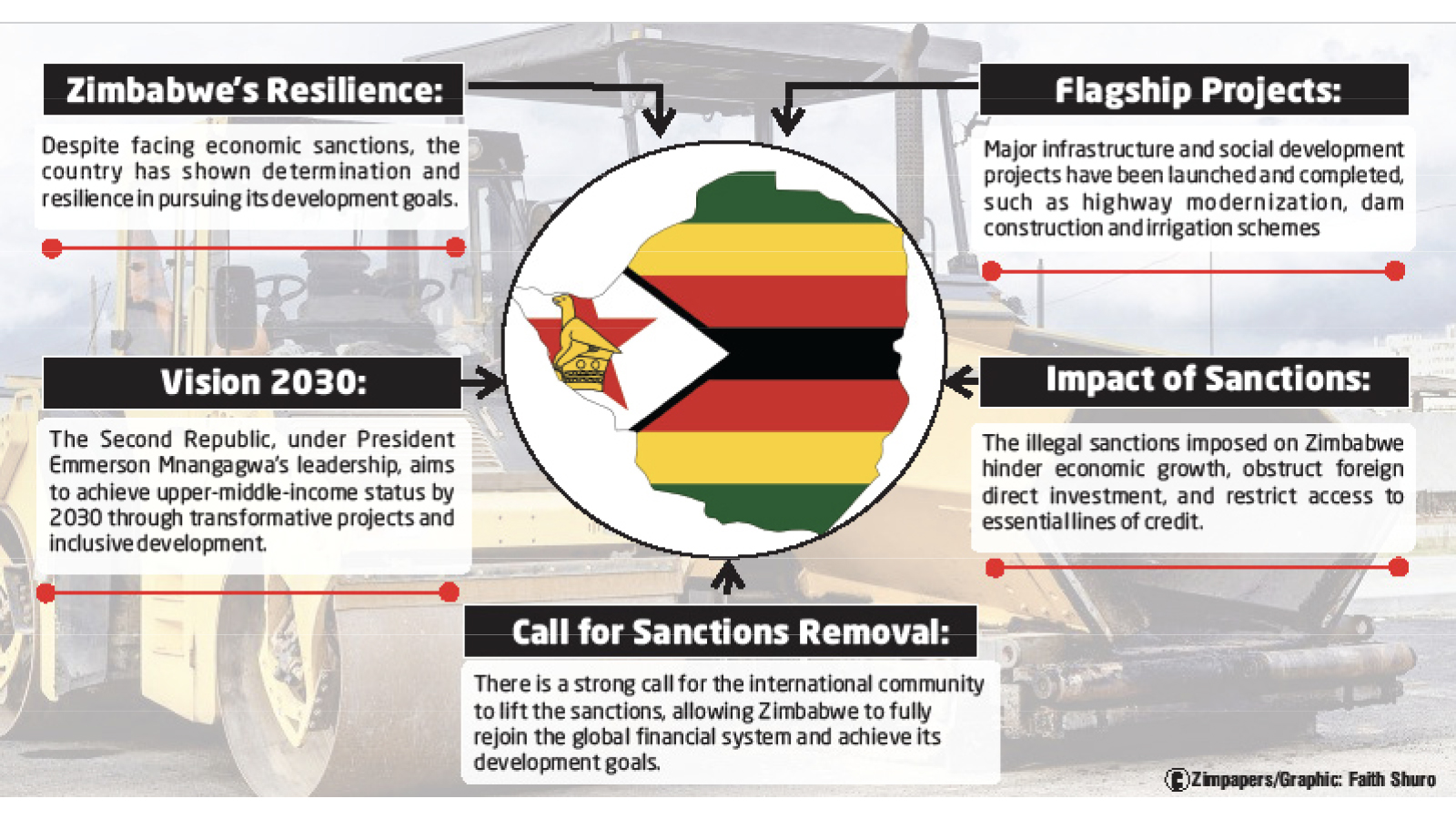
THE story of the Second Republic demands an extra round of applause.
It’s narrative of perseverance perfectly encapsulates the administration’s trajectory.
Indeed, the Second Republic’s narrative is one of relentless determination and tangible progress.
It is a story of promises kept, of dreams turned into reality, and of a nation rising to claim its rightful place on the global stage.
This is evident as Zimbabwe’s development trajectory continues to gain momentum, with the Second Republic, under the leadership of President Mnangagwa, spearheading transformative programmes across all sectors of the economy despite the country being under sanctions.
Driven by a people-centred and inclusive development philosophy, the ZANU PF-led Government has successfully launched and completed major infrastructure and social development projects that have uplifted livelihoods nationwide.
This is a remarkable feat that speaks to the unwavering dedication of its leadership and the resilience of its people.
The Second Republic continues to implement life-changing projects across all 10 of the country’s provinces, confirming the Government’s commitment to its philosophy of “leaving no one and no place behind.”
Since taking office, the Second Republic has prioritised these flagship projects as a key component of the country’s desire to achieve upper-middle-income status by 2030.
These initiatives reflect President Mnangagwa’s political will to stimulate socio-economic growth and enhance the quality of life for all Zimbabweans, all of which occurred despite the illegal and unjustified sanctions imposed on the country since 2000.
Key milestones include the modernisation of the Beitbridge-Chirundu Highway, the construction of strategic dams, and the establishment of business units in communities, all of which have opened the economy to local and foreign investment.
Flagship projects such as the Robert Gabriel Mugabe International Airport upgrade, the Trabablas Interchange, and irrigation schemes linked to newly built dams have transformed access to services and markets for many communities.
Furthermore, through the Engagement and Re-Engagement Foreign Policy, Zimbabwe has witnessed renewed diplomatic and trade relations, enhancing opportunities for growth and cooperation even amid sanctions.
The illegal sanctions imposed on Zimbabwe by the US and its Western allies are detrimental to business as they frustrate potential investments and constrain economic growth.
These unilateral and punitive measures pose a myriad of challenges that hinder the country’s development.
However, in the face of continued illegal sanctions, Zimbabwe remains resolute and unwavering in its commitment to achieving Vision 2030, an aspiration for an upper-middle-income economy.
The echoes of determination resound in the call for reliance on home-grown solutions, undeterred by external pressures.
As preparations for Anti-Sanctions Day gather pace, there is a strong need to highlight the detrimental impact of sanctions on the country’s progress towards achieving Vision 2030 and implementing the National Development Strategy (NDS1).
These punitive measures obstruct foreign direct investment, restrict access to essential lines of credit, and negatively affect the ease of doing business, directly impeding the Government’s ability to finance and complete critical socio-economic projects envisioned under the national development blueprint.
As momentum builds for the annual October 25th observance, there should be a strong, unified call for the immediate and unconditional removal of the illegal sanctions.
This collective demand, supported by SADC, is crucial for unlocking the country’s full economic potential, allowing Zimbabwe to fully rejoin the global financial system, and ensuring that the aspirations for an upper middle-income society by 2030 are not perpetually held hostage by unilateral, external pressure.
The Anti-Sanctions Day, held on October 25 every year, was adopted by the 39th SADC Summit held in Dar es Salaam, Tanzania, in August 2019.
The summit designated the day for solidarity with Zimbabwe against the illegal sanctions imposed by the US, serving as a platform for Zimbabweans to express their opposition and call for their removal.
The Second Republic, under the astute leadership of President Mnangagwa, has set the country’s economy on a recovery path through the ambitious Vision 2030, aligning with the global sustainable development plan.
Vision 2030’s agenda aims to achieve a “Prosperous and Empowered Upper Middle-Income Society by 2030” through a sequential and systematic methodology that leaves no one behind, including in terms of housing delivery in cities and other human settlements.
The global community largely anticipated that the relentless pressure of economic sanctions, coupled with internal challenges, would condemn Zimbabwe to infrastructural decay and economic stagnation.
The prevailing narrative was that the country, politically isolated and starved of critical international capital and lines of credit, would be forced to capitulate or simply collapse.
Instead, under the leadership of President Mnangagwa, the Second Republic has forcefully rewritten this script.
By pioneering the “Nyika inovakwa nevene vayo/ Ilizwe lakhiwa ngabanikazi balo” (A country is built by its own people) philosophy, the Government has mobilised domestic resources to finance monumental projects—from the expansion of the Harare-Beitbridge Highway to the construction of major dams and power plants—achieving transformative development that directly challenges the efficacy of the sanctions regime.
Credit must, therefore, be given to the Second Republic for turning a major political handicap into a source of national pride and motivation.
While development is the core mandate of any government, achieving significant infrastructural leaps while simultaneously being denied access to global financial markets and key technologies makes Zimbabwe’s progress exceptional.
This demonstration of resilience and self-reliance proves that the nation’s destiny is firmly in its own hands, and it is this unadulterated, sanctions-era grit — driven by the singular focus of the current administration — that has allowed Zimbabwe to defy negative expectations and set a new, accelerated pace for achieving Vision 2030.
Ultimately, by successfully delivering massive, self-funded projects like the Hwange Power Expansion and the Beitbridge Road upgrade against the backdrop of sustained economic warfare, the Second Republic has secured a powerful moral and political victory.
This relentless pursuit of Vision 2030 through internal resources not only minimises the leverage of the punitive sanctions but fundamentally validates the philosophy of “Nyika inovakwa nevene vayo/ Ilizwe lakhiwa ngabanikazi balo,” ensuring that the national development momentum is entirely dependent on Zimbabwean will and resilience, rather than external approval.



