admin
admin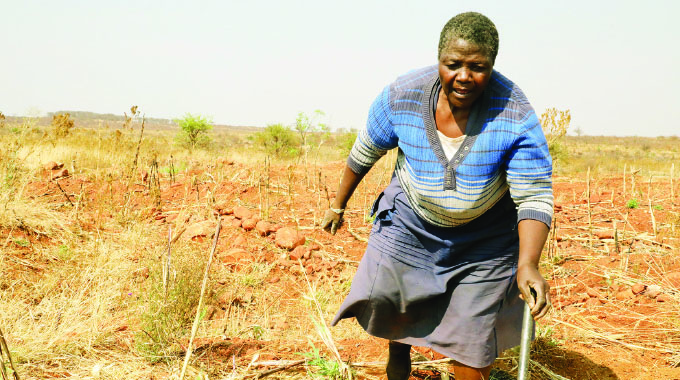
Patrick Chitumba and Nqobile Tshili
Farming inputs are set to be distributed to nearly 500 000 households in Matabeleland region this season to ensure adequate food production as farmers countrywide have started land preparation to maximise output.
At least 3,5 million farmers countrywide are expected to benefit from Government’s free inputs distribution programmes aimed at increasing yields and achieving sustainable food security and nutrition.
Weather experts have already predicted that most parts of the country will receive below-normal to normal rainfalls due to the El Nino effects with southern parts of the country expected to receive the lowest rains.
As a result, farmers have been encouraged to start rolling out land preparatory works ahead of the forthcoming summer cropping season.
The Government has said the digging of Pvumvudza/Intwasa plots is a prerequisite for those who will benefit from the free inputs distribution programme.
In an interview yesterday, Matabeleland North acting director for Agricultural Rural Development and Advisory Services Mr Dumisani Nyoni said the Government has started mobilising inputs and distributing these to regional Grain Marketing Board depots.
“The key factor is that we have started receiving the inputs in the Grain Marketing Board depots. Everything is being put in place,” he said.
“On the farmer’s side, to access these inputs they should have dug a minimum of three plots. We now have fertiliser and we are waiting for the arrival of other inputs before we start distributing to farmers.”
Mr Nyoni said farmers who will receive inputs are those who would have dug Pfumvudza/Intwasa holes, a conservational farming method that has proved to be most effective in generating high yields.
“If all the communal farmers and A1 farmers have dug the holes, we will be looking at a target of 200 000 households. In Bulawayo, we are registering those who are farming in designated peri-urban farming areas,” he said.
“In the past season, our target was 100 000 for Bulawayo, we managed to distribute to 45 000 households.”
Mr Nyoni said in Bulawayo the ministry is working with the city council to address problems associated with stream bank cultivation and cropping in unregulated places.
He said in some cases some of the urban farmers plant their crops closer to the road, obstructing motorists’ vision.
“So, we are working with the council and Environmental Management Agency so that we can demarcate areas for farming. We have seen whitewash marking closer to rivers and the aim would be to discourage farmers not to cultivating beyond that point,” said Mr Nyoni.
“But some farmers go beyond, which is not good. The idea is we want to support as many farmers but farmers should have dug the required holes.”
Mr Nyoni said farmers should invest in moisture conservation farming. His counterpart in Matabeleland South Mr Mkhunjulelwa Ndlovu said the province was targeting to provide inputs to 150 000 farmers who will mainly receive traditional grain inputs.
“We are looking at plus or minus 150 000 households in this province. The seed distribution for summer cropping season has not yet started as we are yet to receive full consignment of seeds,” he said.
“So far, we have received Compound D fertiliser. This season we are going to stick to agro-ecological matching and our emphasis will be on traditional grains.” Mr Ndlovu said only a few areas will be considered for maize seed distribution considering that the areas receive better rainfall.
“We have got irrigation schemes where we will be putting up maize. Other farmers who are interested in maize farming will buy from the shops. Our major focus will be on traditional grains,” he said.
Mr Ndlovu said the Government expects to start input distribution by the end of this month. He said while awaiting input distribution the focus should be on land preparation.
“Right now, we are saying farmers should continue land preparations, apply lime to correct soil PH, and also prepare Intwasa plots. It can be the mechanised ones or basin ones,” he said.
“We are encouraging those with good composed kraal manure to use kraal manure more in sandy soils where leaching is very high.”
Our Bulawayo Bureau yesterday observed that some urban farmers in Bulawayo had started land preparation ahead of the cropping season.
Mrs Simeleni Ndlovu from Nketa 7 suburb was tending to her fields parallel to Bulawayo-Plumtree Road saying she is able to provide for her family through urban farming.
“I have been farming here for the past five years and I’m happy that I’ve been able to produce enough to feed my family. Even up to now, I’m still eating the harvest from the previous season, which helps reduce my budget. So, I’m preparing for the coming season and we hope the rains will be adequate,” said Mrs Ndlovu.
In the Midlands Province, farmers have also started land preparations and training on conservation agriculture techniques are underway, Provincial Agronomist, Mr Innocent Dzuke, said.
Last year farmers who participated in the Pfumvudza/Intwasa programme recorded a good harvest as their crops were not affected by the dry spell.
“Farmers in the province are being trained on Pfumvudza/Intwasa ahead of the summer cropping season. Some farmers are already potholing and by the end of November they should have finished Pfumvudza/ Intwasa plots,” said Mr Dzuke.
“On the type of crops, it depends on the agro-ecological map, but basically small grains are recommended in drier areas this year when we are expecting normal to below normal rainfall,” he added.
Mr Dzuke said modalities were being put in place to ensure that all farmers receive inputs on time. Mr Ronnie Chigombe, a sales agronomist at Seed Co said maximum utilisation of water was critical this season. He said farmers must also take cognisance of their regions and plant crops that will do well as per their regions.
“Water will be very critical, especially in dry land where we are urging farmers to consider small grains. We are talking of regions 4 and 5 where we are saying farmers must prioritise small grains such as rapoko, sorghum, millet among others,” he said.
“In region 1, 2 and 3 farmers should consider mixed crops. We are saying if they were planting SC 727, they can mix it with Shumba or Mbizi. In rural region 3 they must do Tsuro, Tsoko which mature early,” said Mr Chigombe.
He said this will also be the time for commercial farmers who have dams and boreholes to carry the weight of the country by making sure that come harvest time, they will produce like they have never done before.
“Yes, farmers in rural areas depend on rainfall but commercial farmers have alternative water sources, which they must use to feed the nation.
“These must be high-yielding crops such as SC 637, SC 627, SC 643 and SC 727 varieties,” said Mr Chigombe.
Ms Selina Hatidani Sakupwanya, field promoter for Syngenta in the Midlands Province encouraged farmers to start early preparations, which include acquiring inputs early such as herbicides, pesticides and fertilisers and seeds. She said farmers can also be servicing mounted machinery such as ploughs, planters, cultivators.
“Bearing in mind that we are going to experience a normal to below normal rainfall, farmers should invest in short season varieties that mature early at the same time demanding medium to low rainfall,” said Ms Sakupwanya.


 Online Reporter