

 admin
admin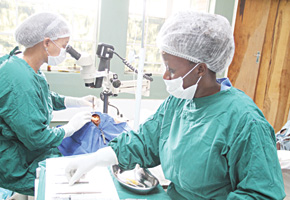
The 70 villagers were beneficiaries of the Zimbabwe Council for the Blind’s week-long outreach programme in the district.
A cataract operation takes less than 30 minutes.
Mr Ziyeli Ndlovu who led the outreach team said prior to the operations, officials from the council screened the patients for cataracts.
Those that had cataracts were then operated on during the outreach week. Dr Dorothy Phiri from the United Bulawayo Hospitals (UBH) assisted by other health officials conducted the operations. The whole exercise was sponsored by the Council for the Blind and its partners so the diagnosis and operations were free.
Mr Ndlovu said an average of four patients were operated on per day.
There was a hive of activity at Binga District Hospital last Friday as scores of eye patients thronged the institution for the free diagnosis and cataract operation. The patients braved the heavy rains that fell in the district throughout the week in order to benefit from this important service meant to change their lives.
“The outreach programme was well received by the people of Binga as we had patients from all corners of the district. The numbers could have been more had it not been for the rains that fell during the week,” said Mr Ndlovu.
He said in some cases the council had to use its own transport to ferry the patients to the hospital for either diagnosis or cataract operation.
Mr Ndlovu said while the majority of people appreciated the importance of undergoing cataract operations, a few people in the district were still sceptical about the operations.
One elderly woman openly refused to be operated for cataract in the presence of the news crew and other patients saying she did not need treatment.
“I was once operated and ended up having mental problems due to the operation. Today I have accompanied my husband to have his eyes checked and I do not want you to touch me,” said the woman in Tonga as Dr Phiri tried to convince her that she needed an operation.
She decided to wait for her husband from a distance.
Among the patients who were operated on was 34-year-old Ms Marata Machijana who said she was delighted to regain her sight.
“This is a good programme. The Council for the Blind has helped many people in this community who thought they were permanently blind. Some of us had to walk long distances to get to this place because we could not afford to miss this opportunity to have our sight restored,” said Ms Machijana.
Mr Poster Mugande (60) also commended the Zimbabwe Council for the Blind, saying many people who had lost hope of seeing again, had regained their sight.
Mr Ndlovu said statistics have shown that approximately one percent of Africans are blind and 50 percent of the blindness is as a result of cataracts.
He said in many cases, the blindness can be reversed such as through cataract operation.
The Zimbabwe Council for the Blind is a charitable organisation whose mandate is to provide services to the visually impaired persons in the country including prevention of blindness, restoration of sight and educating the visually impaired.
The council’s work includes conducting outreach programmes meant to bring services closer to the people, production of low-cost spectacles and eye drops, supporting primary and secondary school resource centres. The council is also involved in the rehabilitation and training of adults with incurable blindness.



 derick.khumalo
 Online Reporter