Online Reporter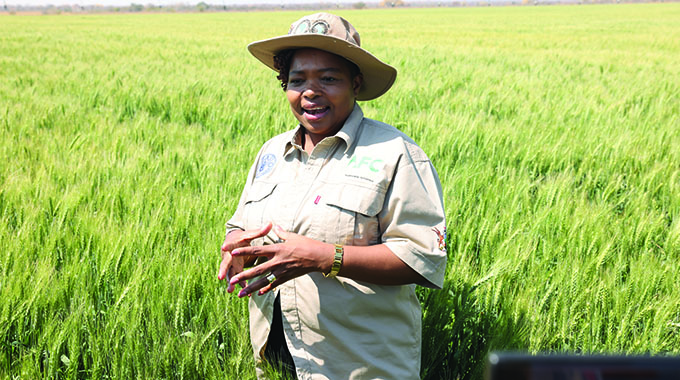
Raymond Jaravaza, [email protected]
A WINTER wheat farming revolution is taking shape in Nyamandlovu, Umguza District, where 12 communal farmers — eight men and four women — have ventured into commercial growing of the cereal after turning a decades-old underutilised piece of land into a mechanised irrigation scheme that is contributing to the nation’s strategic development.
Phaphamani Irrigation Scheme members began their winter wheat journey five years ago and have never looked back.
Tapping into the lucrative farming venture that was once viewed as a preserve of established commercial farmers is inspirational, and the farmers are reaping the transformative results, together with local communities, who are benefitting from employment opportunities.
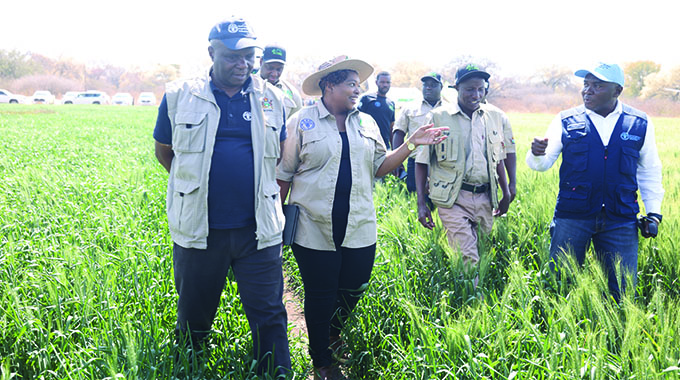
At the peak of the planting and harvesting season, Phaphamani Irrigation Scheme not only keeps its 12 members hard at work in the sprawling 50-hectare wheat fields but also needs over 10 casual workers who are drawn from the local communities.
Established in 2002, the irrigation scheme started with 60 members, but over the years, the number of communal farmers dwindled as members left the project in despair to pursue other interests.
The few communal farmers that did not give up were rewarded for their perseverance and dedication to the growth of the irrigation scheme when the Government, through the Agricultural Rural Development Agency (Arda), assisted Phaphamani Irrigation Scheme with a centre pivot, acquired a tractor and rehabilitated several boreholes.
The shot in the arm by the Government with mechanised equipment a few years ago was the start of good things and has improved productivity levels for the members of Phaphamani Irrigation Scheme, said chairman, Mr Costa Moyo.
“When we started working at this irrigation scheme, we ploughed the land using donkeys and we did a lot of hard and manual work because we did not have any equipment to talk about at the time. So, a majority of members left.
“The Government then stepped in five years ago and revived the irrigation scheme by buying us a tractor and a centre pivot, which made our work a lot easier. New boreholes were drilled by FAO (Food and Agriculture Organisation) and we had finance partners such as AFC (Agricultural Finance Corporation) coming to assist us with financial literacy programmes to turn our farming into a profitable business,” said Mr Moyo.
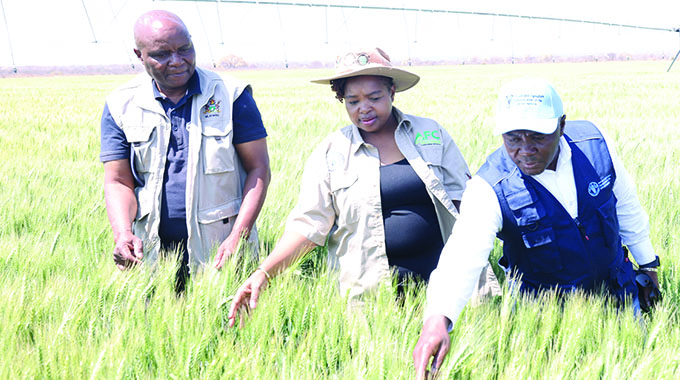
He said Phaphamani Irrigation Scheme turned to commercial winter wheat farming, and FAO assisted them by introducing a seed revolving fund that they tap into to borrow money for seeds and other inputs.
Turning to the winter wheat in the fields, which is in two stages of growth, Mr Moyo said the first batch that is expected to be harvested next month was planted on May 17.
“The biggest challenge in wheat production for smallholder farmers is capital to buy inputs such as seed, but with the assistance of low-interest loans, we are now able to plant on time,” he said.
“Planting for the second batch of wheat was delayed because we first had to harvest a maize crop and get the land ready for wheat planting.
“We expect to harvest the wheat before the onset of the rainy season,” said Mr Moyo.
Another member, Mr Geshom Dube, said over the years, since they ventured into winter wheat production, their yields have kept improving as they are getting better with each season.
“Our local extension officer, Ms Sithabisile Mpofu, has been very helpful in giving us the right technical expertise from the first season we ventured into winter wheat production to date,” he said.
“This season we expect to harvest at least five tonnes per hectare, which is a good improvement from the three tonnes per hectare that we got the previous season.”
Mrs Sithembiso Banda said the project has been productive for the last several years, giving her and fellow female members financial security to take care of their families.
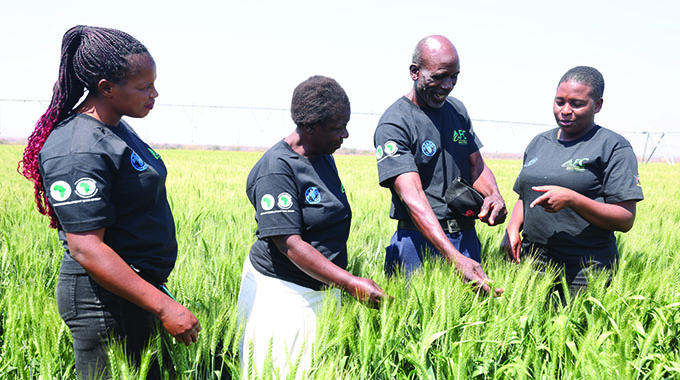
“I never imagined that one day I would be part of a group of women producing winter wheat here in Umguza, but our involvement in Phaphamani Irrigation Scheme is proof that women can also be heavily involved in the country’s food security,” she said.
FAO sub-regional co-ordinator Dr Patrice Talla said Phaphamani Irrigation Scheme in Umguza District is one of the groups supported by the Seed Revolving Fund, an initiative of the Zimbabwe Emergency Food Production Project (ZEFPP).
“The project was developed under the African Emergency Food Production Facility (AEFPF), a rapid response framework created by the African Development Bank.
“It aims to address the food crisis and supply disruptions caused by the Eastern Europe conflict, climate change, and the Covid-19 pandemic.
“The project is fully aligned with Zimbabwe’s Country Programming Framework for 2022-2026, which guides our work in creating sustainable economic empowerment and improving food and nutrition security,” said Dr Talla.
He said in Zimbabwe, the project supports both farmers and the Government in boosting food production in the short term while building long-term food security.
“Our main objective is to increase cereal and oilseed production, improve fertiliser distribution and provide policy support to mitigate the food crisis,” said Dr Talla.
He said, despite operational challenges from a compressed planting window, 3 835 farmers have been assisted, growing 17 014 hectares.
“This slightly exceeds our cumulative target of 17 005 hectares,” said Dr Talla.
Ministry of Lands, Agriculture, Fisheries, Water and Rural Development director for business planning, Mr Abraham Mashumba, reading a speech on behalf of Permanent Secretary Professor Obert Jiri, said the success of Phaphamani Irrigation Scheme is a clear demonstration of the invaluable support the Government continues to receive from its development partners.
“Our ministry carries the responsibility of ensuring food and nutrition security, while driving sustainable agricultural and economic development,” he said.
“This is achieved through clear policy frameworks, investment in research and innovation, strengthening extension services, and developing infrastructure to enable higher productivity.”
Prof Jiri said the Government is encouraged by the progress made under the Zimbabwe Emergency Food Production Project and the Seed Revolving Fund, interventions that demonstrate the power of policy-driven partnerships in achieving national goals.
“We, therefore, extend our appreciation to AfDB (African Development Bank), FAO, and AFC for their role in supporting Zimbabwe’s agricultural transformation,” he said. “Together, we are laying the foundation for food security, farmer empowerment and sustainable growth.”



 Blessing Chizhande