Online Reporter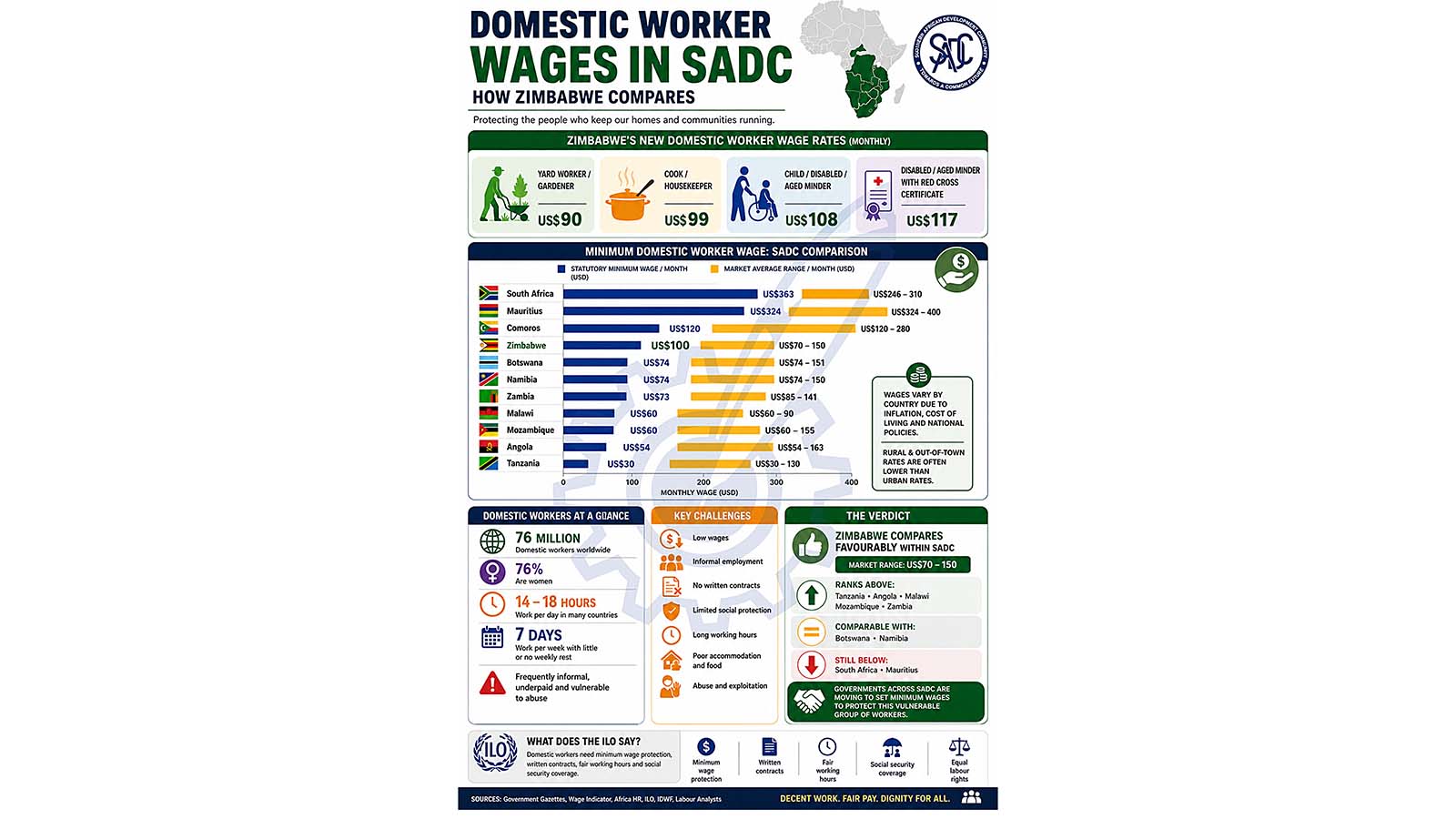
Sifelani Tsiko
Fact Check Editor
Zimbabwe recently approved new adjusted minimum wage rates for domestic workers to help improve employment conditions for them and other classes of workers who are not covered by the National Employment Councils.
Under the revised rates, a yard worker/ gardener will earn US$ 90, cook/housekeeper US$ 99, child/disabled/aged minder US$108, disabled/aged minder with red cross certificate US$117.
Labour analysts say domestic worker wages across the Southern African Development Community (SADC) vary significantly by country depending on local inflation, cost of living, and statutory minimum wage laws.
Much of the differences are dictated by national minimum wage laws and collective bargaining agreements rather than a single regional rate. This domestic labour sector, largely has informal or undocumented, wages and working conditions that often fall below legal thresholds. This cuts across the entire SADC region.
Thousands of women and girls around the SADC are employed as domestic workers in private households. They clean, cook, care for children, look after elderly family members, and perform other essential tasks for their employers.
Despite their important role, they are among the most exploited and abused workers in the workplace across the region. They often work 14 to 18 hours a day, seven days a week, for wages far below the minimum wage. Governments across the region are moving to set minimum wage conditions to protect this vulnerable group of workers.
Globally, there are more than 76 million domestic workers and 76 per cent of them are women according to the ILO. The workers in this sector worldwide experience “lower wages, fewer benefits and fewer legal or social protections than other workers”, according to the International
Domestic Workers Federation. At least three-quarters of them are women. Labour experts say because they work in people’s homes they are isolated, and many get little or no time off. This makes them particularly vulnerable to abuse by employers and particularly hard to organise.
Accommodation is often grim and food inadequate.
Here is a look at the current gazetted base wage minimums and market rates for key SADC nations:
Country Data Source Statutory Min Wage/Month Market Average
South Africa Government USD$363 USD$246 – 310
Zimbabwe Government USD$100 USD$70 – 150
Zambia Government USD$73 USD$85 – 141
Botswana Wage Indicator USD$74 USD$74 – 151
Namibia Wage Indicator USD$74 USD$74 – 150
Malawi Wage Indicator USD$60 USD$60 – 90
Mozambique Wage Indicator USD$60 USD$60 – 155
Tanzania Wage Indicator USD$30 USD$30 – 130
Angola Africa HR USD$54 USD$54 – 163
Comoros Africa HR USD$120 USD$120 -280
Mauritius Africa HR USD$324 USD$324 – 400
Overview
Within the broader regional context, domestic worker wage floors vary significantly depending on local economic policies and living standards. In most urban areas across the SADC region, inflation directly impacts the disposable income workers need for food and transport.
Most employers supplement the base wage with non-monetary benefits like food, electricity and on-site accommodation. Rural and out of town rates are often lower than urban rates. Labour experts say live-in domestic helpers typically negotiate different total compensation compared to live-out, daily-commuter domestic workers who require transport allowances.
Domestic work plays an essential role in securing the maintenance and functioning of households and the well-being of its members and hence most governments within the SADC region are moving to set minimum wages to protect workers in this vulnerable sector.
What does the ILO say about minimum wage coverage for domestic workers?
International labour standards on minimum wage fixing have initially been introduced to bring about protection for groups of wage-earners affected by exceptionally low pay, and for whom no other effective arrangements for wage setting exist. Domestic workers are recognised as one of the groups in need of such protection.
Domestic workers are particularly vulnerable to abusive practices with regard to the payment of wages. They are frequently engaged informally, without terms and conditions regarding hours of work and remuneration being clearly established and agreed upon, and without a written contract or statement of contract particulars.
Hence, the need to set minimum wage standards. Extending minimum wage coverage to domestic workers can serve as an instrument for the social protection of domestic workers.
Verdict
Zimbabwe’s latest step to review the minimum domestic workers’ wage rates is important and ensures a just and fair remuneration. The review helps promote decent work for domestic workers through laws and policies regarding remuneration. The country’s minimum wage rates of between US$70 and USD$150 compare favourably to those prevailing in most countries within the SADC region.