admin
admin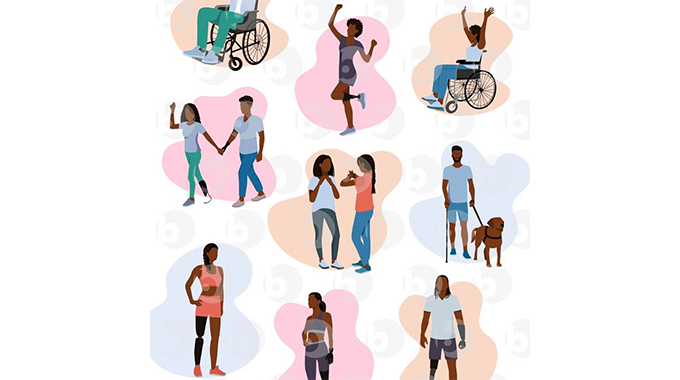
Lovemore Rambiyawo
Correspondent
Zimbabwe joins the rest of the world in celebrating the International Day of Persons with Disabilities (IDPD) today.
Running under the theme: “Building Back Better: toward a disability-inclusive, accessible and sustainable post Covid-19 World”, the theme has tremendous implications for holistic disability inclusion in all spheres of life.
Not only does the theme seek to redress the disability-inclusive, accessible and sustainable economic, social, civic and political processes that have been reversed by the Covid-19 pandemic: it rides on the momentum established, set in motion by Zimbabwe towards the adoption of the National Disability Policy and the Persons with Disabilities Bill, which are at an advanced stage.
The effects of combining the theme of this year’s IDPD with the National Disability Policy and the Persons with Disabilities Act will have far reaching implications on disability inclusion in Zimbabwe.
In pursuance of the theme, Zimbabwe will continue to undertake a number of inclusive actions targeted at the inclusion of persons with disabilities in all aspects of society and development by paying special attention to tackling disability-inclusive, accessible and sustainable economic, social, civic and political processes that have been reversed by the Covid-19 pandemic.
The day also seeks to promote a better understanding of disability and to generate support for the dignity, rights and well-being of persons with disabilities and also raising awareness on the benefits of integration of persons with disabilities in all spheres of life.
The Persons with Disabilities Act, which incorporates vital provisions of the United Nations Convention on the Rights of Persons with Disabilities (CRPD) will result in the domestication of the CRPD, and usher in holistic disability inclusion and participation across all spheres of life.
A benchmark document and roadmap to disability inclusion, the CRPD is the first legally binding human rights instrument to comprehensively address the civil, cultural, political, social and economic rights of people with disabilities.
The application of the convention has immense implications for removal of barriers, equalisation of opportunities and disability inclusion.
The convention sets out the obligations of States to promote, protect and ensure the full and equal enjoyment of all human rights by all persons with disabilities.
The National Disability Policy is another landmark development in disability relations which augurs well for disability inclusion in Zimbabwe as it draws on Section 83 of the Constitution of Zimbabwe, which demonstrates Government’s commitment to fulfilling promoting and respecting the rights of persons with disabilities.
Like the Constitution of Zimbabwe, which has a progressive Bill of Rights that provides for disability integration, the National Disability Policy amplifies the quantum shift in disability relations from a charity and medical model of disability to a human rights approach within the social model of disability espoused by the CRPD.
In order to ensure synchronisation and complementarity of efforts and implementation, the National Disability Policy has sought to draw upon the Bill of Rights providing for disability (Section 83) and its alignment with most provisions of the CRPD.
This includes certain Articles or parts of articles of the CRPD including Article 5; (Equality and Non discrimination); Article 9; (Accessibility); Article 10; ( Right to Life); Article 16(Freedom from exploitation, violence and abuse); Article 17 (Protecting the integrity of the person); Article 18 (Liberty of movement and nationality);Article 23 (Respect for home and the family); Article 24 (; Article 25 ( Health); Article 27 (Work and employment); and Article 30 (Participation in cultural life, recreation, leisure and sport).
The problems of persons with disabilities are multiple and interconnected.
These problems need holistic and integrated solutions that address their interconnectedness for their redress, and not ad hoc, reactive and piecemeal solutions.
The current scenario, where we have a very powerful theme, complemented by a pending National Disability Policy and a Persons with Disabilities Act, holds the best potential for disability inclusion.
All the current solutions are also anchored on disability mainstreaming, which the CRPD recognises as an integral part of sustainable development strategies. There are a number of compelling reasons for mainstreaming disability in all spheres of life.
There are people with disabilities in all target groups of developmental interventions.
Mainstreaming disability addresses the shortcomings of a medical model and disability-specific approach, where the needs of people with disabilities are often not understood, with medical treatment and rehabilitation being prioritised at the expense of economic survival and social participation.
Disability mainstreaming also responds to the interconnectedness of disability problems (poverty, lack of access to education, health, employment, accommodation, etc) in a holistic manner. Charity cannot cope with this structural problem.
Disability mainstreaming relies on existing infrastructure, common knowledge, locally produced equipment and people’s self-sufficiency.
Disability mainstreaming is also in accordance with the United Nations Convention on the Rights on Persons with Disabilities (CRPD), which provides a roadmap for disability inclusion, and which most countries, including Zimbabwe, have signed or ratified.
It is also essential for the achievement of the Sustainable Development Goals (SDGs) which are premised on leaving no-one behind. Its major strengths include fostering disability inclusion.
A key strength of mainstreaming is that it helps decrease attitudinal barriers against impairment, whereas disability-specific programmes often increase stigmatisation.
Experience has shown that when people with a disabilities are allowed to take part in and co-decide over “regular” development programmes, they become more visible to the rest of society.
People will now come to see their abilities and hear their view. Society will start to accept people with a disability when they see the person instead of the impairment.
It also affords societies an opportunity to celebrate human diversity, of which impairment is but one aspect. Mainstreaming disability also creates a range of opportunities for people who formerly were hidden away in shelters and institutions, thus generating self-esteem for people with disabilities.
Instead of being dependent “inmates”, they are gradually allowed to go into the “real” world and do the things that all people do: working, learning, socialising and having fun.
Mainstreaming generates increased action for rights of people with disabilities and also results in raised awareness of disability and disability concerns in the mainstream society.
An immediate impact is that it provides momentum for participation and lifting of institutional barriers as policies, laws and basic services become inclusive of people with disabilities. Also, because mainstreaming is a sector-wide and holistic approach, development programmes are capable of reaching many more people with disabilities.
People with disabilities will be more likely to participate because it will be more affordable to them and more socially accepted.
A major principle of disability mainstreaming, universal design which is the design of products, services, programmes and environments so that they can be used by all, with little or no adaptations, also has major implications for social inclusion.
Universal design and accessibility for people with disabilities also benefits other groups of people such as elderly persons, pregnant women, people wearing glasses, people with temporary injuries, etc. As we celebrate the International Day of Persons with Disabilities amid a glut of disability inclusive and mutually-reinforcing initiatives, Zimbabwe has been given a once in a lifetime opportunity to act collaboratively, collectively, and inclusively to ensure achievement of the overarching goal of disability inclusion.
The time is now.
Even the most exciting priorities have a way of falling under the radar if they are not discussed, repeated, emphasised and celebrated at every opportunity.
Lovemore Rambiyawo, who is physically-impaired, is acting executive director of National Association of Societies for the Care of the Handicapped (NASCOH) is an umbrella body to 70 disability organisations in Zimbabwe. The writer can be reached at: [email protected]


 Online Reporter