admin
admin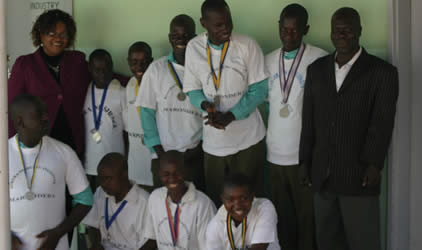
adage is anything to go by it is one phrase to describe the daily activities of Patricia Sibanda, the superintendent of Kukura Neshungu Institute.
Inasmuch as many may take for granted the ability to carry out daily routines such as getting dressed, cleaning up or even feeding oneself, these privileges are just but a dream for most students from Kukura Neshungu in Marondera.
Located in Dombotombo, Kukura Neshungu is an institute catering for 30 children and young adults who are either physically or mentally challenged or both.
Sad as this may seem, the institute is overwhelmed with what Sibanda calls double tragedy.
“On top of having to deal with their disability three-quarters of the students here are orphans who have lost either one or both parents. In other cases the majority of the students’ mothers were divorced to due to stigmatisation after giving birth to a disabled child,” she said.
That being the case it has not discouraged the spirit behind the institution but the gravity of need has made patrons of Kukura Neshungu driven to make a difference.
There are many avenues that people have used as entry points into the institution. They have either been referred by the Ministry of Education, or the Social Welfare Department and some have been seen to approach the institute directly. After special assessment by the special needs department the students are placed at the correct centers, some are brought back here or placed into mainstream schools in surrounding areas such as Dombotombo or Nyameni.
“Mainstream is not always ideal as most students suffer from mental retardation, autism and low self-esteem, self-pity. They need a curriculum such as ours designed to encourage and empower them to know their rights and maximize their talents and gifts ,” she said
Kukura Neshungu is offering three curricular the first being socialisation skills that involves managing their disability. The second involves academics skills training whereby students are taught numeracy and literacy skills. The final is the life skills training which is the main focus especially for those who cannot cope with academic work.
From woodwork, cookery, gardening, mat making and other activities that fall under the life skills curriculum the students have been integrated into the community as citizens that contribute rather than as dependents.
Sibanda eagerly expressed that Kukura Neshungu is now part of the local community. They are involved with takeaways and the Municipality of Marondera who invite them to cook sometimes even for State functions. This has really boosted their morale and has gotten rid of the isolation they suffered before.
The institute has also encouraged its pupils’ participation in other activities such as sports. The Kukura Neshungu students have traveled to America for the Paraplegic Olympics where some of them came back with medals. Last year alone the institute’s seven pupils won medals from the Danhiko Paralympic Games.
It is not enough to care for the students at the campus alone so the hands-on superintendent every Thursday goes on home visits to assess how the pupils are coping and the families in their home environments.
“The purpose of these home visits is to see how my students are living. If the home is not settled they will not come to school. Since the guardians also have challenges that is the time we try to find out how we can help them.
“The elderly guardians will need hospital assistance we will go and try put in a good word especially now that our hospitals have few resources.
“We highlight why they ought to be a priority so that our student does not miss school as a result of taking care of a guardian.
Kukura Neshungu has gone the whole nine yards for its student body.
Due to difficulties in getting to school for some pupils with severe disability a boarding facility has been set up for a few students though initially this was not in their plans.
Sibanda said: “Some of this is so that we create the best possible quality of life for our students. By taking off the pressure and responsibility of having to take care of just one single child all because they have special needs. By so doing we also minimise chances of abuse.”
The institute’s superintendent also picks up some of the other students who are struggling to walk to school in these chilly winter mornings with the school mini-bus.
The institute is trying its best to accommodate its special needs students, they still feel that more can be done in order to aid students to be more self-reliant revealed Sibanda, the former board member of the Miss Zimbabwe Trust.
“It seems almost ironic that we are fighting for the pupils to be enabled and yet in our environment we do not seem to display that in our facilities. Our toilets for example do not even have doors in the cubicle to promote privacy. It is as though we are saying privacy is not important for the disabled.
“We could improve more by putting rails to assist wheelchair users so that they can assist themselves in the toilets without help. We also intend to increase wheelchair access on the premises,” she said.
Kukura is registered with the Social Welfare Department, but since the dollarisation they have not been receiving any support.
The pupils do not pay fees because they come from difficult backgrounds so the institute has been surviving on donations from well-wishers.
Some of these Kukura friends are Proton who have made a lifetime commitment to provide bread. LBG Gas provides the cooking gas and some workers come and donate their services fixing electrical gadgets and working in the garden.
Chinyika Day-Old Chickens provides chicken and eggs fortnightly while Duggie’s Meat provides meat and Forest Lodge flowers for the support groups.
The Roman Catholic women have been providing sugar since last October and have made it a lifetime pledge.
Peterhouse School has been a good friend who comes to pick up the girls on Monday and the boys on Tuesday afternoon and take them for a social interaction afternoon in order to give the hardworking staff an afternoon off.
Monte Casino, on the other hand, are the biggest Kukura Neshungu market for the products manufactured by the students.
They buy freezits, popcorn and other goodies at high prices not paying attention to the product but looking to the person that made the product, said the school head boy Tawanda Mukwena
“I am in charge of the income here at Kukura Neshungu were I have been a student since 2003. My responsibility is to market products so Monte Casino is one of the places I go to. I even attend some of the fund-raising events they hold for us. Everyone here is my friend because we are a little community,” he said.
Marondera has become a haven of equal opportunities for all. The Kukura students have been going around schools to teach spread disability awareness and to encourage people to be friendly towards them.
The community has responded positively so now they work together. The police’s Victim Friendly Unit paid one of their regular visits while Cool Lifestyle was at the institution to give empowerment talks.
Kukura Neshungu is aspiring to reach greater heights by moving to a bigger place where they can be able to create a continuity programme that can financially empower their former students who are finding it difficult to find employment due to stigmatisation.
Kukura Neshungu offers a hope against hope, their success against all odds changes all Cool Teens to treat and help the disabled in anyway they can.
Should the whole country have the same attitude of co-existence that is similar to that radiating from Dombotombo all will be “able- bodied”.


 Online Reporter