Online Reporter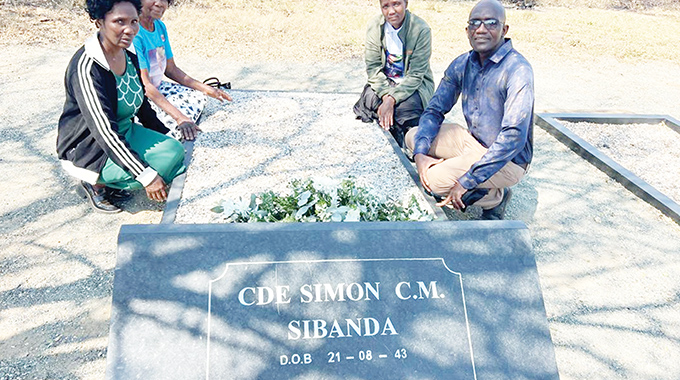
Sukulwenkosi Dube-Matutu, [email protected]
SEEING their father’s grave at the Matabeleland South Provincial Heroes Acre in Gwanda remains a deeply emotional experience for the children of the late liberation war hero Cde Simon Sibanda, whose service to Zimbabwe continued long after Independence.
For the Sibanda family, every Heroes Day is a reminder of a sacrifice that began in 1975 when Cde Sibanda left his young family behind to join the armed struggle for Zimbabwe’s liberation.
He left his wife, Mrs Moddy Sibanda, with their four children, then aged between two and seven and only returned after five years when the war of liberation was over.
His family had no way of knowing whether he was alive or dead.
For Mrs Sibanda, the years of separation were marked by uncertainty, hardship and the responsibility of raising four young children alone.
She survived by doing piece jobs in neighbouring fields, sometimes accepting food as payment to feed her children.
When her husband returned after Independence, the reunion brought immense relief to a family that had spent years living with uncertainty.
Today, decades after that sacrifice, Cde Sibanda’s family says his decision to leave them was painful but necessary.
Cde Sibanda, whose liberation war name was Clearance Majola, was born on August 21, 1943 and died on September 29, 2001 at the age of 58.
Before joining the liberation struggle, he worked at a factory in Bulawayo. In 1975, he left his job and travelled to join the armed struggle while his family remained in the Matshetsheni area of Gwanda.
His contribution, however, did not end with the attainment of Independence.
He later became the first chairperson of the Matabeleland South Provincial Land Committee, where he played a key role in the implementation of the land reform programme in the province.
He was also instrumental in the establishment of the Matabeleland South Provincial Heroes Acre in Gwanda during his tenure as chairperson of the War Veterans Association.
For his family, the provincial shrine is therefore more than a burial place. It is a physical reminder of a man whose life was dedicated to the liberation and empowerment of black Zimbabweans.
Mrs Sibanda said Heroes Day brought back memories of the difficult years when she had to raise her children without knowing whether her husband would ever return.
“My husband left the country in 1975 to join the liberation struggle. He was gone for five years and he came back after Independence. During the time he was away, we didn’t know whether he was alive,” she said.
“I had to look for piece jobs to fend for our children. I would go and work in our neighbours’ fields and would get food as payment, which I would give to my children. When he left, I had four children.”
Looking back, Mrs Sibanda said she now appreciates the enormity of the decision made by her husband and thousands of other freedom fighters who left their families to fight for liberation of the country.
She said their sacrifices had enabled subsequent generations to grow up in a free Zimbabwe.
“If my husband had not made that sacrifice, then no one would have. Today, we are living in a liberated Zimbabwe and enjoying the benefits of the sacrifices that they made,” said Mrs Sibanda.
She said her family had also benefited from programmes introduced after Independence, including Government education support for her children.
For her eldest daughter, Mrs Nokuthula Moyo, seeing her father’s grave at the provincial shrine evokes both pain and pride.
Her father left when she was only seven years old, an age when she could hardly comprehend why he had to abandon his family.
“This day reminds me of the work and sacrifice made by my father to liberate this country. When I see our country today and the freedom we are enjoying, I see the results of the work that was done by my father and his fellow comrades,” she said.
“My father left when I was just seven in order to join the liberation struggle. The injustice which was there at the time pushed him to leave his family and fight for his people. There is no greater sacrifice than this.”
His son, Mr Nqobizitha Sibanda, said his father’s commitment to serving the country continued beyond the liberation struggle.
He recalled working closely with his father during the land reform programme in Matabeleland South and said the late Cde Sibanda remained committed to ensuring that black Zimbabweans gained access to land.
“My father spearheaded the Land Reform programme in Gwanda, Matabeleland South. He was the first chairperson of the provincial land committee and he worked closely with other comrades. I was very close to him when they were working on the Land Reform programme,” he said.
“There were times when they were offered large sums of money to stop the redistribution of land, but he remained focused on empowering citizens through land.”
Mr Sibanda said his father died before fully enjoying the fruits of the work he had dedicated his life to, but his legacy continued through his children, grandchildren and the wider community.
“He left footprints which will remain in the country’s history records,” he said.
The late Cde Sibanda’s contribution to the establishment of the provincial heroes shrine is another part of his legacy that remains close to his family.
Zanu-PF Gwanda District Coordinating Committee chairman Cde David Linda, who trained alongside the late Cde Sibanda during the liberation struggle, said he remembered him as a courageous and principled cadre.
Cde Sibanda was appointed Gwanda War Veterans Association chairperson in 2000, shortly before his death.
Cde Linda said the late liberation war hero played an important role in ensuring that fallen comrades were accorded the dignity they deserved.
“At the time, we didn’t have a district Heroes Acre and comrades who were departing were being buried at their homes. As the war veterans leadership, which included Cde Sibanda, we advocated for a Heroes Acre where our comrades could be laid to rest with the dignity and respect they deserved,” he said.
“The provincial shrine was established and we have been using it also as a district shrine.”
For the Sibanda family, the Heroes Acre has consequently become both a place of remembrance and a tribute to a life defined by sacrifice.
Every visit to his grave brings back memories of a husband and father who left behind a young family to fight for a country he believed should belong to its people.
The country on Monday marked its 46th Heroes Day commemorations under the theme, “Lest We Forget.”