Thupeyo Muleya-Beitbridge Bureau
For many Zimbabweans returning from South Africa, the road home has been marked by fear, uncertainty and heartbreak.
Some left behind businesses built over years of sacrifice.
Others abandoned homes, jobs and treasured possessions with little more than the clothes on their backs.
Many crossed the border carrying emotional scars from days and nights of anxiety as anti-migrant protests swept through parts of South Africa.
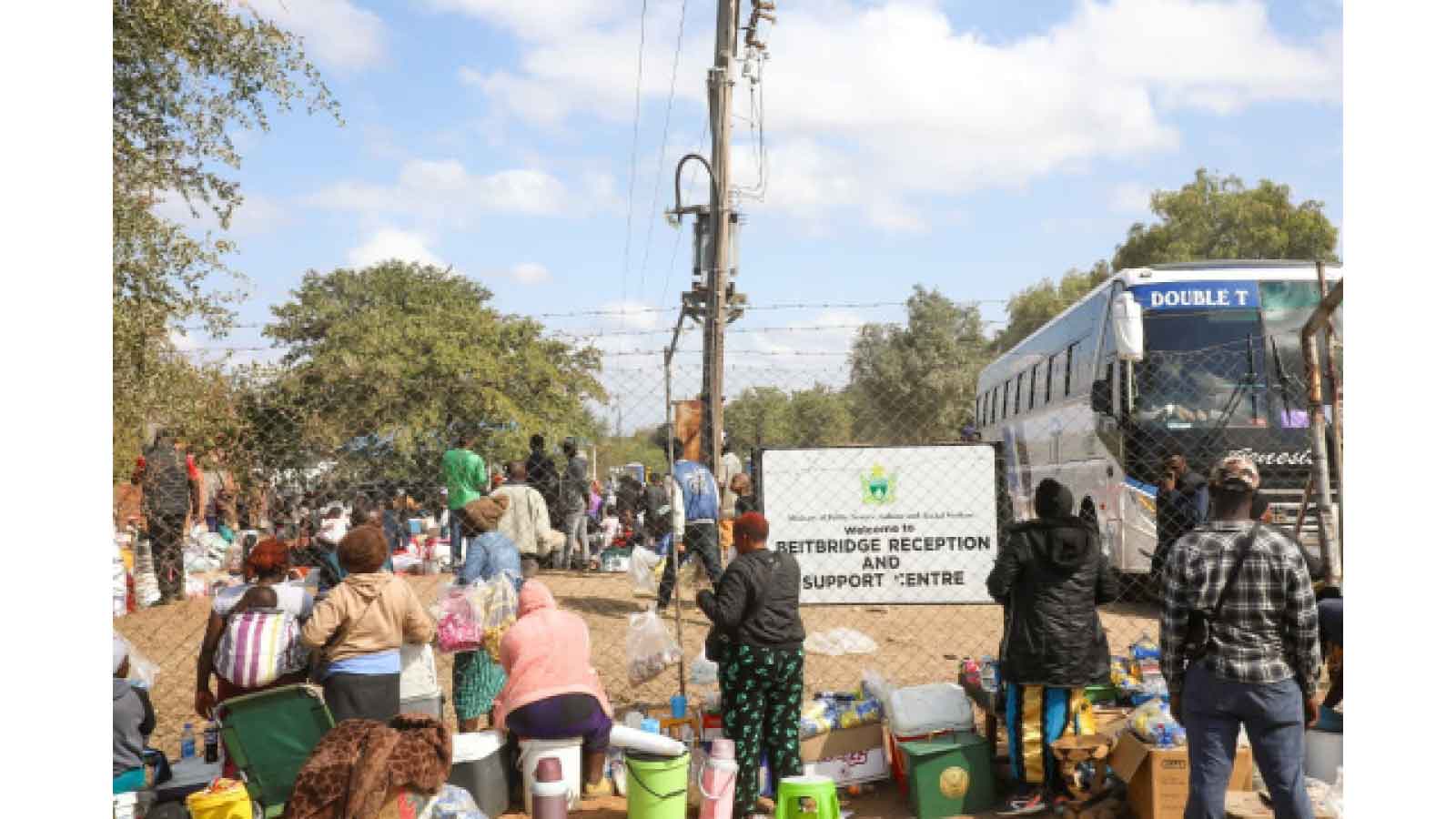
Yet, as buses pull into the Government-run Reception and Support Centre in Beitbridge, the atmosphere changes almost instantly.
Instead of fear, there is reassurance.
Instead of uncertainty, there is order.
Instead of being strangers in distress, the returnees are welcomed home by officials, health workers and volunteers waiting with hot meals, medical care, clean bedding and a simple but reassuring question: “Are you okay?”
For families who feared they had nowhere to turn, those words mark the beginning of a new chapter.
Since May 28, 2026, Zimbabwe has been implementing a coordinated repatriation programme following the outbreak of anti-migrant protests in South Africa that forced many Zimbabweans to flee areas where they had lived and worked for years.
Every returning citizen is brought to the Reception and Support Centre, where Government agencies and humanitarian organisations work around the clock to provide immediate assistance before arranging transport to their final destinations.
The Centre has become something more than a temporary shelter.
It is the country’s frontline humanitarian response, where lives disrupted by violence and displacement begin the slow process of recovery.
Each day, hundreds of people arrive carrying bags, blankets and children.
Some are visibly exhausted after travelling for days.
Others struggle to hold back tears as they recount the difficult decisions they had to make to leave behind livelihoods painstakingly built over many years.
Despite their different stories, almost everyone arrives with the same hope — to reach home safely.
The Reception and Support Centre has been designed to process up to 1 000 adults and children every day.
The operation reflects a whole-of-government approach involving numerous ministries, departments and humanitarian partners working together to ensure that no returnee is left without assistance.
Inside the Centre, activity is constant.
Rows of large tents provide temporary accommodation, while neatly arranged blankets offer protection against Beitbridge’s cold winter nights.
Water points and sanitation facilities have been established throughout the camp, while kitchens prepare hot meals for new arrivals.
Outside, dozens of buses stand ready to transport returnees to Harare, Bulawayo, Masvingo, Mutare, Chiredzi and other parts of the country.
The International Organisation for Migration is assisting with transportation logistics, while the Department of Immigration profiles every returnee, recording arrivals, verifying identities and identifying vulnerable individuals requiring specialised support.
The profiling process enables authorities to ensure that women travelling alone, children, older citizens and people living with disabilities receive additional care.
Health services operate throughout the day under the Ministry of Health and Child Care, with support from humanitarian partners.
Medical personnel conduct health assessments, provide medication where necessary and identify patients requiring further treatment.
Médecins Sans Frontières has reinforced the medical response by deploying two additional doctors to the Centre, while the National AIDS Council is providing voluntary HIV prevention, testing and treatment services.
UNICEF is supporting child protection initiatives and sanitation programmes, ensuring vulnerable children are identified and protected throughout the repatriation process.
The Zimbabwe Red Cross Society is helping reunite separated families by providing tracing services and free telephone calls, allowing anxious returnees to contact loved ones with perhaps the most comforting message of all: “I have made it home.”
Beyond physical assistance, considerable attention is being given to emotional healing.
Many returnees witnessed violence, intimidation and the destruction of homes or businesses before deciding to leave South Africa.
Professional counsellors provide psychosocial support, helping families process traumatic experiences and prepare emotionally for reintegration into their communities.
Children receive specialised protection services, while those requiring ongoing medical care are referred to appropriate health facilities.
Coordinating the complex operation is the district Civil Protection Committee under the leadership of chairperson Miss Sikhangezile Mafu, supported by provincial and national Government structures.
She said every agency has a clearly defined responsibility to ensure that the repatriation exercise proceeds efficiently.
“As the local Civil Protection Committee, with the support of provincial and national structures, we have all the State actors on the ground ensuring the repatriation and reintegration processes are seamless,” said Miss Mafu.
“We are using the whole-of-government approach and all sub-committees have been activated for health, transport, resource mobilisation and social protection.
“Upon arrival, each person is registered and profiled by officials from the Department of Social Development and Immigration, while the Ministry of Health and Child Care checks for medical needs. In addition, the Department of Civil Registry helps anyone with lost or damaged documents, and the police ensure safety and security.”
Once registration has been completed, returnees immediately receive meals, drinking water, counselling and psychosocial support before being allocated transport to their respective destinations.
“Everyone arriving is assessed and provided with social support to help them reintegrate with their families. They get three meals per day and those travelling also receive food vouchers for their onward journeys,” said Miss Mafu.
“We have handled more human traffic before and we will continue using the same strategies. We are ready to absorb any amount of pressure and make processes seamless.”
The humanitarian response has also attracted support from the Office of the First Lady.
During a visit to the Centre this week, First Lady Dr Auxillia Mnangagwa delivered more than 50 tonnes of rice and maize meal to strengthen food supplies for returning families.
She also donated sanitary wear for women and girls, clothing for young children, blankets and other essential consumables.
In a moving demonstration of her motherly love for vulnerable citizens, the First Lady shared words of comfort, encouragement and hope with families, children and older people as they prepared to begin a new chapter in their lives.
Beyond words of encouragement, she personally handed over food hampers, toiletries, baby nappies, warm clothing and blankets to help families begin rebuilding their lives with dignity.
Additional assistance continues to flow into the Centre.
Presidential Adviser on Special Projects Dr Paul Tungwarara has been providing lunch packs for families awaiting onward transport, while the coordination of humanitarian activities on the ground is being supported by Dr Chipo Maketo, working alongside Safe Haven, an organisation led by Mr Claude and Mrs Babongile Gora that focuses on gender-based violence prevention and social protection for migrants.
For many returnees, however, the greatest source of comfort is simply the knowledge that someone was waiting for them on the Zimbabwean side of the border.
Mr Ernest Runhare, who spent two months in Durban before deciding to return home to Chiredzi, said the Government’s intervention restored hope during one of the most difficult periods of his life.
“I am grateful to the Government. South Africa became difficult for us. When we heard that Zimbabwe was bringing people home, we had hope. The buses, the food and the way we were received here show that the Government cares,” he said.
Ms Lena Mutanda travelled from Chatsworth in KwaZulu-Natal to Masvingo after leaving behind both her rented accommodation and years of employment.
Although saddened by what she lost, she said the reception she received in Zimbabwe gave her renewed confidence.
“I appreciate the transport, the food, the counselling and the moral support. It was not easy leaving behind everything, but at least we are not coming home empty-handed. The officers and volunteers spoke to us with respect. That alone gives us strength,” she said.
President Mnangagwa has directed all arms of Government to ensure that every returning Zimbabwean is repatriated and reintegrated with dignity.
Officials say capacity at the Reception and Support Centre will continue to be expanded for as long as evacuations remain necessary.
As darkness falls over Beitbridge, solar-powered lights illuminate the rows of tents.
Children, exhausted from days of travel, fall asleep wrapped in warm blankets, while parents sit quietly outside, reflecting on lives interrupted and uncertain futures still to be written.
Conversations drift between memories of what was left behind and cautious optimism about what can be rebuilt.
The losses are immense.
So too is the resilience.
For now, every hot meal served, every blanket distributed, every counselling session conducted and every bus that departs carrying families towards their home districts represents more than humanitarian assistance.
It represents a nation standing beside its own.
At Zimbabwe’s busiest border post, the Reception and Support Centre has become more than a place of transit.
It has become a symbol of compassion, solidarity and hope — a place where frightened travellers arrive carrying the weight of uncertainty but leave with the reassurance that, whatever they have lost along the way, they have not lost their place at home.