admin
admin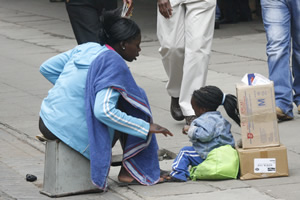
make it one of Harare’s Central Business District’s busiest streets.
Also making up the composition of the street is a group of vendors, among them women selling wares ranging from trendy hand-made earrings, cockroach and rat killers, combs, Bibles, vegetable seedlings and socks, among many others.
The women sit on flattened cardboard boxes and chit chat as they wait for customers.
What is interesting though is that even as the women appear to be absorbed in their chat, they often lift their heads as if they are on the lookout for something.
It is in the evening and the women are not worried about the municipal police as they have already made their rounds arresting a few unfortunate ones in the process. The women are simply mothers who are looking out for their minor children, some two years old crawling on the dirty pavement as they play.
Three more children aged between three and four also seem to be engrossed in their own version of soccer as they kick a plastic ball on the pavement. They are quite a distance from their mothers, who seem not to worry about the little boys.
This has been the situation in the CBD as vendors bring their children “to work” risking them being run over by Harare’s speeding cars.
Many of these mothers have to supplement their husbands’ meagre earnings and in some cases are single and the principal breadwinners for their families.
Society has raised concerns that the mothers are exposing their children to environmental dangers and in addition, “abandonment” through inadequate supervision during working hours and poor hygiene.
Some of the vendors who spoke to The Herald last week said they expose their children to risk because they have no baby minders as they cannot afford them.
Mary, who has been selling pirated discs for a year along Speke Avenue, said she tries to keep an eye on her daughter Caroline (3).
“I have no one to leave the child with at home and the only option is to bring her here.
“It is sometimes difficult to keep an eye on my wares and also on Caroline as she can be quite a handful and wants to run all over the place,” Mary admitted.
She adds: “I cannot take the child to my rural home since both my parents are late. My two sisters are also vendors and sell wares outside Mupedzanhamo Flea Market in Mbare.
“They also take their minor children to work. This is the way things are. I have to feed the child at the end of the day.” Barbra Moyo, another vendor along Robert Mugabe Road, said she brings her two-year old twins to work six days a week.
The section between Inez Terrace and Mbuya Nehanda is one of the busiest and most crowded in the CBD yet this has become the playground for the twins.
“It is a difficult choice to make. It’s either I have to take care of these children at home or bring them to work so that I can put food on the table.
“This is a dilemma that we female vendors have to face as we have the burden of ensuring that children are taken care of.
“Male vendors find it quite easier as their wives stay at home with the kids,” she pointed out.
Moyo said she sometimes has problems, especially when municipal police pounce on them.
“It becomes very difficult for me as I first have to look for my children who usually play with their toys on the pavements and also make sure that none of my wares are taken by the council police.
“I play what I now call the grabbing and dragging game. I first grab the kids then drag the sack containing my wares. Both are important for my survival.
“I have gotten accustomed to this as I try to protect my children,” she said.
She said there have been incidences where some pedestrians have stepped on the toes of her kids; some have threatened to have her arrested for exposing them to danger.
“One of the twins once strayed into one of the clothing shops close by, went under a basket containing wares and slept there unnoticed.
“My heart beat so fast and I looked for him for close to two hours. A guard who noticed his little shoes raised alarm and I was reunited with him.
“The other found her way to the busy Robert Mugabe Road while I was serving a customer and was only picked up by a good Samaritan who alerted me.
“These were both anxious moments for me,” she added.
Others said they bring their children to use them as shields against municipal police.
Martha of Mufakose is one such mother who believes that bringing her four-year child to work is the solution to the problem of municipal police.
“I make sure that I cry holding my child each time they come. I have escaped on many occasions,” she added.
With jobs hard to come by as the country is still recovering from a decade of economic hardships and industries still bleeding from these difficulties, the female vendors are caught between a rock and hard surface. They have simply discarded what is expected of them when it comes to the safety and protection of their children.
Council of Social Workers chairperson Mr Phillip Bohwasi said while they understand that these women have to fend for their children, the Zimbabwean society lacks well-polished parenting guidelines and treat children like any other person.
He said as a council, they will be pushing for legislation that has to do with parenting.
Those who expose their children to difficult situations would have to face the law, according to Mr Bohwasi.
He said a multi-sectoral response is required and they are pushing for comprehensive legislation.
Another social worker, Mr Musekiwa Makwanya, said: “All these are crimes scenes where women bring children on the streets for all sorts of reasons and fail to supervise them.
“I am talking about the vendors who leave children crawling on streets to those who stand in the middle of busy roads using their children as baits when begging.
“They neglect the children and put them at risk. All this is covered under Section 7 of the Children’s Act.
“The Department of Social Welfare should do something because when you take your child and dangle them in the middle of the street, you are exposing them to danger.
“In most cases, the mothers will be seated somewhere and the child is the one who will be begging.
“The police, together with the Department of Social Services, should come in and intervene. A multi-agency approach is required and there is also the question of where you will put them once you take them.
“The children can be abducted, snatched and all these are risk areas. This says something about our society’s ability to respond to socio-economic circumstances.
“We should continue to look at the legislation and see if it has the adequate social safety nets for children. This legislation will come as a result of that multi-stakeholder involvement,” he said.
He added that most people believe that it is only the duty of social workers to protect children, yet it is everyone’s role.
“We need to review our Acts so that they are sufficient for the problems that we have in Zimbabwe. We can then start talking of implementation,” he added.
l roselyne.sachiti@ zimpapers.co.zw



 Online Reporter