
Francisca Mutapi-Herald Correspondent
ON 31 May 2021, the World Health Assembly officially recognised January 30 as World Neglected Tropical Disease Day. This landmark decision elevated a long-standing global movement into a formal international observance, creating a dedicated moment each year to raise awareness of diseases that continue to affect the world’s poorest and most marginalised communities.
World NTD Day is both a reminder of the devastating impact of these diseases and a call to action. It is also a day associated with progress and “world firsts”. Over the years, major global milestones have been launched on or around this day, including the first WHO NTD Roadmap in 2012, the London Declaration on NTDs, and, most recently, the current WHO NTD Roadmap launched in January 2021.
This year marked the fifth anniversary of World NTD Day, and the Tackling Infections to Benefit Africa (TIBA) partnership chose to celebrate the occasion through a week-long series of events in Zimbabwe that highlighted leadership, collaboration, and tangible progress.
A New Specialist Institute at NUST
The week began on January 27, with TIBA’s participation in the launch of the Institute of Immunopharmacology and Biobanking at the National University of Science and Technology (NUST). This pioneering institute, the first of its kind in Zimbabwe, is spearheaded by TIBA Zimbabwe’s Professor Elopy Sibanda, dean of Medicine at NUST.
The institute will strengthen national capacity to develop diagnostics and therapeutics for priority diseases, including neglected tropical diseases. One important focus area will be the development of snake antivenom, addressing snakebite envenoming, a rising but often overlooked NTD. The launch marked an important step towards scientific self-reliance and innovation within the country.
A Child-Friendly Breakthrough for Bilharzia
The highlight of the week came on January 28, with the launch of paediatric praziquantel — a new, child-friendly treatment for bilharzia (schistosomiasis).
For many Zimbabweans, the challenges of treating bilharzia in young children are well known. The tablets currently used are large and extremely bitter. To treat young children, tablets must be broken into smaller pieces, crushed into powder, and mixed with liquids — often with cordial to mask the taste — making treating young children difficult.
The new paediatric formulation represents a major improvement. Launched by the Provincial Medical Director at Mupfure Clinic, it comes in smaller, better-tasting tablets that dissolve easily in a small amount of water, making treatment much simpler for preschool children aged six years and below.
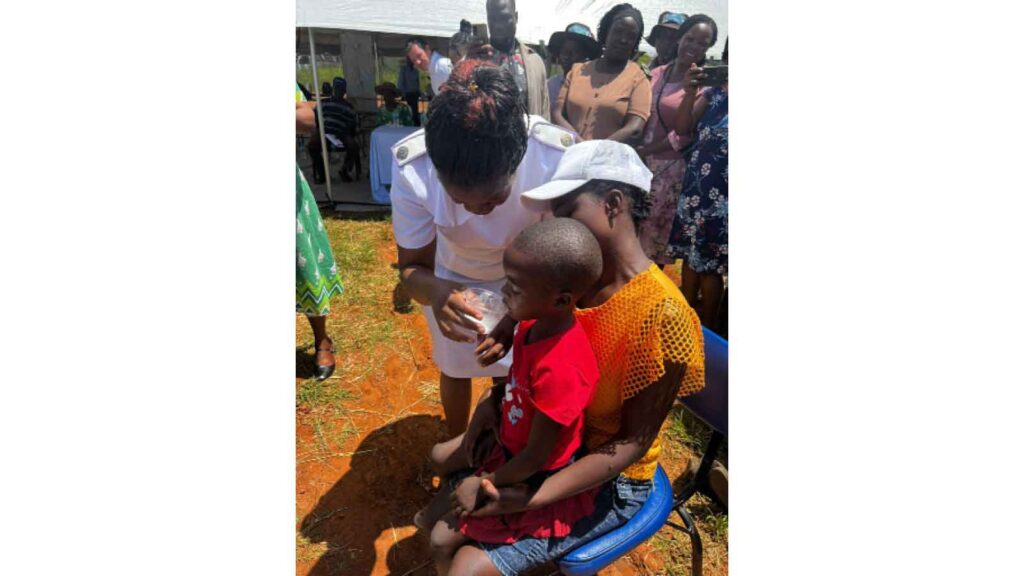
First children being treated with better tasting medication for bilharzia in Zimbabwe.
“This is a day we have worked towards for over 20 years,” said TIBA deputy director Professor Francisca Mutapi of the University of Edinburgh.
“The launch of a simple, child-friendly treatment transforms the health and future prospects of children,” she said.
The TIBA partnership has been working on childhood bilharzia for the past 20 years in several countries, initially in Zimbabwe and extending to Rwanda, South Africa and Tanzania. As a result of this work, Zimbabwe is the first country in southern Africa to launch this treatment. Tanzania will host the official launch of the medicine next month.
Mr Justin Brown, the president of the Thrasher Research Fund — which supported research that informed the prioritisation of treating childhood schistosomiasis- praised the collaborative effort. He commended the strong partnership between the Universities of Edinburgh and Zimbabwe, the Ministry of Health, and the active participation of affected communities.
Mr Remco de Vrueh, representing the team that developed the new formulation, explained how the new tablets were specifically designed with young children in mind, ensuring easier dosing and improved acceptability.
Reflecting on Partnerships and Progress
On January 29, TIBA stakeholders gathered to reflect on the long journey leading to the launch of paediatric praziquantel, sharing lessons learnt and discussing next steps. Participants included representatives from the African Union’s AUDA-NEPAD, the Higherlife Foundation, KEMRI-Wellcome Trust Kilifi, and TIBA researchers from Tanzania, South Africa, Uganda, Zimbabwe, and Edinburgh.
A key highlight of the meeting was the formal welcome of Malawi as a new TIBA partner, bringing the number of African countries in the TIBA partnership to 10. The talks reinforced a central message: meaningful progress towards eliminating NTDs depends on strong, equitable partnerships and African leadership.
Amplifying Affected Voices Through Art
The week concluded with the launch of a public exhibition celebrating resilience and agency among Zimbabweans living with NTDs.
The exhibition, a collaboration between TIBA and the National Gallery of Zimbabwe, combines photography and art to raise awareness, reduce stigma, and ensure that affected voices are heard when policies and programmes are developed.
The executive director of the National Gallery of Zimbabwe, Mr Raphael Chikukwa, emphasised the powerful connection between art and science, noting how combining them provides an effective tool for communicating complex messages and supporting health education.
During the exhibition, two winners of an NTD art competition from Mupfure primary and secondary schools were announced. Highlighting the importance of engaging children in health education, Prof Mutapi said, “When we educate a child, we educate a village.”
The children’s artworks are currently displayed alongside photographs of people living with NTDs, many of whom attended the exhibition launch in person. Visitors also joined in the NTD dance challenge to the theme song calling on everyone to “Unite, Act and Eliminate NTDs”.
A Week That Signals What Is Possible
This remarkable week of “firsts” demonstrated what can be achieved when research, government, communities, funders, and creatives work together. It showcased Zimbabwe’s NTD leadership and reinforced the importance of country ownership in driving progress towards the elimination of these diseases.
World NTD Day is not just a date on the calendar. In Zimbabwe this year, it became a celebration of hope, innovation, and collective action — and a reminder that elimination is possible when partnerships are strong and people are placed at the centre of progress.
Francisca Mutapi BSc DPhil FAAS FZAS FRSE
Professor Global Health Infection & Immunity
Co-Director Global Health Academy
Deputy Director TIBA
Senior Adviser to the Principal on Africa
Honorary Visiting Research Fellow, Nuffield Department of Medicine, Oxford
Adjunct Professor, University of Ghana
2021 TED Fellow, Aspen New Voices Senior Fellow
Room GA.56
Institute of Immunology & Infection Research
University of Edinburgh
Ashworth Laboratories, King’s Buildings
Charlotte Auerbach Road, Edinburgh, EH9 3FL