Chronicle Editor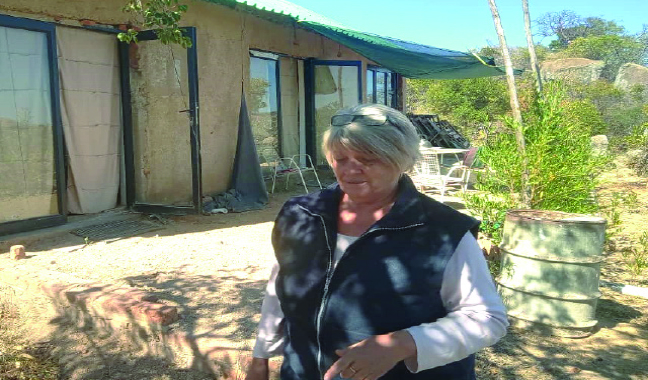
Raymond Jaravaza, [email protected]
DOROTHEA Bekker, known as Sipho to the locals in Gulathi Village, has found her true home in Matobo District after living in five different countries.
Her homestead is situated on a rocky hill, surrounded by her beloved community who call her Sipho. Bekker, who lives with her pets, says that Zimbabweans are rich in terms of land, something that people in Europe can only envy.
She travelled over 20 000km, across 18 countries, and has lived in five countries — South Africa, United Kingdom, Portugal, Luxembourg and Spain — before settling in Gulathi Village. Bekker sees herself as part of the community.
She has already funded a project that shows off the women of Matobo’s exceptional talents by painting the Jairos Jiri Craft Centre.
She says waking up to the African sunrise and watching the sunset in the evening is the most divine feeling.
“I know a lot of people in Europe, well-off individuals that will do anything or part with their most valuable possessions just to own a small piece of land that villagers here in Matobo and other rural areas in Zimbabwe take for granted.
“Zimbabweans are so much rich in terms of land that they own, something that most people in Europe can only envy and I’m proud to say the last few years living in my rural home here in Gulathi Village has been the happiest period of my life,” she told Saturday Chronicle at her homestead.
In August 2019, Bekker bade farewell to her life overseas in the most dramatic and adventure-driven goodbyes. She re-modelled her modest vehicle van into a camper van — a moving home on wheels, and put it into a ferry to cross from Spain into Africa across 18 African countries — from Morocco down to Zimbabwe.
With her mind and heart fixated on finally settling in Matobo District, she began the 20 000km trek that took her over eight and a half months.
“My friends in Europe call and say ‘you are so brave, living alone in the rural areas’ and I try not to laugh at the subtle insinuations that a white woman cannot live alone among black people.
“I see myself as a villager and part of the community of Gulathi Village, nothing more, nothing less. If you are looking for my homestead, it’s easier to find when you ask for directions to Sipho’s place. That’s what the other villagers call me,” said Bekker.
Born at Mater Dei Hospital in 1958, Bekker married at 26 years in South Africa, but unfortunately lost her husband early into the marriage. She lived across the Limpopo for 16 years, then immigrated to the UK for over a decade and moved around three European countries for nine years.
Her childhood days were spent in Queens Park suburb, at the family home and she attended Eveline High School.
Although not proud of it, she says she won’t hide the fact that she lived a privileged life under the Rhodesian regime, where black Zimbabweans were segregated and faced years of oppression.
“We were taught by the system that black people wanted to be treated in a particular way and that by being white, we deserved certain privileges. The most horrific form of racism against black people that I ever witnessed was under South African apartheid and the more I met more black friends, I realised just how wrong the system was.
“In Europe, I met a lot of diasporans from Zimbabwe, Malawi, Angola and other African countries who were appalled by the way the oppression worked and I didn’t consider myself Rhodesian anymore,” she said.
Colonisation is the worst thing that could have ever happened to Zimbabweans, Bekker says, and she gets angry when some people who benefited from the Rhodesian regime try to justify it.
“It gets me very angry when I hear some white people say Cecil John Rhodes was a successful businessman, no, that’s not true. He was a mercenary who was only after enriching himself.
“The worst form of oppression is to disfranchise a people by taking away their land and that is what Rhodesians did, all in the name of looking for precious minerals underground that would supposedly improve the lives of the people. We all know how that turned out. They simply looted the country and left black people in no better position than they were before colonisation.”
Rural living has taught Bekker to survive on the bare minimum. She has a friend who brings her water from the local dam in bulk, plants her favourite vegetables like broccoli, and goes on days without cellphone network; the life of a typical villager in Gulathi Village.
She says she travels to Bulawayo for meetings once a week, but otherwise spends much of her life quietly in the rural areas. She doesn’t hire domestic workers as she prefers doing everything on her own. The only exceptional help she hired is a lady who cleared the land of an invasive species of shrubs that had invaded part of her 3-hectare homestead before she moved in.
She says that the most valuable asset that villagers have is their land and has therefore, galvanised her community to form the Gulathi Community Trust to harness the villagers’ resources in building a successful business centre, using their land as the most important asset.
“The most valuable asset that we have as villagers is our land and our mandate at the Gulathi Community Trust is to use that land to build a centre right here in Ward 24 that will have a restaurant, training centre and other services. As a business development coach, my heart is so much into helping villagers realise their full potential by using their land as the most important asset,” she added.
Last week, the Bulawayo City Council unveiled the re-painted Jairos Jiri Craft Centre which was done by a group of Matobo women who were put together by Bekker in a project funded by the German Embassy.
“Those women have such exceptional talent, they paint their homes using readily available materials such as clay and ash with the most amazing results. We put together a team that did the painting job at Jairos Jiri Craft Centre and I’m proud that they did a good job and showed the world what women of Matobo can do with their hands,” she said.



 Online Reporter