admin
admin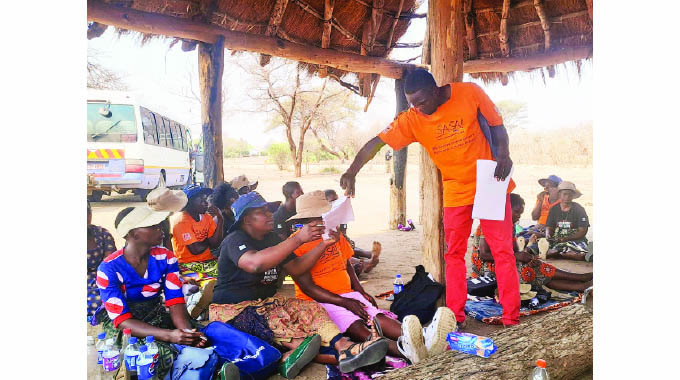
Fungai Lupande-Mashonaland Central Bureau
HE used to be a perpetrator of violence but has since transformed to become a powerful leading voice against gender-based violence (GBV) in Mbire.
This is the story of Mr Vitalis Mahembe of Muoneka Village 1, Mbire, who is now a gender champion advocating for the protection and empowerment of women in the district.
Mr Mahembe admits his wife suffered his aggression and this was fueled by cultural norms that regard spousal abuse as normal. He confessed that he would often take out his frustrations on his wife, after experiencing mistreatment by other men at social events.
Transformation came to Mr Mahembe when in 2019, a non-governmental organisation Katswe Sistahood, visited the village, where the community members identified him as a notorious wife-beater.
This marked the beginning of his transformation as he became involved in the model of Start Awareness Support Action (SASA).
He admitted that his violent behaviour had deeply affected his family.
His community now recognises him as a gender champion due to his transformation.
“I have scars all over my arms from my wife as she tried to free herself. I was tired of this life and decided to change it after receiving education from Katswe Sistahood.
“People in my village accept me and believe me as a gender champion because they know of my bad behaviour,” he said.
The SASA programme is a community-based initiative aimed at eradicating violence against women and is being implemented by Katswe Sistahood under the social contracting of the National AIDS Council.
Ms Sabina Nyamudzingwa from Guveya 1 village in Mbire highlighted the importance of behavioural and mindset change in the success of the SASA programme.
She emphasised that SASA champions needed to undergo a personal transformation before attempting to influence others.
Ms Nyamudzingwa acknowledged that while the journey was challenging, community members eventually recognised that what they had previously considered normal was, in fact, a form of GBV.
The SASA champions were provided with bicycles to facilitate outreach efforts across Mbire.
“The bicycles proved essential in reaching out to community members and educating them about gender violence, HIV/AIDS, and antenatal care,” she said.
Ms Nyamudzingwa mentioned that domestic violence cases in Mbire often stem from men stealing relief grain or farm produce from their families to exchange for alcohol or sex. It is reported that men in Mbire frequently exploit their wives for money from agricultural produce.
To address economic empowerment and reduce domestic violence, Katswe Sistahood initiated a goat project for women in Mbire. Additionally, the district AIDS coordinator, Mr Claudius Musandaira, noted that sesame production has contributed to economic empowerment, albeit with an increase in GBV.


 Online Reporter