


 Chronicle Editor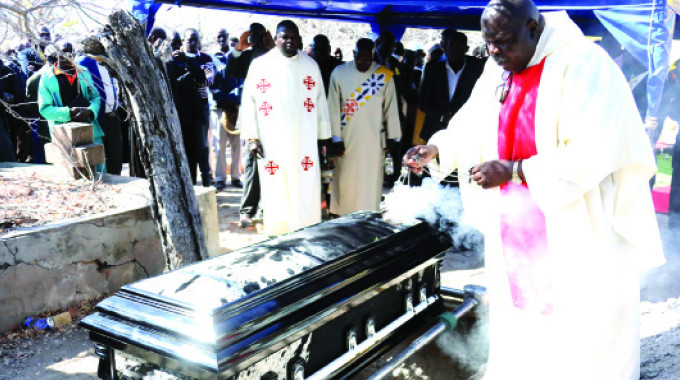
Bruce Ndlovu, Sunday Life Reporter
AT some point in his sermon during the burial of Chief Malaba at Nyashongwe Village in Kezi, Matabeleland South Province, Father Innocent Makawule Ndlovu lightened the mood with some jokes.
As the parish priest at St Joseph’s Mission, Father Ndlovu had known the late chief for a long time and was thus tasked with delivering his personal history.
Sometimes even in the house of the Lord, the word is delivered with a comedic touch, and on that windy Saturday (15 June) morning, Father Ndlovu delivered a few comedic gems that gladdened the dejected hearts of the mourners and drove the winter chill away from their shivering bodies.
“In 1956, our parish priest passed away after he drowned going down a well in search of water for our people. That is why you must appreciate your priests because they care greatly about you. However, you must show this appreciation by offering to the church. Show this appreciation by offering to your priest,” he said much to the amusement of the gathering.

Such was the mood at a gathering that brought together dignitaries that included highest-ranking officers of the country’s courts like the country’s Chief Justice, Luke Malaba, Cabinet Ministers, traditional leaders, and high-ranking civil servants.
Father Ndlovu’s sublime mix of the religious and the comic was fitting for a gathering in which the interaction of traditional cultural burial rites and Catholicism offered a seamless blend, instead of a clash, between the Western and the African.
While he was a traditional leader of note Chief Malaba was also a devout Catholic, with his farewell offering a mixture of the cultural and religious forces that drove him in life.

The burial of chiefs is not a uniform procedure, as authorities take their cue from the traditional practices in the area. For example, in some clans, chiefs are not buried lying down but laid to rest sitting up, preferably in a cave located on a mountain. The cave is usually sealed with rocks that disguise it from the inquisitive eyes of mere mortals.
“When it comes to the burial of chiefs, it all differs, depending on the tribe that they all come from,” Father Ndlovu, who has written a book on African burial rituals and also comes from a family of headmen in the Malaba area, told Sunday Life.
“The Venda have their traditions and so do the Kalanga and the Ndebele. It all differs but one of the outstanding things is that the Catholic faith is respectful of African culture. In our religion, we say there are great many things to admire about African religion.

There’s some bad in every culture but if you look at things like respect of chiefs and other traditional leaders, we regard that as something to admire about African traditional religion. This respect is extended to our chiefs even after they have passed on. In this case, I can say that our faith is not so different from African tradition, particularly Kalanga tradition, because there’s a belief in one God.”
For Chief Malaba, everything had to be in sync with his station as a chief and also a Catholic. While the funeral parlour the late chief subscribed to provided a casket, it would be replaced closer to his burial, with one that reflected his status as chief.
The all-black casket in which the chief was eventually buried in had a covering of distinct cowhide, which adequately reflected his royal status even as he prepared to enter the afterlife.
As Father Ndlovu administered the last rites, the chief’s wife, accompanied by four other women, sat in front of his casket, hidden from public view by blankets draped over their heads.

“Before burial, there are prayer services with scripture in the evening, to comfort the bereaved. There’s no difference whether one is a chief or from a higher office. Then there’s the Holy Mass which is also carried out on a select day. It can be done either on the day or after burial.
It’s the full service which is the highest form of prayer in the Christian church because it’s the sacrifice of Jesus Christ that is being done. The priest in the Catholic Church offers sacrifice in the form of bread and wine to the comfort of the living.
“The wife sits next to the corpse as part of our African Kalanga tradition and she is supposed to be in that position until she goes on to the burial site where she can then remove the blanket. She has to be in that state even when she is in the house. For the burial of Chief Malaba, we took the body outside because of the number of people that were there for the burial. The body was outside next to the priest because the service is directed towards the departed,” Father Ndlovu said.
Some visitors were startled when the body viewing ceremony was skipped. But according to Father Ndlovu, this was something forbidden by the late Chief Malaba and thus, not a tradition observed in the area.
“The payment of last respects is only done by the family members in our culture. This is more so in the case of a chief and in this case, Chief Malaba was not in favour of the ritual of body viewing. So, during a lot of the burials that we held here in his area, he was opposed to a deceased’s body being viewed by the public.
That would explain why at the administration of his last rites, there was no body viewing or payment of last respects. Chief Malaba believed that this procedure was only meant for the identification of the body and not something meant for the general public,” he said.
As the June sun rose towards mid-afternoon, only family members were asked to make their way towards the Malaba family graveyard. Here, the cocktail of African tradition and Catholic traditions was even more evident.
As Catholic songs were belted out to the thumping sound of African drums, the chief’s supposed heir stood in front of his lowered casket, with his father’s staff in his hand, completing a silent change of guard amid a unique melting pot of culture and religion.


 Online Reporter
 Bongani Ndlovu