admin
admin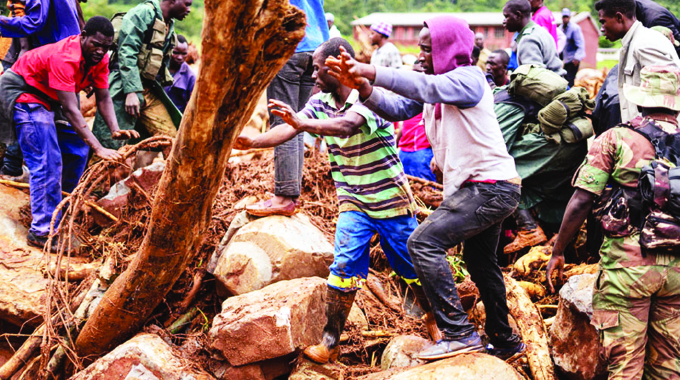
Sifelani Tsiko Environment Editor
Africa has incurred economic losses of up to US$5 billion due to weather-related disasters that have hit the continent and other parts of the world over the past five decades, says the World Meteorological Organisation.
According to the WMO Atlas of Mortality and Economic Losses from Weather, Climate and Water Extremes (1970-2019) released this week, Africa recorded 1 695 disasters that caused the loss of 731 747 lives and $5 billion in economic losses.
The continent accounts for 15 percent of weather, climate, and water-related disasters, 35 percent of associated deaths and one percent of economic losses reported globally.
Although disasters associated with floods were the most prevalent at 60 percent, droughts led to the highest number of deaths, accounting for 95 per cent of all lives lost in the region, with most occurring in Ethiopia, Mozambique and Sudan.
WMO report said over the past 50 years, disasters related to weather, climate or water hazards, have become a regular occurrence, responsible for the deaths of at least 115 people, and causing $202 million in economic loses every day.
The report noted that the number of weather-related disasters to hit the world has increased five-fold over the past 50 years even though the number of deaths due to storms, floods and droughts has declined sharply.
Climate experts say that climate change, more extreme weather and better reporting are behind the rise in these extreme events.
An improvement to warning systems and disaster management has played a significant role in cutting the number of deaths.
The number of deaths decreased almost threefold between 1970 and 2019 — falling from 50 000 in the 1970s to less than 20 000 in the 2010s.
“Economic losses are mounting as exposure increases. But, behind the stark statistics, lies a message of hope. Improved multi-hazard early warning systems have led to a significant reduction in mortality. Quite simply, we are better than ever before at saving lives,” said WMO secretary-general Petteri Taalas.
According to the Atlas, from 1970 to 2019, weather, climate and water hazards accounted for 50 percent of all disasters, 45 percent of all reported deaths and 74 percent of all reported economic losses.
There were more than 11 000 reported disasters attributed to these hazards globally, with just over two million deaths and $3,64 trillion in losses.
More than 91 percent of the deaths occurred in developing countries.
Of the top 10 disasters, droughts proved to be the deadliest hazard during the period, causing 650 000 deaths, followed by storms that led to 577 232 deaths; floods, which took 58 700 lives and extreme temperature events, during which 55 736 died.
The WMO said economic losses have increased sevenfold from the 1970s to the 2010s, going from an average of $49 million to a whopping $383 million per day globally.
Storms, the most prevalent cause of damage, resulted in the largest economic losses around the globe.
Three of the costliest 10 disasters, all hurricanes that occurred in 2017, accounted for 35 percent of total economic disaster losses around the world from 1970 to 2019.
In the United States, Hurricane Harvey caused $96,9 billion in damage, Maria in the Caribbean $69,4 billion and Irma $58,2 billion in Cape Verde.
Southern Africa has also not been spared from weather-related disasters. The region is now experiencing an average or above-average number of tropical cyclones every season.
Tropical Cyclone Idai, the worst in more than 50 years, brought heavy rainfall and strong winds to Malawi, Mozambique and Zimbabwe between March 5 and 19 2019, causing severe flooding which led to loss of lives, destruction of infrastructure, disruption of livelihoods and destruction of crops.
“The number of weather, climate and water extremes are increasing and will become more frequent and severe in many parts of the world as a result of climate change,” said Taalas.
“That means more heatwaves, drought and forest fires such as those we have observed recently in Europe and North America.”
Climate change and human-induced factors have worsened the problems.
“We have more water vapour in the atmosphere, which is exacerbating extreme rainfall and deadly flooding. The warming of the oceans has affected the frequency and area of existence of the most intense tropical storms,” Taalas said.
More than 90 percent of the deaths related to weather disasters have occurred in developing countries.
In Asia, 3 454 disasters were recorded, with 975 622 lives lost and $2 trillion reported in economic damages.
Asia accounts for nearly one third, or 31 percent of weather, climate, and water-related disasters globally, for nearly half of all deaths and one-third of associated economic losses.
The top 10 recorded disasters in the South American region accounted for 60 percent of the 34 854 lives lost, 38 percent of economic losses equalling US$39,2 billion.
Floods represented 90 percent of events in the top 10 list of disasters by death toll and 41 per cent of the top ten list by economic losses.
Floods were responsible for 59 percent of disasters, 77 percent for lives lost and 58 per cent of economic loss for the region.
The WMO said half of its members — 193 countries — have multi-hazard early warning systems and severe gaps in weather and hydrological observing networks exist in Africa, some parts of Latin America and in Pacific and Caribbean island countries.
“More lives are being saved thanks to early warning systems, but it is also true that the number of people exposed to disaster risk is increasing due to population growth in hazard-exposed areas and the growing intensity and frequency of weather events.
“More international cooperation is needed to tackle the chronic problem of huge numbers of people being displaced each year by floods, storms and drought,” said Mami Mizutori, UN Special Representative and head of the Office for Disaster Risk Reduction (UNDRR).
Mizutori called for a greater investment in comprehensive disaster risk management to ensure that climate change adaptation is integrated in national and local disaster risk reduction strategies.
She warned that the failure to reduce disaster losses as set out in the 2015 Sendai Framework is putting at risk the ability of developing countries to eradicate poverty and to achieve other important Sustainable Development Goals (SDGs).
Climate experts recommended countries to review hazard exposure and vulnerability considering a changing climate to reflect that tropical cyclones may have different tracks, intensity and speed than in the past.
They also called for the development of integrated and proactive policies on slow — onset disasters such as drought.



 Online Reporter