admin
admin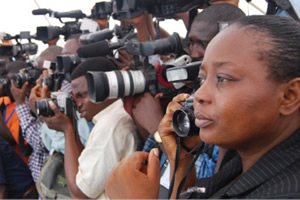
often disappear from the newsrooms and settle for jobs in the public relations sector and non-governmental organisations, indeed a worrying trend.
While South Africa has more newsrooms that are bigger and more staffed than Zimbabwe, female journalists in that country continue to struggle to break into the glass ceiling and this is a matter of concern to many of them. This has been attributed to African males’ opinion on female journalists who they view as weaker and cannot be trusted to make clear and effective decisions or bring out the story behind the story, especially when it comes to political and business reporting.
Some men still believe that women are weak and cannot balance between breastfeeding and breaking news, often assigning them to softer beats. A group of 15 Zimbabwe young female journalists learnt during a tour of South African newsrooms that included The Star, Sunday Times, Mail & Guardian, SABC, CNN, AP, e-TV, Wits Journalism School, 702 Talk Radio, Channel Africa, Fraymedia, and Kaya FM last week, that women still have to fight for recognition in the newsrooms.
WE Public Affairs Section and the Humanitarian Information Facility Centre (HIFC) organised the educational tour. The visit and discussions held with senior journalists and editors of the newspapers, television and radio stations revealed that women share similar challenges when it comes to being recognised in leadership positions and in being assigned to “hard” beats.
Decision-making remains male-dominated despite having strong female presence in the newsrooms.
e-TV senior reporter and morning news anchor Iman Rappetti believes that it has been always challenging being a woman who is socially conscious and an activist.
She said journalists were responsible for shaping opinion, which is a powerful position and it came with an incredible amount of responsibility. Rappetti added that there was need for women to be responsible for the space they worked in, and credibility was the most powerful to develop in any career. She advised women that earning salaries and things that came with doing the job were just accidental. It is about having the heart for humanity not about people calling you an icon.
Making it in the male-dominated field is more about bringing stories in a truthful and credible manner at all times. She said if women wanted to make it in the newsroom, they have to know how to shape ideas and bring out developments in the country in terms of service delivery and make those responsible answerable.
She said she has worked hard to be where she was and had overcome many obstacles. She said there was an element of fear, but women should overcome it.
“I went to a Press conference in 2007 planning to ask the president a question and I did not realise that this was going to be the biggest highlight of my journalism career. I sneaked into the venue with my cameraman, I did not know what I was going to do but walked straight to the president and asked him a question.
“The bodyguards came, the ministers laughed at me, I was embarrassed, humiliated and felt like an idiot as I was thrown out of the Union Building.
“That story was part of a series of building blocks that led to the arrest of former Interpol chief and national South African police chief Jackie Selebi. It uncovered a whole lot of criminal activity in the underworld in South Africa,” she said.
Rappetti advised women that they could not be a shrinking violet in the media profession. Women cannot look at a crime scene with blood and react as their hair is on fire. The best, she said, was to get out of the way and let a story reveal itself. A female SABC senior political reporter said it has been difficult for women to crack the space dominated by male journalists. She said women should know where to draw the line when it came to socialising with contacts as some, especially those in powerful positions and in the political spheres, may want to harass females both sexually and verbally.
702 Talk radio is an example of where gender balance at staff and leadership positions exists.
The Star newspaper has three women at executive editorship positions and a female news editor.
The majority of the staff are women but their numbers dwindle at management level. Women are more visible in magazines but limited in the mainstream media.


 Online Reporter