admin
admin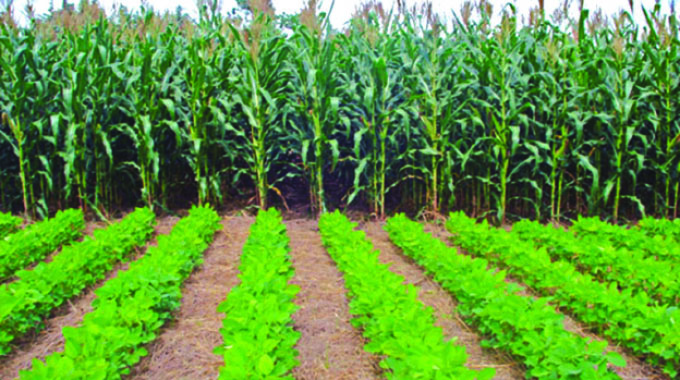
Since the advent of the Second Republic, President Mnangagwa’s Government has implemented a number of interventions to transform the country’s agriculture sector.
The Herald has been serialising the Agriculture, Food Systems and Rural Transformation Strategy -2023-2025 every Thursday for the benefit of our readers.
(Continued from last week)
Transient urban cultivation
The ZIMVAC 2023 report indicates urban food insecurity to be at 29 percent and is envisaged to increase.
The Government will, therefore, from the 2023/2024 season onwards, provide Pfumvudza/Intwasa inputs to all urban households for transient urban cultivation, being one Pfumvudza/Intwasa plot worth of inputs for each of the 500 000 beneficiaries.
The productive social investment scheme should provide food security for 1,5 million people in urban areas.
Agro-biodiversity and nature-based agriculture production
Agrobiodiversity has been recognised in Zimbabwe as a valuable resource for food security, nutrition, livelihoods, and climate change adaptation.
Land degradation, deforestation, commercialisation of seed system and climate change threaten agro-biodiversity preservation.
Conservation and sustainable land, crops, livestock and fisheries use strategies that include genetic resource conservation, farmer-led initiatives, climate smart initiatives, in a favourable policy environment, the nation can safeguard its tangible and intangible agrobiodiversity.
Coordination
The transformation of the agriculture sector requires a whole of sector-multi-stakeholder coordination mechanism supported by a “whole-of-government” system.
In this regard, some 20 Working Groups among them are youth, women, cotton, tobacco, industrial crops, tuber crops, farmer’s union, irrigation, horticulture, mechanisation, livestock, sugarcane, fisheries, dairy, agriculture policy, WASH, research and winter and summer crops) were established to provide participatory and inclusive agriculture sector planning, implementation, monitoring and evaluation mechanisms for transformation of agriculture at both space and scale.
These working groups have been invaluable in shaping the Agriculture, Food Systems and Rural Transformation Strategy.
Sector mandate, vision, mission, values and strategic objectives sector mandate
To transform and sustain a viable agricultural sector for national food security, food sovereignty and economic development.
Vision 2030
A prosperous and empowered upper middle-income society by 2030
Sector Vision
A prosperous, inclusive, diverse, sustainable and competitive agricultural sector by 2030.
Sector Mission
To develop a diverse, robust, and sustainable agriculture sector to ensure national food and nutrition security while contributing to improved economic development for the attainment of Vision 2030.
Sector Values
Innovative: Continuous creativity-led and creativity-driven improvement, from ideation to cost-efficient implementation of programmes and projects;
Collaborative: Promoting inclusive stakeholder cooperation to facilitate increased production and productivity;
Reliable: Nurturing a culture of trust dependability and predictability for accelerated transformation of the agriculture sector.
Sector Strategic Objectives
The strategy is anchored on the following broad objectives to be achieved by 2025:
To increase crop, livestock and fisheries production and productivity for national food and nutrition security, and for food sovereignty and build a US$13,75 billion agriculture sector;
To improve livelihoods for accelerated rural agro-centred development.
To build a, modern, technology-driven, diverse, resilient, inclusive and climate-smart agriculture sector;
To broaden and diversify agricultural markets and trade;
To enhance value addition and beneficiation of agricultural produce through aggregation and agro industrialisation;
To catalyse public and private sector reform and mobilise investments for accelerated agricultural development.
Objective 1:
To increase crop, livestock and fisheries production and productivity for national food and nutrition security, and for food sovereignty and build a US$13,75 billion agriculture sector by 2025;
To increase maize production from 2,2 million tonnes in 2023 to 2,8 million tonnes against an annual requirement of 2,2 million tonnes, and increase yield from 1.14 tonnes/ha to 1.5 tonnes/ha.
To increase traditional grains production from 280 956 tonnes in 2023 to 350 000 tonnes against an annual national requirement of 550 000 tonnes and increase yield levels of sorghum from 0.6 tonnes/ha to 0.8 tonnes/ha, and pearl millet from 0,38 tonnes/ha to 0,6 tonnes/ha.
To increase wheat production from 375 131 tonnes in 2023 to 500 000 tonnes against an annual national requirement of 360 000, and increase yield levels from 4,8 tonnes/ha to 5,5 tonnes/ha.
To increase citrus production from 250 000 tonnes to 300 000 tonnes annually.
To increase floriculture production from 4 million tonnes to 4,1 million tonnes annually.
To increase sunflower seed production from 260 tonnes to 1 000 tonnes annually.
To increase traditional grains seed production from 5 557 tonnes and 7 000 tonnes for sorghum from 1 100 tonnes to 3 000 tonnes for millets.
To increase seed production of all crops annually.
To increase sunflower production to 150 000 tonnes annually.
To increase cotton production to 300 000 tonnes annually.
To increase sugarcane production from 6,1 million tonnes to 6,2 million tonnes.
To increase tobacco production from 296 million kg to 300 million kg.
Increase national cattle herd from 5,6 million cattle to 6 million cattle.
Increase broiler production from 191 813 tonnes to 220 000 tonnes against an annual national requirement of 226 000 tonnes.
Increase milk production from 91 million litres to 120 million litres against an annual national requirement of 130 million litres.
Increase fish production from 26 231 tonnes to 35 697 tonnes against an annual national requirement of 60 000 tonnes.
Increase crocodile production from 65 530 skins to 100 000 skins.
Increase egg production from 80 million dozens to 100 million dozens against an annual national requirement of 125 million dozen.
Increase sheep production from 750 000 in to 1 million sheep.
To reduce Tsetse infestation from 20 000 square km to 17 900 square km.
Promote local production of top dressing fertiliser from 90 000 tonnes in 2023 to 210 000 tonnes against a national requirement of 350 000 tonnes and Basal fertiliser to 400 000 tonnes annually from 150 000 tonnes.
To increase the proportion of households with acceptable food consumption score from 35 percent in 2022 to 75 percent.
Increase household access of clean and safe water supply from 78,2 percent to 90 percent.
Increase household access to safe rural sanitation from 61 percent to 70 percent.
Increase development of multi-stress tolerant and yielding crops, livestock and fisheries by 20 percent.
To expand national strategic grain storage from 750 000 tonnes to 1 250 000 tonnes.
To build a US$ 13,75 billion sector.
To be continued …



 Online Reporter