Online Reporter
Patrick Chitumba, Midlands Bureau Chief
ZIMBABWE is poised to become a regional agricultural industrial hub anchored on robust food production, efficient logistics, and enhanced marketing, which will yield earnings of up to US$15 billion per year by 2030, Dr Anxious Masuka, the Minister of Lands, Agriculture, Water, Fisheries, and Rural Development, has said.
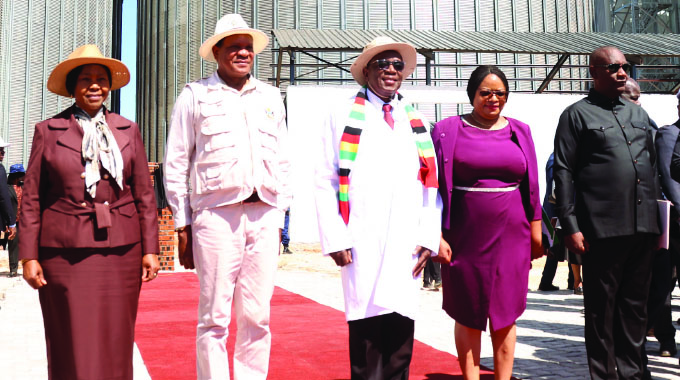
He was speaking during the commissioning of the newly constructed Artificial Intelligence-powered Grain Marketing Board (GMB) silos in Kwekwe, where President Mnangagwa officiated yesterday.
The 56 000-tonne storage facility, featuring seven cutting-edge silos, is now functional after it received its first grain delivery on Sunday.
“Zimbabwe is setting a course to becoming a regional agricultural industrial hub anchored on robust production, efficient logistics and enhanced marketing and modern and state-of-the-art facilities,” said Dr Masuka.
“Our mandate has been clearly laid out by you, Your Excellency, the first one being assuring the nation of food security going towards food sovereignty, contributing to peace and security, livelihood improvement, contributing to economic development. We are making progress on all fronts.”
Growing from an agricultural gross value of about US$5 billion in 2020, the minister said the country set a target of US$8 billion by 2025, which has long been surpassed, and now the country is aiming to make it a US$15,8 billion sector by 2030.
Dr Masuka said President Mnangagwa came up with several programmes in the agriculture sector to end food insecurities in the country.
“You wanted an assurance that Zimbabwe will become perennially food secure. Last year, when we experienced the worst drought, the results of your leadership emerged, and there was food throughout the country. You distributed historically 328 000 tonnes,” he said.
“You also, through your visionary leadership, Your Excellency, directed that we put together a strategic plan to assure this nation of at least three years’ supply of grain and to do so, we calculated and saw that we require 1,5 million tonnes of physical storage before 2030,” said Dr Masuka.

He said the commissioning of Kwekwe silos comes at a time when there are many success stories recorded in and broken in the agriculture sector.
For example, Dr Masuka said the country witnessed a record tobacco crop in the 2022/23 season, where 296 million kgs were produced, becoming the highest ever following the success of the land reform programme.
“In 2021/22, we achieved a maize harvest of 2,7 million tonnes, which was the second highest ever in the history of the country. This season, because we have said we want agro-tailoring, to make sure that what is grown in a region is tailored for that region and not necessarily what the farmer wants,” he said.
“This year, we anticipate 436 000 tonnes of sorghum will be produced, which will be the highest ever in the history of the country. We also have a record Blueberry volume in Zimbabwe.
“Our wheat exploits are now known throughout the continent. Last year, we attained 562 000 tonnes. Zimbabwe and Ethiopia are the only two countries that are self-sufficient in Africa,” he said.
Dr Masuka said the country last year achieved the highest goat population of 5,2 million through the Goat Presidential scheme.

This year, he indicated that the country will produce 130 million litres of milk, double what was produced back in 2017.
“This year, we will achieve milk self-sufficiency. The area under irrigation was 175 000 ha; we are now well past 220 000 ha, and we are on course to achieve over 496 000 ha to assure the nation that we have irrigable land under irrigation,” said the minister.
“We now have 15 000 tractors from about 7 000 in 2017. This is a testament to visionary leadership under President Mnangagwa. This sector is very grateful. According to livestock and fisheries reports, this year’s maize production is estimated at 2,2 million tonnes.
“We will also have 634 000 tonnes produced under the traditional grains, cumulatively 29 million tonnes of cereal,” said Dr Masuka.
Addressing the same ceremony, Minister of State for Midlands Provincial Affairs and Devolution, Cde Owen Ncube, said the commissioning event underscores the Second Republic’s commitment to deliver tangible, signature national development milestones despite the negative impact of global shocks, natural disasters, and the illegal economic sanctions imposed on Zimbabwe by Western powers.
“These GMB silos bear testimony to the commitment by the New Dispensation to ensure quality, affordable, and accessible services closer to the people for their convenience,” he said.
“As in the past, our committed, hardworking, loyal, and patriotic farmers used to transport their grain at high costs to Chegutu and Chinhoyi depots for storage.”
Minister Ncube said the investment bolsters the provincial economy in line with the devolution and decentralisation agenda, which has transformed subnational community livelihoods and economic landscape.
“The grain silos being commissioned today add to a growing inventory of more than 8 000 tangible and impactful milestone programmes and projects implemented by the Second Republic since its inception on November 24, 2017 under the able and visionary leadership of President Mnangagwa.
“We salute you for stabilising the economy and, most importantly, our domestic currency, despite unrelenting subversive machinations by enemies of the state,” he said.