Online Reporter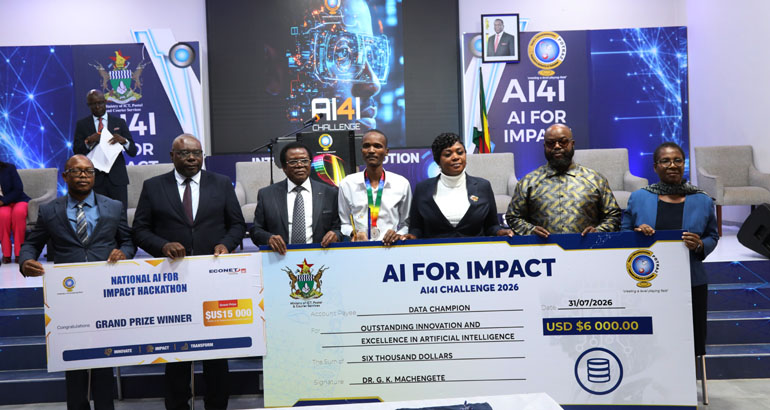
Ray Bande
Senior Reporter
ZIMBABWE is narrowing 60 artificial intelligence experts, selected from 768 applicants nationwide, to 18 finalists as the country shifts AI from academic theory to practical solutions for real estate, business, communication and other key sectors of the economy.
The 60 took part in a Postal and Telecommunications Regulatory Authority of Zimbabwe (POTRAZ) boot camp in Nyanga last week, where they were recognised for projects designed to deliver lasting solutions to everyday community challenges using AI.
Speaking at the closing ceremony, Computer Systems Engineering student at Midlands State University, Mr Nigel Basarokwe, said his team’s project, Inzwi, addresses the lack of voice technology in local languages.
“We are working on a project called Inzwi. Basically the challenge is that if you interact with voice technologies, most of them are mainly based in English. We do not have voice technologies in our own languages, be it Shona or Ndebele. The challenge is that there is no data to train AI models on our languages. For example, if you call the Econet 111 number, you will notice that if you select English as your preferred language, you will be directed to an AI model, and you can ask any question you feel like. But when you select Shona or Ndebele, you will be given prompts.
“Of course, it is Shona or Ndebele, but one would not be exactly interacting with the AI model in that other format. So what we are trying to do with Inzwi is to collect a data set of our own languages in voice note. That means we are giving the general populace in Zimbabwe a prompt. We are giving out a sentence in Shona or Ndebele, and then ask them to read that sentence out loud. That way we are building a data set, a national data set that can be worked on by researchers or engineers in AI systems.”
Mr Munashe Pswatai, who came third in the Data Set Track, said his team developed the Zimbabwe Real Estate Intelligence Data Set.
“This data set will assist by providing intelligence to solve real estate issues. This will help people who want to buy houses, looking for rented accommodation who would have been scammed by fake land barons. We are coming up with a solution to deter this kind of predatory behaviour so that it becomes easy to invest in the Zimbabwe real estate sector,” he said.
Information Communication Technology, Postal and Courier Services Minister, Honourable Tatenda Mavetera said AI must solve citizens’ everyday problems to be relevant.
“We are gathered here in Nyanga for the AI for Impact Challenge, and while that may sound like three or four simple words, they remind us that AI is not an end in itself, but it must go further to touch lives in communities. Until a farmer in Gokwe receives an animal disease alert in real time, a nurse at a clinic in Binga gets diagnostic and treatment support using AI assistive devices, or an informal trader at Mbare Musika gets business loan application details as well as market trends using AI, we have not achieved the real purpose and benefit of AI. That is the impact we expect. Impact does not happen by accident. It requires bold and deliberate steps carefully taken to achieve it.”
POTRAZ Director General, Dr Gift Machengete, outlined the selection process.
“We had a total of 738 individuals who applied for this initiative, ranging from students, innovators, and researchers to software developers and others. Out of this huge number, only 68 projects were selected to take part in the Nyanga Boot Camp. These were drawn from different sectors that include healthcare, agriculture, public service delivery, financial technology among others. The most promising projects selected here will progress to the next stage as we move towards making impact in our communities,” he said.
Minister of State for Manicaland Provincial Affairs and Devolution, Advocate Misheck Mugadza said the province should use AI to market tourism.
“AI can enhance destination marketing. By embracing these new technologies, we can position Manicaland as a smart tourist destination. We must ensure that AI responds to our needs as a community while enhancing our global competitiveness,” he said.
Ends