Online Reporter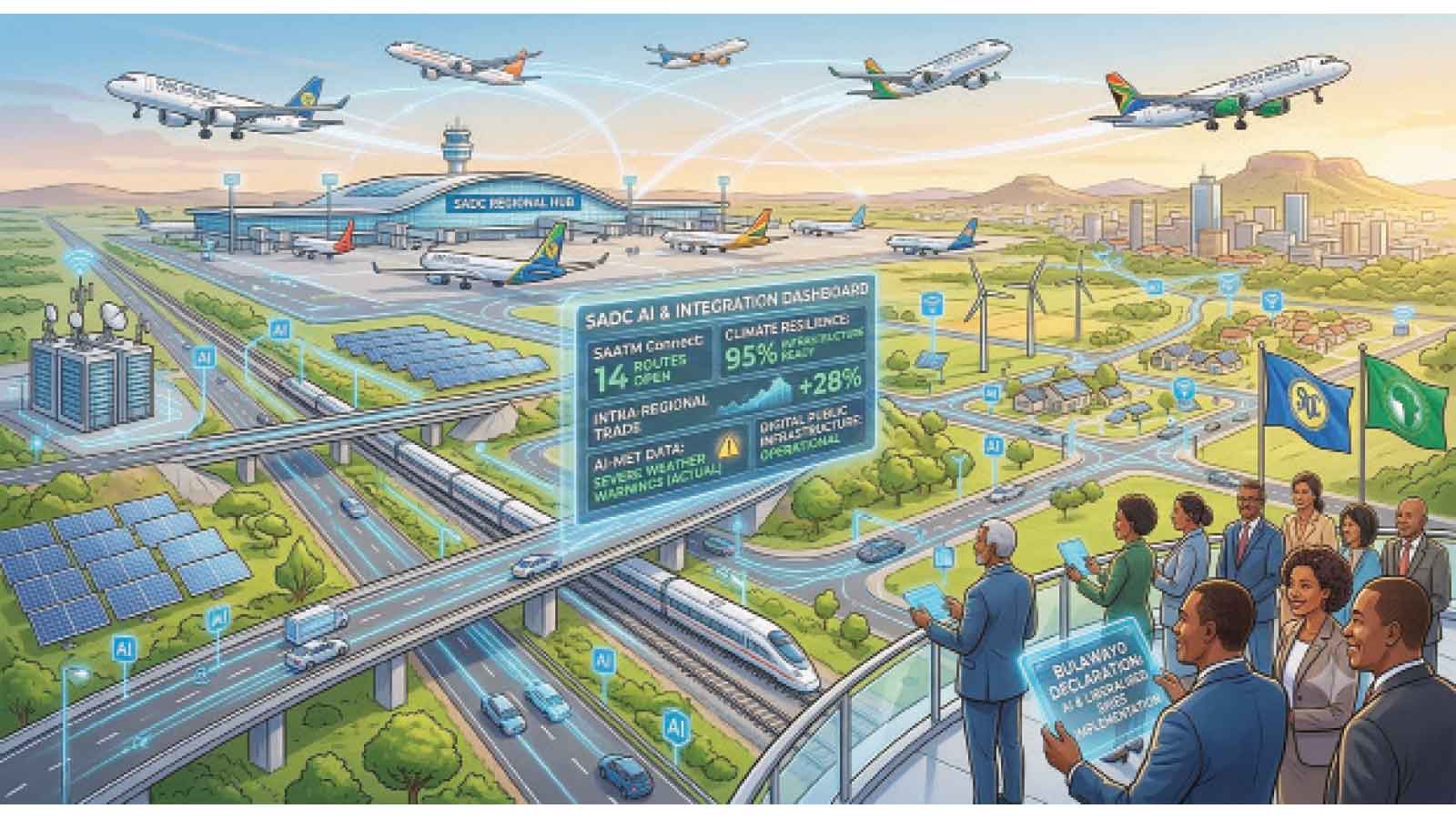
Gibson Mhaka-Zimpapers Politics Hub
Southern Africa is at a defining moment in its regional integration agenda.
For decades, SADC has pursued deeper economic cooperation through improved transport corridors, harmonised trade policies, energy integration and infrastructure development.
While notable progress has been made, barriers such as high transport costs, fragmented digital systems, climate-related disasters and limited air connectivity continue to constrain intra-regional trade and economic growth.
However, deliberations at the Sixth SADC Cluster Meeting of Ministers Responsible for Transport, ICT, Information and Meteorology in Bulawayo last week suggest that the region is now looking beyond conventional approaches to integration. Increasingly, policymakers are placing artificial intelligence, digital transformation, aviation liberalisation and climate resilience at the centre of SADC’s next phase of development.
The meeting, held under the theme “Liberalised Skies and AI-Enabled Climate-Resilient Infrastructure to Accelerate Regional Integration and Sustainable Development in SADC,” reflected growing recognition that the future competitiveness of Southern Africa will depend not only on physical infrastructure, but also on the intelligent use of technology.
Addressing ministers and senior officials, SADC deputy executive secretary for Regional Integration Ms Angele Makombo N’tumba challenged member states to accelerate implementation of the Single African Air Transport Market (SAATM), while embracing artificial intelligence and investing in infrastructure capable of withstanding the increasing impacts of climate change.
Her remarks reflected a broader shift in regional thinking.
Traditionally, transport, aviation, information and communication technologies (ICTs) and meteorology have been treated as separate sectors, each governed by its own institutions and policy frameworks.
Today, however, technological advances and growing climate challenges are making these sectors increasingly interdependent.
Transport systems rely heavily on accurate meteorological information. Aviation depends on advanced communications technology and weather forecasting. Digital infrastructure now supports virtually every aspect of transport planning and logistics, while artificial intelligence offers opportunities to optimise the performance of all these sectors simultaneously.
This convergence is reshaping how governments think about regional integration.
One of the clearest examples is the Single African Air Transport Market.
For many years, African aviation has remained one of the least connected in the world despite growing demand for air travel. Direct flights between neighbouring countries are often limited, forcing passengers to transit through distant hubs, increasing travel costs and reducing business efficiency.
The implementation of SAATM seeks to change this by creating a single liberalised aviation market across Africa. Greater competition among airlines is expected to lower ticket prices, improve connectivity, stimulate tourism and facilitate trade and investment.
For SADC, where regional economic integration remains a strategic priority, improved aviation connectivity could significantly strengthen cross-border commerce, enhance labour mobility and improve the movement of goods and services.
The economic implications extend beyond passenger travel. Efficient air transport facilitates exports of high-value products, strengthens supply chains, supports emergency response capabilities and improves access to international markets.
Improved connectivity also encourages foreign direct investment by reducing the time and cost of doing business across borders.
Yet the discussions in Bulawayo also demonstrated that physical connectivity alone is no longer sufficient.
Artificial intelligence is increasingly emerging as a strategic development tool capable of transforming public administration, infrastructure management and disaster preparedness.
Rather than replacing existing systems, AI has the potential to make them more efficient.
Advanced algorithms can analyse vast amounts of weather data to improve forecasting accuracy, enabling governments to issue earlier warnings ahead of floods, cyclones or droughts.
AI can monitor transport infrastructure in real time, identifying maintenance needs before costly failures occur.
Digital platforms powered by AI can optimise freight movement, reduce congestion and improve the efficiency of logistics networks.
These capabilities are particularly relevant for Southern Africa, where climate change continues to place enormous pressure on infrastructure.
Roads, bridges, railways, airports and communication systems have increasingly become vulnerable to floods, tropical cyclones and prolonged droughts.
Recent disasters across several SADC member states have demonstrated how quickly climate shocks can disrupt transport corridors, interrupt trade and impose significant economic losses.
As climate risks intensify, infrastructure planning can no longer focus solely on construction. It must increasingly incorporate climate risk assessments, early warning systems, robust data management and long-term resilience planning.
This is where meteorological services assume greater strategic importance.
Far from merely producing daily weather forecasts, modern meteorological institutions now play a central role in aviation safety, infrastructure planning, disaster risk reduction and emergency preparedness.
When integrated with satellite observation systems, digital platforms and artificial intelligence, weather intelligence becomes a powerful decision-making tool capable of protecting both lives and investments.
Another important dimension highlighted during the meeting is Digital Public Infrastructure (DPI).
Across the world, governments are increasingly recognising digital identity systems, secure payment platforms and trusted data exchange mechanisms as foundational infrastructure for modern economies.
For SADC, such systems could simplify cross-border trade, strengthen customs administration, facilitate secure digital transactions and improve interoperability among member states.
The benefits extend beyond government administration.
Businesses stand to gain through faster cross-border payments, reduced transaction costs and more efficient movement of goods and services.
Citizens would equally benefit from improved access to public services delivered through integrated digital platforms.
Encouragingly, the region is no longer approaching artificial intelligence as a future aspiration.
The African Union’s adoption of the Continental AI Strategy in July 2024 established a continental framework for responsible AI development.
Building on that momentum, Botswana, Malawi, Mauritius, Mozambique, Namibia, South Africa, Tanzania and Zimbabwe have already undertaken AI Readiness Assessments to evaluate their preparedness for AI deployment and governance.
Several member states are also developing national AI strategies and policies.
At regional level, the SADC Secretariat has begun developing a model AI strategy and regulatory framework designed to promote innovation while ensuring ethical safeguards and protecting citizens from potential misuse of emerging technologies.
This reflects an understanding that technological advancement must be accompanied by effective governance.
Without appropriate regulatory frameworks, AI presents risks relating to privacy, cybersecurity, misinformation and unequal access to technology. Balanced regulation therefore becomes essential in ensuring innovation serves public interest.
Perhaps the most important message emerging from the Bulawayo meeting is that implementation will determine success.
SADC has adopted numerous regional protocols, infrastructure master plans and integration strategies over the years.
While these frameworks have established a solid policy foundation, translating commitments into measurable outcomes has often proved challenging.
Achieving the region’s ambitions will require coordinated action involving governments, regulators, academia, research institutions, development finance institutions, the private sector and international cooperating partners.
No single institution can deliver regional integration on its own.
Strong partnerships, sustained investment and political commitment will be essential.
If SADC succeeds in accelerating implementation of SAATM, embracing responsible artificial intelligence and investing in climate-resilient infrastructure, the region could significantly reduce the cost of doing business, improve trade competitiveness, strengthen disaster preparedness and unlock new opportunities for industrialisation and sustainable economic growth.
The discussions in Bulawayo, therefore, point to more than technological innovation.
They signal a broader evolution in SADC’s development strategy—one in which regional integration is no longer defined only by highways, railways and border posts, but also by digital connectivity, intelligent infrastructure, resilient systems and data-driven governance.
For Southern Africa, that evolution may well determine the pace of its economic transformation in the years ahead.