Online Reporter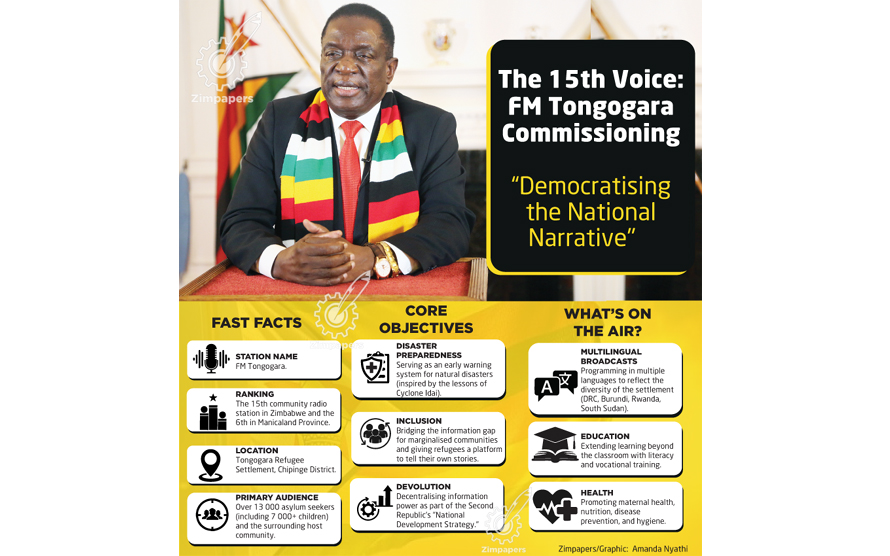
Ray Bande
Senior Reporter
THE Government has officially commissioned FM Tongogara, the country’s 15th community radio station, as part of a broader initiative to expand access to information, strengthen disaster preparedness, improve communication infrastructure, and drive development in Manicaland Province.
As the sixth radio station in the province, FM Tongogara is expected to play a vital role in delivering early warning systems and advancing disaster risk reduction strategies — particularly in light of natural disasters such as Cyclone Idai, which devastated Manicaland in March 2019.
FM Tongogara joins Nyangani FM, Chimanimani FM, Vemuganga FM, and Ndau FM, complementing the province’s flagship commercial broadcaster, Diamond FM, operated by Zimpapers.
This expansion reflects the Second Republic’s commitment, under President Mnangagwa, to devolving information and fostering inclusive national development.
On Monday, the Government handed over broadcasting equipment to FM Tongogara and Ndau FM, both located in Chipinge District.
The handover was officiated by former Information, Publicity and Broadcasting Services Minister, Dr Jenfan Muswere who was represented by his deputy, Honourable Omupilo Marupi.
FM Tongogara is uniquely positioned within the Tongogara Refugee Settlement, which shelters more than 13 000 asylum seekers, including over 7 000 children aged three to 18.
Beyond providing refuge, the settlement offers opportunities and hope for the future.
Its diverse community — comprising people from South Sudan, the Democratic Republic of Congo, Burundi, and Rwanda — is a testament to the trust placed in Zimbabwe’s stability, resilience, and compassion.
The latest establishment, FM Tongogara, a community radio station, is the first of its kind in the region – a dedicated broadcasting platform for a refugee community that acknowledges their unique information needs, cultural contexts, and valuable contributions to the national tapestry.
Through this bold initiative, Government affirms that refugee voices matter, refugee stories are enriching, and refugee rights are human rights, too.
The FM Tongogara will broadcast in multiple languages, ensuring that refugees from diverse background receive critical information about health services, educational opportunities, legal rights, and community events.
Minister Muswere said President Mnangagwa’s Government has prioritised the devolution of information as a key component of the country’s national development strategy.
“Under the visionary and transformative leadership of His Excellency, President Dr Emmerson Dambudzo Mnangagwa, the Second Republic has boldly prioritised the devolution of information as a cornerstone of our national development strategy. This historic commitment has manifested in the unprecedented licensing of 14 community radio stations across Zimbabwe – a revolutionary achievement that has bridged the information gap in previously marginalised areas.
“By strategically devolving broadcasting power to communities, we are dismantling outdated centralised information paradigms and embracing a future where every voice, every language, and every community wields the sovereign power to tell its own story. This is not merely policy – it is the democratisation of our national narrative,” said Minister Muswere.
Minister Muswere underscored the importance of the new radio station in relating educational and health related messages to the refugee community.
“Every child in Tongogara receives education through the Ministry of Primary and Secondary Education’s tireless efforts. Now, with the community radio station, educational programming will extend beyond the classroom, reaching adults and children alike with literacy programmes, health education, and vocational training information. Our commitment to health stands unshaken and resolute. Through the work of our Ministry of Health and Child Care, we demonstrate that in Zimbabwe, human dignity knows no nationality. The community radio stations will amplify vital health messages, providing information about disease prevention, maternal health, nutrition, and available medical services,” said Minister Muswere.
Speaking during the same occasion, UNESCO Assistant Director General – information and communication – Dr Tawfik Jelassi commended Government and its relevant departments in ensuring access to information.
“Allow me to begin by expressing UNESCO’s sincere appreciation to the Government of Zimbabwe, in particular the Ministry of Public Service, Labour and Social Welfare, for its leadership on refugee coordination and social inclusion, and the Ministry of Information, Publicity and Broadcasting Services for its role in shaping the national media environment.
“I also wish to thank the Broadcasting Authority of Zimbabwe, Transmedia Corporation, UNHCR, Tongogara Camp Management, and all partners and colleagues whose collaboration made this initiative possible. We gather today around a simple, but fundamental principle – access to information is a right, not a privilege. Zimbabwe’s Constitution guarantees the right of access to information, a commitment operationalised through the Freedom of Information Act of 2020.
“This legal framework reflects an important national commitment to transparency, accountability, and public participation. Yet, as we know, the effectiveness of access to information is measured not only by laws and policies, but by people’s ability to receive, understand, and use information in their daily lives,” he said.
Speaking during the same function, National Commission for UNESCO Secretary General, Ms Margaret Chirapa, said: “The Government of Zimbabwe attaches great importance to access to information as a constitutional right and as a foundation for participation, accountability, and social cohesion. In complex environments such as refugee settlements, where diversity of language, culture, and experience is high, trusted and community-based communication platforms are not optional, but, they are essential.
“Tongogara Community Radio responds directly to this need. It provides a space where refugees and host communities can access reliable information, express their voices, and engage constructively on issues that affect their daily lives, from health and education to protection, livelihoods, and social cohesion. We also commend the strong role played by national institutions, particularly the Ministry of Information, Publicity and Broadcasting Services, the Ministry of Public Service, Labour and Social Welfare, the Broadcasting Authority of Zimbabwe, and Transmedia Corporation, in ensuring that this initiative is embedded within Zimbabwe’s national media and governance frameworks. This institutional grounding is what will ensure sustainability beyond today’s handover.”