Online Reporter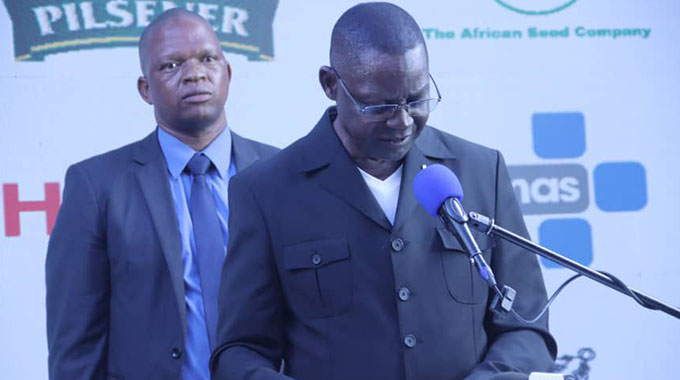
Mthabisi Tshuma, recently in Dombodema
GOVERNMENT is set to list the Amabhiza dance on the Representative List of the Intangible Cultural Heritage of Humanity, a Cabinet Minister has revealed.
Speaking at the official opening of the Awareness Raising Seminar on the Unesco 2003 Intangible Cultural Heritage (ICH) Convention held at Dombodema High School last week, Minister of Sport, Recreation, Arts and Culture, Anselem Sanyatwe, announced that measures were underway to strengthen the documentation of cultural activities across the country.
“To date, Zimbabwe has successfully listed the Mbira/Sansi and the Jerusarema Mbende Dance on the Representative List of the Intangible Cultural Heritage of Humanity. Regarding the Mbira element, we collaborated with our sister country, Malawi, where it is known as Sansi or Kalimba.
“From Matabeleland South Province, we are working towards nominating Amabhiza, and documentation has already commenced. Traditional ceremonies, as well as the knowledge of local medicinal plants and food, are all part of the intangible cultural wealth that must be inventoried.
“These practices are not only a source of pride but also a driver of sustainable development, tourism and community cohesion,” said Minister Sanyatwe.
The Unesco 2003 Convention is a global framework that recognises the importance of traditions, practices, and expressions passed down from generation to generation.
The Dombodema seminar, which ran from Monday to Friday last week, aimed to raise awareness of the Unesco 2003 Convention, targeting officers, traditional leaders and communities. It also sought to build the capacity of cultural officers and communities to apply for international assistance and co-operation in implementing the Convention.
Minister Sanyatwe described the gathering as a milestone in ensuring Zimbabwe’s cultures are safeguarded.
“We have gathered for the sole purpose of awakening our collective consciousness towards the safeguarding of our living heritage – the very soul of our nation. This workshop is not merely a meeting; it is a call to action to ensure our heritage does not become extinct.
“As President Mnangagwa has enunciated, ‘Ilizwe lakhiwa ngabanikazi balo / Nyika inovakwa nevene vayo’. This project is a community-driven initiative, which aims, among other things, to foster dialogue on safeguarding our cultural heritage, with communities at the forefront of preserving their living heritage,” said the Minister.
He applauded stakeholders for their support, revealing that more than US$500 000 has been committed to the two-year project.
“This is a collaborative project between the Government, through the Ministry of Sport, Recreation, Arts and Culture, and UNESCO. It will run from 2025 to 2026. At this point, I would like to thank UNESCO, through the ICH Fund, for releasing US$321 339, while the Government of Zimbabwe has contributed US$240 515.20 towards the project.
“I extend my appreciation to UNESCO and all partners who have made these seminars possible. Your support is invaluable in our mission to protect and celebrate our non-physical heritage,” said Sanyatwe.
Deputy Minister of Information, Communication Technology, Postal and Courier Services, and Bulilima legislator, Dingumuzi Phuti, described Bulilima district as a living museum of the nation’s cultural wealth.
“We see this in the wisdom of our traditional leaders, in the rhythms of our traditional music, in the skills of our dances (Amabhiza/iHoso), in our rituals, and in the very languages we speak. This heritage is not frozen in time; it is the living and breathing pulse of our communities.
The UNESCO 2003 Convention recognises that cultural heritage is not only about stone monuments and ancient ruins. It is about the practices, indigenous knowledge systems, and skills that communities embrace as part of their cultural identity.
“It is also about the stories grandmothers tell, the healing methods of our people, and the ceremonies that mark our journey from birth to the afterlife,” said Phuti.
The listing of Amabhiza would make it the third Zimbabwean cultural practice to be recognised on UNESCO’s Representative List of the Intangible Cultural Heritage of Humanity, following the Mbira/Sansi and the Jerusarema Mbende Dance.
— Follow on X: @mthabisi_mthire