

 admin
admin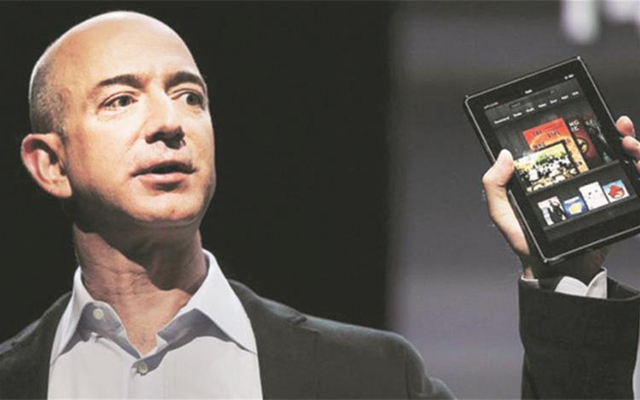
Stanely Mushava Literature Today
Bezos is not content with being a phenomenally successful entrepreneur, even as Forbes ranks him the fourth wealthiest man on the planet. He also wants the prophetic mantle.
“It is not written anywhere that books shall forever be printed on dead trees,” Amazon founder Jeff Bezos said in defence of his digital disruption of the book industry.
With traditional publishers jittery following Amazon’s unilateral markdown of bestsellers and new releases on its Kindle Store, Bezos was on a media tour to preach the virtues of the revolution.
In hindsight, the digital revolution meant greater access to a varied selection for readers but publishers were being written off by this e-commerce behemoth.
They were ceding their entitlement to their content to a ruthless new player, quite the opposite for consumers who were being wired to Amazon’s potentially infinite shelf space.
Depending on which constituency one judges from, Jeff Bezos is a mercenary in a winner-take-all era or a democratising innovator.
Amazon’s Janus-faced title role in the digital revolution is a recurring interest in Brad Stone’s 2013 biography, “The Everything Store: Jeff Bezos and the Age of Amazon”.
In Internet gold rush of the 1990s, Amazon.com set out as a dark horse, specialising as an online bookstore.
By 2010, it was no longer a modest intermediary between traditional format booksellers and consumers.
It boasted a diversified catalogue beyond books and imperial ambitions to turn the book industry on its head.
To sell evolving generations of the Kindle, an electronic gadget for long-form reading, Amazon had to offer consumers enough digitised books to justify the acquisition.
The e-commerce behemoth cajoled publishers into supplying the content only to turn around and make it clear that it set the terms.
Amazon’s unilateral marking down of Kindle book prices facilitated the digital migration and ushered in a frugal book economy.
Record companies had been sent to the retail dustbin by Steve Jobs’ iTunes. It was publishers’ turn to have their status diminished by another disruptive innovator.
As Jeff Bezos mopped up return on content, not so much by demanding more but by stretching wider, publishers anticipated the worst of times.
“If I could rewrite history I would have said, ‘Thanks so much, I love the idea of the Kindle, but let’s have an agreement that says you will not sell below the cost.’ I feel like I was asleep at the tiller,’” a major publisher told Stone.
“The new low price for top-selling e-books changed everything. It tilted the playing field in the direction of digital, putting additional pressure on physical retailers, threatening independent bookstores, and giving Amazon even more market power,” Stone explains.
“The publishers had seen over many years what Amazon did with this kind of additional leverage. It exacted more concessions and passed the savings on to customers in the form of lower prices and shipping discounts, which helped it amass even greater market share – and more negotiating leverage,” writes Stone.
Publishers and record companies in developing countries are relatively immune to Amazon and Apple’s disruptive penetration.
In a sense, the imperial behemoths have been held back because the plastic infrastructure on which the behemoths ride is not optimally developed.
All the same, these traditional creative industries which made a killing before digitisation are struggling, suggesting that even without the e-commerce disruption, the writing was on the wall for the traditional scheme of this things.
Piracy presents a more debilitating challenge. It looks more gainful for traditional publishers to claim a stake in digitisation than to be written off by the waves of creative destruction. The terms, not the shift, should be the question.
Emerging start-ups in developing countries must customise solutions for local creative industries and claim a joint stake in this digital economy which, for now, is the preserve of pirates.
The impending shutdown of music giant, Gramma Records, after the folding of enterprising ventures such as Baobab Books and the apparent retreat of classic repositories of literature into schools, is the clearest signal so far a dormant digital economy in Zimbabwe.
The ignition of such a digital economy will breathe fresh shelf life to defining Zimbabwean texts which have not become less relevant but only less visible n the lapse of generations.
It will also freshly incentivise contemporary artistes who are losing out to piracy. Thanks to the sparse penetration of the means used by imperial behemoths like Amazon and Apple, customised solutions by young Zimbabwean developers will be better placed to utilise this space.
I came to an interesting observation, while following Amazon current, that definitive cultural innovations require spirit as much as they technology.
This explains why Bezos succeeded with books while Jobs failed, whereas Jobs succeeded with music where Bezos failed.
Jobs had the technology but not the spirit for books. Bezos, in turn, had the technology but not the spirit for music. Each man succeeded where he was more spirited.
“Bezos’s colleagues and friends often attribute Amazon’s tardiness in digital music to Bezos’s lack of interest in music of any kind . . . Steve Jobs, on the other hand, lived and breathed music. He was a notoriously devoted fan of Bob Dylan and the Beatles and had once dated singer Joan Baez,” Stone observes.
“Jobs’s personal interests guided Apple’s strategy. Bezos’s particular passions would have the same defining impact at Amazon. Bezos didn’t just love books – he fully imbibed them, methodically processing each detail,” he writes.
The spirit, not the state-of-the-art passion for culture, more than technological infrastructure, academic precision and business templates, may well be what breathes life into a creative industry.
Bezos is not content with being a phenomenally successful entrepreneur, even as Forbes ranks him the fourth wealthiest man on the planet. He also wants the prophetic mantle.
A black plaque at Amazon proclaims: “There is so much stuff that has yet to be invented. There’s so much new that’s going to happen. People don’t have any idea yet how impactful the Internet is going to be and that this is still Day 1 in such a big way.”
And Day 2 may not be as benign. Technology giants, including Amazon, Google and Facebook, are currently exploiting artificial intelligence and automation in ways that may cost millions of their jobs and maximise return on creative destruction.
Again, developing countries, must customise what reaches their turf, so that it will be socially oriented rather than a case of profit over people.



 Online Reporter