Online Reporter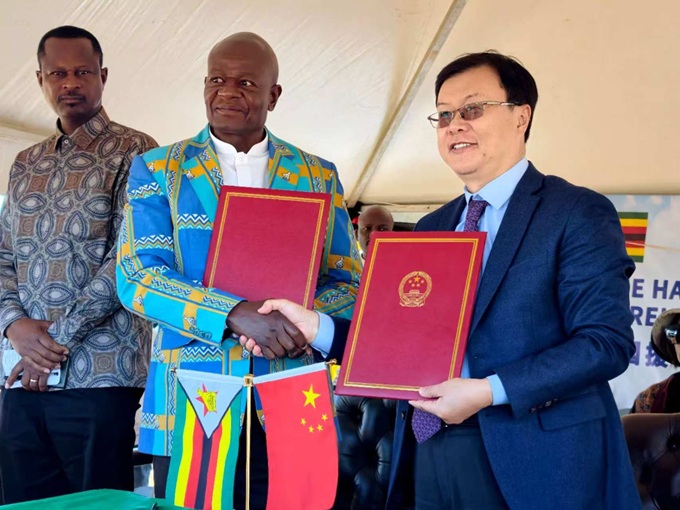
Remarks by H.E. Ambassador Zhou Ding at the Handover Ceremony of the China-Aid 300 Boreholes Drilling Project
It is both an honour and a pleasure to be here today at this Handover Ceremony for the China-aid 300 Boreholes Project. On behalf of the Chinese Government, I wish to extend my warm congratulations to the Government of Zimbabwe and to all the communities benefiting from this initiative. I also want to express my sincere appreciation to the Ministry of Local Government and Public Works, the Manicaland provincial government, as well as the other three provincial authorities, for the strong support and effective coordination.
My heartfelt thanks also go to the engineers and local workers of China Geo-Engineering Corporation, Thanks to your hard work and dedication, this milestone project has been a resounding success.
In less than two years, the project team reached 300 villages across four provinces, amid countless challenges. They sometimes slept in leaky temporary camps or in their vehicles. They fell ill with fevers from tick bites; some worked at borehole-drilling sites for five consecutive days while battling fevers, and sometimes even labored until two or three in the morning.
Working side by side as one united team, Chinese and Zimbabwean staff drove the project to the final completion. For them, the sight of clean, running water and the joyful smiles of the local people made every hardship truly worthwhile.
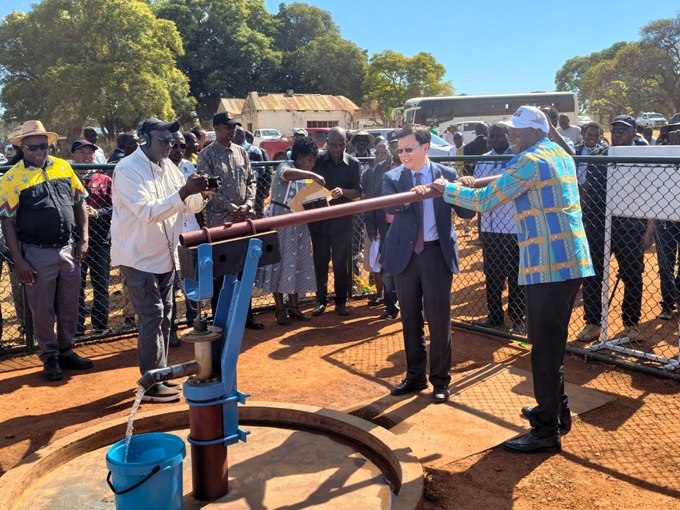
Back in April 2024, severe drought triggered by El Niño prompted His Excellency President E.D. Mnangagwa to declare a national state of disaster across Zimbabwe. As Zimbabwe’s all-weather friend, China swiftly responded to the President’s call by rolling out the 300 Boreholes Project in the drought-stricken areas of Mashonaland East, Manicaland, Masvingo, and Midlands, to help local people cope with the acute water shortages.
Today, this project has brought clean water to more than 75,000 residents across 300 villages, 21 districts, and 4 provinces. These boreholes do not just supply supply safe water for daily use and farming.
They also help reduce waterborne diseases and strengthen agricultural resilience. With reliable water access, crop farming, livestock rearing, poultry raising, and vegetable cultivation have all thrived in the local communities. This project has also empowered tens of thousands of women and children, freeing up their time for schooling and other meaningful works to build better livelihoods.
Ladies and Gentlemen, Friends,
This is by no means China’s first effort to help Zimbabwe drill water boreholes. As a long-standing and trusted friend, China has been engaged in such efforts for decades. Over the past ten years, we have dilled more than 1,300 boreholes across Zimbabwe, delivering clean water and agricultural irrigation to approximately half a million people. This new batch of 300 boreholes stands as yet another testament to the enduring, profound friendship between our two nations — a bond we will always cherish and keep strengthening.
In addition to water projects, China has carried out a wide range of livelihood initiatives that have benefited local communities and improved people’s lives. Let me name just a few examples:
To ease Zimbabwe’s food shortage caused by the El Niño-induced drought in 2024, China has also provided three batches of food assistance, totaling 10,000 tons of wheat and rice. To boost Zimbabwe’s agricultural resilience and support its poverty reduction efforts, We’ve launched the Juncao Technical Assistance Project, which has introduced a fast-growing, high-yielding grass that can be used to cultivate edible mushrooms, produce high-protein animal feed, and help restore the ecological environment in Zimbabwe.
The Chinese agricultural experts team has also set up Agricultural Cooperation Demonstration Villages, offering practical, hands-on training in crop cultivation, vegetable farming, poultry breeding, and irrigation management.
We are also partnering with various UN agencies to advance sustainable soil management and water resource planning in Zimbabwe, lending a helping hand to those in rural communities who have suffered from repeated droughts in recent years. Moreover, we will soon upgrade nine irrigation schemes with Chinese grant funding before the end of this year.
Beyond these people-centered initiatives, our cooperation has also delivered a number of flagship projects that are transforming Zimbabwe’s infrastructure landscape. Together with our robust private-sector investment and thriving bilateral trade, these efforts sustain the livelihood of more than one million people across Zimbabwe.
Dear Friends,
Starting from May 1, 2026, China has implemented its zero-tariff treatment for all products imported from 53 African countries, Zimbabwe included. This policy will substantially expand access for Zimbabwean products to the vast Chinese market, promote local industrial growth, and create more jobs and income opportunities for Zimbabwe.
This is fantastic news for farmers and manufacturers here in Manicaland. Yesterday, I had the pleasure of visiting several orchards. I learned that Manicaland Province, particularly Chimanimani and Chipinge, is a key production base for tobacco and high-value horticultural produce, such as avocados, citrus, and macadamia nuts. China is the largest buyer of Zimbabwean tobacco and macadamia nuts. Last year, nearly half of Zimbabwe’s tobacco output was exported to China, valued at about 800 million U.S. dollars.
We also imported over 5,000 tons of macadamia nuts worth 12 million U.S. dollars. Zimbabwe’s citrus fruits, blueberries, and dried chilies have also gained entry to the Chinese market. Manicaland’s sesame seeds are also expected to be exported to China in the near future. China’s vast market is bringing greater income prospects for farmers in Manicaland and across Zimbabwe.
Ladies and Gentlemen, Friends,
China and Zimbabwe enjoy a time-honored friendship. Going forward, China will continue to stand firmly with Zimbabwe as you implement the National Development Strategy 2 (NDS2) and work toward Vision 2030.
I look forward to working with our Zimbabwean friends to translate the shared vision of our leaders into more concrete achievements on the ground and to jointly build an all-weather China-Zimbabwe community with a shared future.
Once again, congratulations on the successful completion of the 300 Boreholes Project. May these water boreholes keep bringing clean water, good health, hope, and lasting prosperity to local communities for generations to come.
Thank you (Tatenda).


 Bongani Ndlovu