


 Online Reporter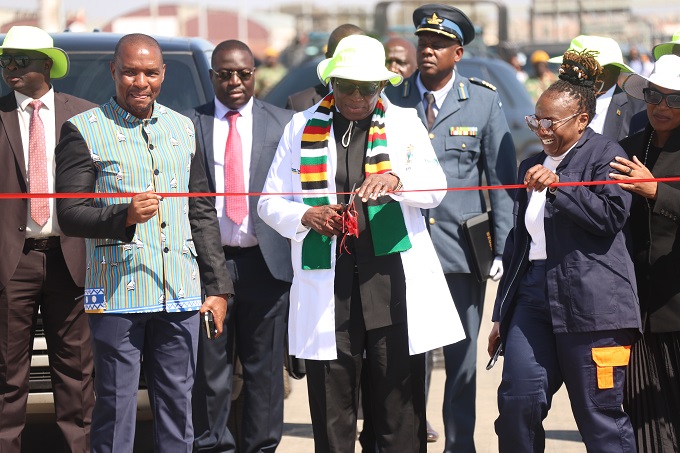
Debra Matabvu
IN September 2022, construction of what would become Zimbabwe’s largest traffic interchange began.
The project was designed not only to streamline local traffic in western Harare but also to serve as a vital link along the North-South Corridor that connects the Southern African Development Community (SADC) to the rest of the African continent.
Almost three years later, that vision has come to pass.
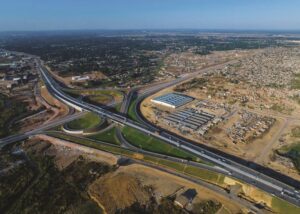
On Friday, President Mnangagwa officially commissioned the Trabablas Interchange, located at the confluence of Simon Mazorodze, Chitungwiza and High Glen roads.
Speaking at the ceremony, President Mnangagwa reaffirmed the Government’s commitment to upgrading national infrastructure.
“One project under this strategy was the construction of this state-of-the-art interchange,” he said.
“With its completion, we expect a transformation in the way we travel, a reduction in congestion and improved connectivity with regards to local transport but also along the North-South Corridor.”
History
The site where the Trabablas Interchange now stands was once home to the Mbudzi Roundabout, constructed in 1998 at a cost of ZWL$4,5 million.
Its original purpose was to reduce the high number of accidents occurring at the junction.
However, as the city’s vehicle population grew, so, too, did traffic congestion and road accidents.
At times, traffic jams at the roundabout would last up to three hours.
A Harare City Council study had shown that between 1992 and 1998, the intersection had recorded 132 accidents, claiming numerous lives.
In April 2022, an emergency crew responding to a road accident near the Watyoka turn-off on the Harare-Masvingo highway struggled to get through the Mbudzi Roundabout due to gridlock, prompting the City Council to enlist the services of the police and local radio stations to help clear the way.
Urban planning expert Dr Percy Toriro said the Mbudzi Roundabout had become an albatross on the country’s developmental aspirations.
“The Mbudzi Roundabout had become a huge bottleneck on a junction with important local, intercity and international significance,” Dr Toriro said.
“It was no longer just inconvenient and hazardous, but was costing individuals, businesses and the country in extra fuel consumption and lost time.
“The upgrade of the junction . . . solves all the old problems.”
A new lease on life
The US$88 million Trabablas Interchange is now set to become a critical component of Zimbabwe’s drive to attain an upper middle-income economy by 2030. It forms part of the broader rehabilitation and reconstruction of the Beitbridge-Harare-Chirundu highway.
To date, around 500 kilometres of the Harare-Beitbridge road has been reconstructed, while work on the Harare-Chirundu stretch is expected to commence later this year.
The interchange consists of 15 bridges — 13 within the interchange itself and two along Amalinda Road and Harare Drive.
Some bridges reach heights of 18 metres and have been strategically positioned to streamline traffic flow from and to Harare, Masvingo, Chitungwiza and the southern suburbs, including Glen Norah and Glen View.
At the height of its construction, the Trabablas Interchange project employed over 2 000 workers.
As the project progressed towards completion, the workforce gradually dropped to around 1 500.
President Mnangagwa said the project had not only created employment but also stimulated growth in downstream industries.
“Beyond its economic value, this project has created jobs and empowered local contractors while also showcasing Zimbabwe’s engineering prowess,” said the President.
“Over 2 000 workers, including the youth and women, were directly employed on this project.
“Further, the ripple effects on downstream industries were also noteworthy, with most of the materials used being sourced and manufactured locally.
“The hard work, professional flexibility, focus and unity of purpose have laid a strong foundation for future projects.”
By easing congestion and reducing turnaround times, the Trabablas Interchange is set to be a game-changer.
Success of the project has also spurred plans for similar interchanges across Harare.
Two more interchanges are set to be constructed at the intersection of Simon Mazorodze Road and Willowvale Road, as well as at the junction of Simon Mazorodze Road and Remembrance Drive.
Experts contend that these locations are critical because they lie along major industrial and commercial routes.
Heavy-duty vehicles transporting goods from the city’s industrial zones frequently use these roads, and the current traffic conditions often result in long delays and logistical bottlenecks.
The new interchanges are expected to improve the movement of goods, reduce delivery times and boost industrial productivity. In addition, four further interchanges are planned in Harare, including one at Mabvuku Junction and another at the busy intersection of Harare Drive and Mutare Road.
The Mabvuku area is a growing residential zone, and the planned interchange will ease congestion during peak hours, improving daily commutes for thousands of residents.
Meanwhile, Harare Drive and Mutare Road form part of a strategic corridor that connects the city to eastern Zimbabwe and the Mozambican port of Beira.
A modern interchange at this junction will significantly improve regional trade logistics by allowing uninterrupted flow of traffic, especially for freight transport.
Local is lekker
Notably, construction of the Trabablas Interchange was carried out using local resources, expertise and contractors — a major milestone in Zimbabwe’s infrastructure development journey.
The project was undertaken by a consortium of three local contractors — Tensor Systems, Fossil Contracting and Masimba Construction — operating under the Tefoma Construction joint venture.
Development of the mega project demonstrated that local engineers, technicians and construction firms’ growing capacity to undertake large-scale, complex civil engineering works without relying on foreign contractors.
This approach not only reduced costs and turnaround time but also empowered local professionals and created employment opportunities for Zimbabweans.
Dr Toriro applauded the use of local contractors in the construction of the interchange.
“It is also significant that local consultants and contractors did the work,” he said.
“Moving forward, the experience gained should build momentum that should lead to faster and more efficient development of similar infrastructure.”
However, development of the project was not without challenges.
One of the major delays stemmed from prolonged negotiations with property owners who needed to be compensated and relocated before full-scale construction could proceed.
Engineers also had to contend with complex ground conditions, as the interchange is situated on wetlands formed by the Mukuvisi River and its tributaries.
This required innovative engineering solutions to ensure stability and durability.
Despite these hurdles, the project yielded lasting benefits beyond the road itself.
Companies contracted for the project were able to invest in and acquire heavy-duty capital equipment, positioning them to take on even larger infrastructure projects in the future and strengthening local capacity in the construction sector.
Harare Residents Trust (HRT) director Mr Precious Shumba welcomed the new interchange but called for complementary improvements in residential areas.
“What remains is the rehabilitation of suburban roads and streets to improve vehicle movement across the length and breadth of the Harare Metropolitan province,” he said.
Major interchange projects on cards
Simon Mazorodze Road/Willowvale Road
Simon Mazorodze Road/Remembrance Drive
Mabvuku Junction
Harare Drive/Mutare Road
Liberation Legacy Way/Harare Drive
Liberation Legacy Way/Churchill Road
Nemakonde Way/Harare Drive
Sam Nujoma/Harare Drive
Westgate Traffic Circle
Kuwadzana Traffic Circle



 Online Reporter