Chronicle Editor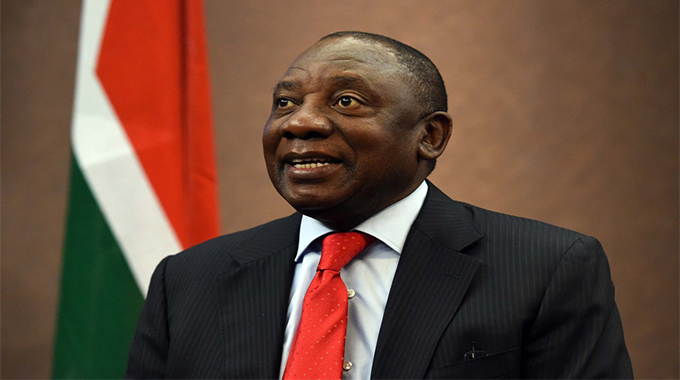
Ranga Mataire,Group Political Editor
THIS Monday, South Africans are casting votes to elect a new government, in an election in which the West (United States) has been accused of meddling in the process to influence the outcome.
Barely two weeks ago, a report emerged of the underhand intelligence gatherings that were being conducted by the United States to gauge the strengths and dynamics within the governing ANC party.
The South African Supreme Court overturned an earlier judgment by the High Court to bar Independent Media from publishing a report dated November 5, 2020, titled “Top Secret; US interests in party dynamics” commissioned by the United States intelligence operating at the country’s offices in Pretoria.
The report revealed that the US National Security Strategy mandated the US intelligence formations to identify and assess capabilities, activities, and intentions of state and non-state entities to develop a deep understanding of the strategic environment and to warn of future developments.
“The Political Office of the US Embassy in Tshwane continues to gather information related to the ruling party, which is then sent to the US State Department. This brief confirms that the US Embassy is party of the US intelligence community, and has a network of ANC party officials who, wittingly or unwittingly, share privileged information,” read the intelligence report.
While it is given that countries gather intelligence information about each other, what is peculiar about the US activities in South Africa is their timing ahead of elections.
Of interest to the South African government and political observers in the region is the sudden upsurge in anti-ANC propaganda from the US following its International Court of Justice (ICJ) court case against Israel.
During the ICJ court proceedings, the United States criticised South Africa for bringing a genocide case against Israel before the UN’s top court, with the White House National Security Council spokesperson, John Kirby saying the submission was “meritless, counterproductive and completely without any basis whatsoever.”
But even before the ICJ court case, relations between the US relations South Africa had already soured over Pretoria’s refusal to join Western pressure on Russia over its invasion of Ukraine. US ambassador to South Africa, publicly accused South Africa last year of sending a shipload of weapons to Russia, claims that the State Department backtracked on.
Earlier in January, President Cyril Ramaphosa warned ANC members of a looming fightback both internationally and domestically over South Africa’s case against Israel at the ICJ.
President Ramaphosa said South Africa should brace for a “systematic fightback campaign” that “may focus on our domestic politics and our electoral outcomes to pursue regime change agenda.”
Barely weeks after President Ramaphosa issued the warning, the opposition Democratic Alliance appealed for US observers to monitor South Africa’s elections. The ANC government through Foreign Minister Naledi Pandor scoffed at the appeal describing it as “astound” and an attempt to “mortgage” the nation to foreign powers.
Minister Pandor said South Africa has always invited observers who wish to observe the elections. She told journalists that regional organisations and even the United Nations have always monitored the elections at the invitation of South Africa.
As voting begins on Monday, it’s clear the US is itching for a weakening of ANC. It is beyond coincidence that the very nation that continues to arm Israel in pursuit of a genocidal agenda and blocks pleas for a ceasefire at the United Nations Security Council is being called upon by the opposition to oversee South African elections.
ICJ lawsuit by South Africa was a huge moral victory for all people striving for a fair global status just like Zimbabwe’s revolutionary land reform exercise. Both actions by South Africa and Zimbabwe had the effect of exposing the obduracy of the US’s lack of adherence to principles of international fair play and democracy.
Gone are the days when the future of Africa used to be decided in Paris, Washington, Berlin or Tokyo. Just like in Zimbabwe, the machinations to effect a regime change in South Africa will not succeed. The majority of people still have confidence in the governing ANC. Africa is re-awakening and African leaders won’t be easily cajoled to abdicate their responsibility of safeguarding their people’s interests. It is highly unlikely that a region born out of liberation struggles will at any time accede power to individuals kowtowing to foreign interests.
At least 70 political parties are taking part in the 7th democratic elections since the end of apartheid. The number of political parties contesting is a reflection of the deepening and strengthening of democracy in a country long held back by a racist apartheid system.
According to the Electoral Commission of South Africa (IEC), Gauteng and KwaZulu-Natal jointly account for 44 percent of the country’s nearly 28 million registered voters. Gauteng has 6.5 million voters and KwaZulu-Natal has 5,7 million voters. Eastern Cape comes third with 3,4 million voters. These are the three key battleground provinces for any serious party that wants to assume the leadership of South Africa.
South Africa’s Chief Elections officer, Sy Mamabolo on Friday told journalists that the certified voters’ roll stood at 27,7 million voters. He said South Africa has not seen this level of registration since the voters’ roll was first established in 1999.
Mamabolo said according to historical trends, there are more female voters than men — 15,3 million for the former and 12,4 million for the latter. He said indications were that 70 political parties have succeeded in submitting nominations. Fifteen political parties are contesting all tiers of the elections and in total over 14 903 candidates are vying for 887 seats in the National Assembly and Provincial legislatures.
South Africa is a unitary parliamentary democratic republic. The President serves both as Head of State and Head of Government. The President is elected by the National Assembly (the lower house of South African Parliament) and must retain the confidence of the Assembly to remain in office. South Africans also elect provincial legislatures, which govern each of the country’s nine provinces.


 Online Reporter