

 Online Reporter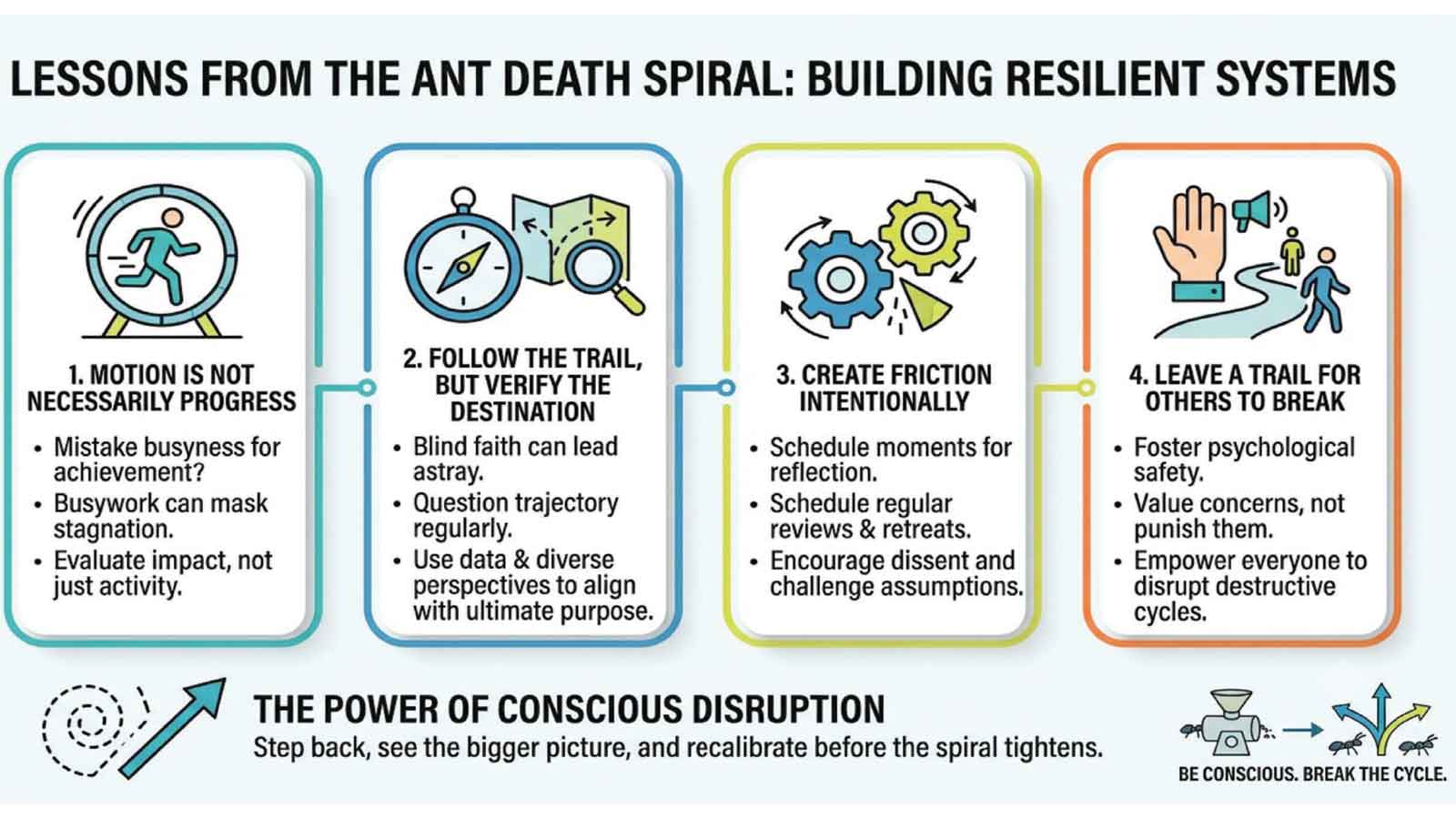
Arthur Marara
Point Blank
The ant death spiral serves as a powerful and sobering reminder: even the most intelligent and seemingly resilient systems—be they ant colonies or human organisations—are vulnerable to failure when feedback loops are left unchecked.
It exposes a fundamental truth: without conscious intervention, systems can spiral into chaos, exhaustion, and ultimately collapse, no matter how well-designed they appear.
Yet, within this stark lesson lies a beacon of hope. By understanding these patterns, we can develop strategies to recognize, disrupt, and ultimately transcend destructive cycles—turning potential failures into opportunities for renewal and growth.
Key Lessons to Embrace: Motion is Not Necessarily Progress
It’s easy to mistake busyness for achievement. A thriving team with endless meetings, expanding projects, and rising metrics might seem successful—yet sometimes, these are signs of aimless activity, not meaningful progress. Busywork can mask stagnation or decline. Ask yourself: What have we truly accomplished? Regularly evaluate whether your actions are moving you closer to your core purpose or simply keeping the wheels turning. Progress is about clarity and impact, not just activity.
Follow the Trail, but Verify the Destination
Trust in your systems, mentors, and past experiences is vital. However, blind faith can lead you astray if the path no longer aligns with your true goals. The terrain may shift, and the original destination might no longer be relevant. Practice: Continually question whether your current trajectory still leads to your desired future. Use data, honest reflection, and diverse perspectives to verify that your efforts are aligned with your ultimate purpose.
Create Friction Intentionally
Disruption isn’t always about chaos; sometimes, it’s about strategic friction. Schedule regular moments for reflection—quarterly reviews, retreats, or dedicated “pause” periods—where the focus is on questioning assumptions and resetting direction. Encourage dissent and challenge the status quo. Cultivate an environment where team members feel safe to speak up, voice concerns, and suggest alternatives. This friction prevents complacency and catalyses innovation.
Leave a Trail for Others to Break.
Leadership is about creating an environment where recognising and escaping spirals is possible. Foster a culture of psychological safety—where raising concerns is welcomed, not punished. Practical: Implement mechanisms like anonymous feedback channels, “red teams,” or open forums for honest dialogue. When organisations and leaders model humility and openness, they empower everyone to identify and disrupt destructive cycles early.
The Power of Conscious Disruption
The goal isn’t to eliminate effort or progress but to ensure that our momentum is sustainable and aligned with our values and purpose. Disruption—when intentional and strategic—is a vital tool. It allows us to step back, see the bigger picture, and recalibrate before the spiral tightens into a destructive vortex.
Remember: every spiral has an end, and every cycle can be broken. The most resilient systems—and the most inspiring leaders—are those who recognise the signs early, create intentional friction, and foster a culture where feedback and dissent are valued.
Ultimately, the lesson from the spiral is this: Stay vigilant. Embrace reflection. Question assumptions. Disrupt when necessary. And lead with courage—knowing that true progress often begins at the edge of chaos.
Conclusion
Watching an ant mill is both mesmerising and unsettling—a stark reminder of how rational behavior, when driven by feedback loops and local interactions, can spiral into collective catastrophe. Hundreds of thousands of ants, each acting instinctively and logically based on their immediate environment, dance in a relentless, self-reinforcing death spiral.
It’s not out of malice, ignorance, or stupidity; rather, it’s the natural outcome of simple rules followed repeatedly, with each individual responding to its local cues. When aggregated, these behaviors create a powerful, destructive momentum that is difficult to halt.
Similarly, in our organisations, communities, and personal lives, we are vulnerable to these self-reinforcing cycles. The most insidious traps are often subtle and deceptively rational. They emerge from countless small decisions—clinging to routines, conforming to norms, chasing after fleeting momentum—that, over time, lead us away from our true purpose or growth. These patterns can lull us into complacency, convincing us that we’re progressing when we are simply caught in a loop.
But here’s the good news: unlike ants, humans possess a remarkable capacity that can break these spirals—an awareness that we are part of a larger system and the ability to step outside of it. We can see the pattern from above, recognise the signs of a spiral forming, and choose to act differently. This awareness is a gift—an opportunity for deliberate intervention, reflection, and recalibration.
All it takes is one moment of friction—a pause, a question, a conscious choice—to disrupt the cycle. It might be a strategic retreat, a difficult conversation, or a simple act of questioning assumptions. These small acts of courage and mindfulness can redirect our path and restore agency over our trajectory.
So, if you find yourself or your organisation walking in circles—repeating the same actions and expecting different results—consider this your “stick in the dirt,” your sign to stop. Look around honestly. Take a step back. And if you see the spiral tightening, summon the courage to step out of line. Break the pattern. Shift the course. Lead yourself and others toward a future shaped not by unconscious repetition, but by conscious choice.
Remember: progress isn’t about relentless motion; it’s about intentional movement, guided by awareness and purpose. The power to change direction lies within your grasp—if you’re willing to see the pattern, embrace the friction, and choose a different path.
Arthur Marara is a corporate law attorney, keynote speaker, peak performance, and corporate strategy speaker. With his delightful humour, raw energy, and wealth of life experiences, he captivates audiences and inspires them to unlock their full potential. Through his engaging talks and workshops, he imparts invaluable insights and practical strategies that empower individuals to lead with confidence and make a lasting impact. Arthur is the author of “Toys for Adults,” a thought-provoking book on entrepreneurship, and “No One is Coming,” a book that seeks to equip leaders to take charge. Send your feedback to bookings@arthurmararaattorneys.
com, visit his website www.arthurmarara.
com, or contact him at +263772467255.



