admin
admin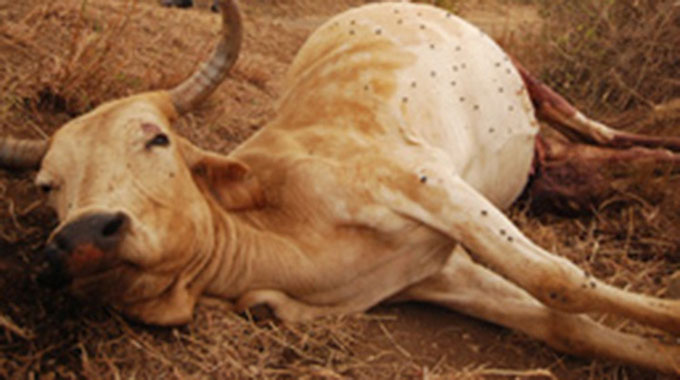
Fildah Gwati Agriculture Correspondent
Thirty-six cattle have died this season due to anthrax in Chipinge, Hurungwe, and Gokwe South and North, Department of Veterinary Services acting chief director Dr Pious Makaya said yesterday.
He added that cases involving 518 people who contracted anthrax were also reported but no reports of deaths have been received.
People in areas where anthrax has been reported remain at risk, and called for urgent vaccination efforts and preventive measures to contain the outbreak.
“There is an outbreak of anthrax in Zambia which originated from the hippos in Kariba and Zambezi basin and the hippos are not only for Zambia as we share wildlife and they are likely to come into Zimbabwe so it’s actually our problem,” said Dr Makaya.
“We have to vaccinate along the interface where livestock, wildlife and humans meet because the anthrax will creep in through the interface as carnivores and scavengers, like lions and hyenas, can eat infected carcases of infected hippos and transmit the disease towards the border of our national parks and the Hwange National Park and that border which borders our national parks and the mainland which our livestock farming takes place is what we call the interface.”
Dr Makaya said there was a rapid spread of the disease, especially during this rainy season, but they have mapped anthrax hotspots and 31 districts in the county for them to control the disease.
“We have to vaccinate districts towards that interface plus the 31 hotspots and at the present moment, Zimbabwe has arranged 436 000 doses of anthrax vaccine which we are already using to vaccinate animals in infected areas.
“And from the 436 000 doses we received from Botswana we are already vaccinating.”
So far, 57 000 cattle have been vaccinated in Gokwe South and more will be vaccinated in other hotspots.
Dr Makaya emphasised the need to increase vaccine quantities, as the available doses only fulfil roughly 21 percent of the country’s requirements. To effectively control the outbreak, an estimated 1,6 million to 2 million doses of anthrax vaccine are required.
Going forward, the Department of Veterinary Services aims to produce its own vaccine in 2024-2025.
Dr Makaya said the people have already been trained to produce the vaccine and they just need pieces of equipment and some specialised equipment to produce the vaccines.
People were advised not to eat meat whose source they do not know.
He also advised farmers to report cattle deaths to the Department of Veterinary Services so that carcasses are burnt and the areas disinfected for the infection not to remain on the ground as it might trigger the spread of the disease.
Individual farmers have been encouraged to buy vaccines, which are available in the market to prevent the death of animals due to anthrax.



 Online Reporter