admin
admin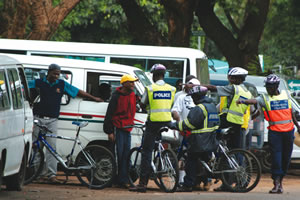
This is yet another commission and as required under GPA but what is important to the ordinary Zimbabwean is the resultant work.
Unless there is tangible work done, the commission will be yet another white elephant.
We just hope it does not take that route.
The commission was set up in 2005 to combat corruption, economic crimes, abuse of power and other improprieties in Zimbabwe through public education, prevention, investigation and prosecution.
It was also okayed in the 2008 Global Political Agreement and was, along the commissions on Human Rights, Media to have new commissioners.
The Commission consists of nine Commissioners who are employed full time and have executive powers.
The chairperson is assisted by a deputy chairperson heads the Commission.
Below the Commissioners is the Secretariat, which consists of three operating arms namely Corruption Prevention and Corporate Governance; Investigation and Prosecution; and lastly Publicity and Education.
The new commissioners, who have the blessings of the parties in the inclusive Government and Parliament, are the chairman Mr Denford Chirindo, Ms Teresa Mugadza, Mr Shephered Gwasira, Dr Elita Sakupwanya, Mr Lakayana Chabaka Keith Dube, Dr Goodwills Shana, Mrs Anna Collettah Chitsike and Mr Emmanuel Chimwanda.
These are men and women of integrity hailing from fields such as law, law enforcement, education right up to the religious realm as represented by Dr Shana.
It is to be expected that these men and women will cleanse the land of the scourge of corruption in Zimbabwe, which they swear to do as required by the Constitution of Zimbabwe.
Now, is it too much to ask that a rural farmer should benefit from a Government programme like Maguta without the farm inputs being siphoned away by some official, senior or petty?
Or that a prospective university graduate gets the place without a kickback; that one gets a passport without the same?
The list of expectations is expansive and extends to weighty scales in politics and economics.
Zimbabwe has been faring badly in terms of dealing with corruption with some international statistics (whatever their demerits) confirming as much.
The Commission states that it is “mandated to deal with economic crimes as prescribed in a number of stipulated Acts.”
“The Acts relate to a wide range of offences such as dealing in precious minerals, dealing in drugs, violation of exchange control regulations, immigration offences and money laundering. Over and above these offences, the Criminal Law Code gives a number of offences as listed below:
l Bribery
l Corruptly using a false document
l Corruptly concealing a transaction from a principal
l Corruptly concealing from a principal a personal interest in a transaction and
l Criminal abuse of duty as a public officer.
Broadly speaking, corruption stalls development in a country as it leads to inefficiencies and incompetencies.
It breeds few fat cats that milk the majority.
Corruption, especially high levels of it, turns off potential investors as they are wary of paying the “extra tax” in kickbacks.
Corruption gnaws at the very fabric of society as the abnormal becomes normal and the normative and morally correct paths are dispensed with.
It breeds anomie.
This is a strong case that the Commission makes good use of its teeth and prosecute offenders.
So far Zimbabwe has seen precious little of these, or have we?
It has been observed that the AntiCorruption Commission has only but netted “small fish”. Where is the big fish?
Many people do not want to see a couple of “big fish” on the hook simply because they are jealous of prominent people in society.
Corruption affects their daily lives.
It taxes their opportunities.
It deletes their chances.
It hits them where it hurts the most and taxes their sleep.
Even when a country is ranged against foreign forces and machinations like the West and its sanctions are to Zimbabwe, one is bound to lose sleep over Maguta inputs that do not reach him because some unscrupulous individuals have helped themselves to that, which should have accrued to the poor, hungry majority.
Evidence, and suspicion, abounds in our localities and workplaces of corrupt activities right down to the police “chefs” in the Benzes that routinely park at the now all too familiar roadblocks.
But corruption, being a broad phenomenon, needs an equally broad approach.
It is prudent that the commission budgeted not only for prosecution but for such aspects as public education and prevention.
Sometimes corruption involves small things that people might not feel constitute crime or corruption.
Would you believe that kombi crews now budget for bribing police officers at the now so frequent roadblocks, and that kombi owners take within their strides the prospect of getting a few dollars lesser each day because his crew would have given money to the police?
Drivers of defective vehicles might pay so that they “save” the time and cost of having the car impounded.
Similarly, a publicdrinking member of the public might find it expedient to pay a police officer a couple of dollars to get off the hook.
There are reports recording residents allegedly paying Zesa or city council officials to expedite reconnections of services.
On the other hand, not many people would consider employing a relative or a friend’s contact an act of corruption.
The list of “harmless” corruption, which many people do not find as reprehensible as the government official involved in a graft scandal.
Simply put, education, and a lot of it, is needed so that people understand what constitutes corruption.
One of the greatest yet simplest lessons people might learn is that corruption involves two people or parties at the very least; namely the one who offers a bribe and the one that takes – whether or not they would have solicited for it.
A corrupt society is a sick society.
It is as sick of its inefficiencies as it is morally and spiritually. This means that the role of religion, hence the inclusion of Dr Shana, is only logical.
At any rate, even in the churches corruption is rife as officials abuse and misappropriate parishioners’ funds. But there are a number of conditions that should make the Commision’s life easy, and easy for everybody.
The body should be fully supported economically (hoping there won’t be misappropriation here as well) so that it can have massive outreach that will bring it out of the anonymity it currently suffers. It should also have the requisite legal structures that make it able to dispense its duties in accordance with the laws of the land.
There should be co-ordination in the various aspects of the work of the Commission as well as it relates to the outside structures.
But the long and short of it is that this Commission should work: it will be corruption of the highest order if they are not to do that which they are appointed to do.
The Commission must do its work without fear or favour. After all, the politicians that usually stand in the way of investigations and prosecution of corruption are the ones that mandated the Commission.
It is only prudent that these politicians be asked to walk the talk.
As important is the need for Government, along its African peers, to divest of the view that corruption is an African problem.
(Of course there is corruption elsewhere, which has tragic consequences, only it is draped in more glorious terms.)
Consider the following passage from a US thinktank, Council on Foreign Relations.
“Africa is widely considered among the world’s most corrupt places,” it states noting corruption is “a factor seen as contributing to the stunted development and impoverishment of many African states.”
“Of the ten countries considered most corrupt in the world, six are in sub Saharan Africa, according to Transparency International, a leading global watchdog on corruption.”


 Online Reporter