Online Reporter
Theseus Mauruki Shambare in MASVINGO
AQUACULTURE is emerging as an important climate-resilience strategy for rural communities as Zimbabwe braces for another potentially difficult agricultural season characterised by El Niño-induced drought, authorities and development partners have said.
Representing Minister of State for Provincial Affairs and Devolution Ezra Chadzamira, Acting Permanent Secretary Rosemary Chingwe said fisheries and aquaculture could help communities maintain food and income sources when traditional rain-fed agriculture comes under pressure from unreliable rainfall.

“With recurring El Niño predictions threatening traditional rain-fed agriculture, fisheries and aquaculture have become critical pillars in our agricultural systems.
“They offer a reliable shield against climate shocks, ensuring food and nutrition security while substantially enhancing household-level incomes,” she said
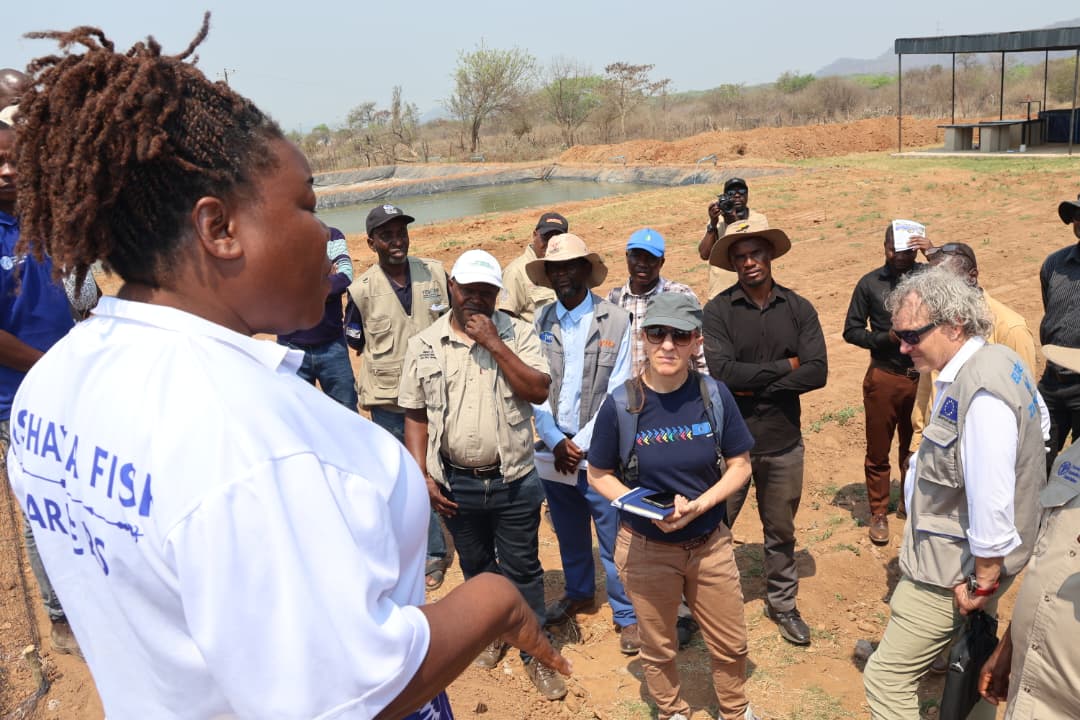
Chingwe was speaking during a project implementation assessment tour by the European Union delegation to provinces where the FISH4ACP programme was rolled out.
The delegation visited the Maponga Fish Hub in Masvingo to assess the implementation and impact of investments made under the programme, which seeks to strengthen Zimbabwe’s aquaculture value chain.
The climate-resilience potential of aquaculture is particularly relevant to drought-prone communities, where crop failures can leave households with reduced food supplies and incomes.
Representing FAO Sub-Regional Coordinator for Southern Africa and Country Representative in Zimbabwe Dr Patrice Talla Takoukam, Assistant Representative-Programmes Tendai Munyokoveri said fish farming offered communities an alternative source of food, income and employment.
“Aquaculture provides households with an alternative source of income when crop production is affected by drought and changing climatic conditions,” she said.
Munyokoveri said livelihood diversification was becoming increasingly important as climate shocks affected agricultural production across Southern Africa.
“By diversifying livelihoods, communities become better equipped to absorb shocks and recover from adverse events,” she said.
She said the FISH4ACP programme had invested in strengthening Zimbabwe’s aquaculture value chain, including improving access to quality fingerlings, production practices, market access and business development.
Representing EU Head of Cooperation Anna Cichocka, Agriculture, Environment, Private Sector and Trade Engineer Martin Andersen said the Maponga hub demonstrated how rural infrastructure could bring essential aquaculture services closer to farmers.
“Farmers can access quality and abundant fingerlings here, they can access feed, equipment and other services without having to travel long distances,” he said.
Andersen said reducing the distance farmers travelled to access inputs could lower production costs and make participation in aquaculture more viable.
Munyokoveri said the investments made through FISH4ACP had created a foundation for continued development of Zimbabwe’s aquaculture sector beyond the programme’s conclusion.
The assessment tour is set to continue in Manicaland Province, where the EU delegation will assess the implementation and impact of FISH4ACP investments and their contribution to improving livelihoods and strengthening the aquaculture value chain.