admin
admin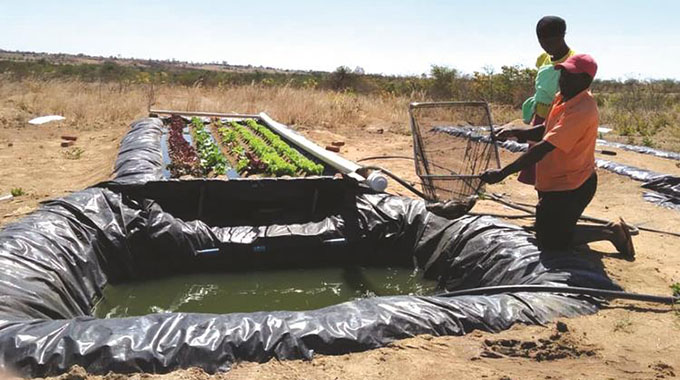
Elita Chikwati Senior Agriculture Reporter
While many aspiring farmers are searching for vast tracts of land to farm, others are making use of limited resources at their disposal to maximise production and increase their income.
A local company based in Chivhu, Sapphire Aqua Tourism Development Trust, has ventured into aquaponics, a system that involves the integration of fish farming and vegetable production.
This emerging technology can be implented by smallholder farmers in both rural and urban areas.
It can also be taken up at a commercial level.
The system does not require much land as 3 by 8 metres can support 150 fish and 125 heads of cabbages.
Sapphire farm manager Mr Killian Ruzande said the project started in 2016 with the setting up of the infrastructure while production began in 2017.
He said he got the knowledge from a fellow farmer in South Africa who was doing fish and vegetable farming using the system.
Agricultural experts describe aquaponics as a closed loop system whereby plants are grown in water which the roots filter down to a pool of fish, whose waste water is then pumped up to the plants as a source of nutrients.
This, they say, can be achieved at small scale, with personal aquaponics kits to supplement an individual’s diet.
There are many advantages of aquaponics over traditional farming methods, including the efficient use of resources, namely water, fertiliser, infrastructure and land.
As it is a closed circuit, aquaponics requires very little water and no plant fertilisers.
One only needs a fish tank, grow bed media and river sand.
Water is pumped into the tank and the waste water from the fish tank used to water vegetables where it is filtered mechanically and goes back to the fish.
The water is recycled.
Through the use of this technology, the farmers are producing vegetables such as lettuce, spinach, cucumbers, tomatoes, beetroot, parsley, coriander, sweet rocker, basil, mint and tilapia fish.
“This knowledge on aquaponics must be shared and spread to rural areas and schools as an empowerment innovative solution,” said Mr Ruzande.
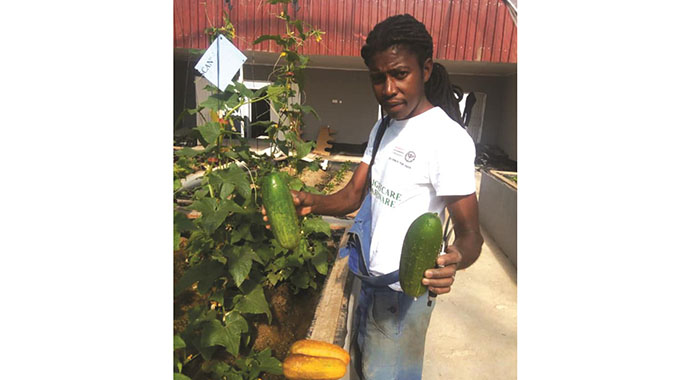
“From this innovation technology, students can learn more about biology, chemistry, maths, engineering and all other scientific aspects to enhance farm productivity.”
This system requires only occasional topping up and is important in areas where rainfall is minimal or unpredictable.
Experts say it is allows much more efficient use of water than traditional irrigation. The system also prevents run-off and eutrophication of nearby water sources, as no fertiliser is added.
Farmers can produce fish and vegetables in the most efficient way of any current farming system on limited cropping land.
Many now see aquaponics as a sustainable agricultural practice that can help farmers produce organic and healthy foods which do not use artificial fertilisers, herbicides or pesticides.
Despite registering some success, Mr Ruzande said he still needs more support and funding to scale up his activities.
“Funding is still a problem. We only received some help from the Chikomba Rural District Council to set up our infrastructure,” he said.
“We want to do more and supply more vegetables and fish to the local supermarkets.”
Zimbabwe has been exploring innovative agricultural practices to boost farm productivity at low cost and to help farming communities to cope with the risks associated with climate change.
With growing concerns around climate change and food security, the drive to adopt new agricultural methods such as aquaponics is the way to go.
It is a sustainable agricultural system that promote food production in poor communities while offering a cheaper source of protein.
Aquaponics is one better that can help bring solutions for rural and urban families to enhance food security and improve livelihoods.
With support, it can gain traction.



 Online Reporter