Online Reporter
It’s really quite funny how decisions by millions of Americans can affect billions of people across the world.
THE re-election of Donald Trump as president of the United States in November last year will probably rank as the most consequential and momentous in a generation.
Inasmuch as Bishop Lazi would like to disagree, he will have to grudgingly concede that America chibaba chedu tose. Kikikiki. (Yes, indeed, America has an outsized role in world politics, economics and cultural affairs).
Decisions by a coterie of crazed men and women in the White House can affect ordinary wananchi in every corner of the world.
Nowhere is this more evident today than in Ireland, where the government had to recently unleash the army to reopen highways and ports affected by protesters riled by galloping fuel prices and attendant shortages caused by the United States and Israel’s February 28 war of aggression on Iran.
By some accounts, the fuel price protests across Ireland were “arguably the most serious insurrection” since the southern Irish state was created in the 1920s. They say hauliers and farmers were the most affected by fuel price increases of around 28 percent for diesel and 25 percent for petrol since the US and Israel launched the first strikes on Tehran.
A fortnight ago, around 80 percent of petrol stations across Ireland were reportedly empty at the weekend.
So dire had the situation become that the Dublin government had to shell out an eye-watering €505 million worth of fuel subsidies.
Similarly, Asia, and most especially Southeast Asia, is still anxious, as it gets almost 90 percent of its oil and gas through the Strait of Hormuz, which was again shut over the weekend as the tenuous ceasefire between Washington and Tehran struggles to take hold.
Ominously, the Philippines declared a national energy emergency due to severe shortages, while Vietnam is experiencing a sharp rise in fuel prices.
Fuel rationing has also been implemented in countries such as Thailand, Bangladesh and Sri Lanka.
Europe is not in great shape either, with the International Energy Agency warning that it has “maybe six weeks of jet fuel left”.
Some of the perennially fragile economies in Africa are already creaking.
Almost everyone across the globe is feeling the pain. The lesser said about the current woes of the cash-rich Gulf countries the better.
Suffice to say, the longer this needless conflict in the Middle East continues, the more the world is likely to go into a tailspin that will wreck lives, livelihoods, societies and nations, bringing untold grief, misery, devastation, death and destruction — in no particular order.
A wrecking ball in flesh and blood
Well, some would say the current Trump 2.0 is different from the Trump we saw between January 20, 2017 and January 20, 2021 — during his first term. Absolute baloney!
Trump is the same yesterday, today and tomorrow.
So, what really has changed?
During his first term, he was fortunate enough to have a group of adults, such as James Mattis (Secretary of Defence), Rex Tillerson (Secretary of State) and H.R. McMaster (National Security Adviser), who controlled both his excesses and dangerous impulses.
Gentle reader, you only need to read the book “Fear: Trump in the White House”, written by journalist Bob Woodward, to appreciate the chaos that was Trump’s first term as president.
There are tales of how staff used to hide papers from his desk so that he would not sign them in order to save him from himself.
Most of the mature staff members, unused to Trump’s rough-and-tumble style of leadership, grew increasingly exasperated by his reported mendacity, ignorance and erratic behaviour.
His former Chief of Staff John Kelly did not hold back.
“He is an idiot. It’s pointless to try to convince him of anything. He has gone off the rails. We are in crazytown. I don’t even know why any of us are here. This is the worst job I have ever had,” Kelly is quoted as saying at a staff meeting in his office. Kikikiki.
In other words, Trump was a wrecking ball in flesh and blood or an accident that was just waiting to happen.
Clearly, the Trump that was re-elected last year is a Trump that learnt his lesson.
This time around, he made sure there would not be any adults in the room. He made sure to choose obsequious folks who pander to his every petulant whim and caprice.
A story is told about how, during a recent cabinet meeting, Trump, of all the weighty issues affecting his country and the world that could be discussed in such an onerous meeting, decided to let rip at Vice President JD Vance and Secretary of State Marco Rubio’s shoes, which he reportedly described as “terrible” and “shitty”. Kikikiki.
He subsequently gifted them US$145 Florsheim Oxford shoes.
And Trump being Trump, he just guessed their sizes, with the result that many of them were too large for them.
One of the victims who suffered the ignominy of walking Capitol Hill with oversized shoes — for there were fears of not wearing them — was Rubio.
Yes, the man who wants to portray himself as a tough-as-nails diplomat was reduced to a joke and naturally became the butt of jokes in Washington. Kikikiki.
It would have been funny if it were not tragic.
Fatal mistake that changed the world
Without the due care or regard demonstrated by previous American presidents, it was, therefore, unsurprising that Trump, against the advice of his security chiefs, was going to be the one to make the fatal mistake of attacking Iran.
The outcome of this conflict, through which the US has been strategically defeated, has announced the arrival of a new world order in which the mighty, regardless of what they say, will no longer have their way.
We used to watch in hopeless disgust as the redoubtable US military would hopelessly crash week states, but not this time around.
Perhaps to the surprise of many, Iran managed to hold its own symmetrically and tactically against both the US and Israel.
Tehran’s awesome ability to target earlier-warning expensive radar systems, inflict damage to US bases in Gulf states and render them inoperable, launch ingenious modern missile systems that penetrated high-end air defences of the enemy, as well as shoot down the US’ most advanced stealth fighters and drones, shook Washington’s military establishment and neocons to the core.
Iran’s resistance pretty much reminds Bishop Lazi of the heroic war we fought against the well-armed and resourced Rhodesians, whose defeat culminated in the country’s independence, which we celebrated yesterday.
You just need to reflect on the iconic and symbolic Battle of Mavonde, where guerrilla fighters, who proved to be tactically adept, stood toe to toe with the Rhodesians, downing fighter jets and killing numerous enemy fighters.
Just as has been proven yet again in the US-Israel war of aggression against Iran, it is not the size of the dog in the fight that matters, but the size of the fight in the dog.
The US will walk away from the conflict in Iran having lost its aura of invincibility and, probably most damaging, its moral authority through which is used to preach and pontificate moral values to the world.
Trump’s tit-for-tat exchanges with the pontiff, Pope Leo XIV, did not help much.
“The masters of war pretend not to know that it takes only a moment to destroy, yet often a lifetime is not enough to rebuild,” the pope was to later say in remarks at a peace meeting at Bamenda Cathedral in Cameroon last week.
“They turn a blind eye to the fact that billions of dollars are spent on killing and devastation, yet the resources needed for healing, education and restoration are nowhere to be found. Those who rob your land of its resources generally invest much of the profit in weapons, thus perpetuating an endless cycle of destabilisation and death. It is a world turned upside down, an exploitation of God’s creation that must be denounced and rejected by every honest conscience.”
This was as damning as it was chastising.
Vindication
How Iran — which, like Zimbabwe, has been on the receiving end of sanctions from the US for decades — successfully defended its sovereignty and resisted aggression from the combined forces of the US and Israeli military vindicate the path that Harare has taken as it seeks to develop on its own terms.
Leveraging indigenous knowledge systems and resources, investing in science and technology, harnessing heritage-based systems and a sound ideological grounding — which are all encapsulated in President ED’s Vision 2030 — are a trusted recipe of success, regardless of the circumstances.
So, we must stay the course of our current development trajectory, comforted by the knowledge and assurance that the visionary ED is leading us to the Promised Land.
As we near the country’s Golden Jubilee, which will coincide with our Vision 2030 milestone, victory is certain.
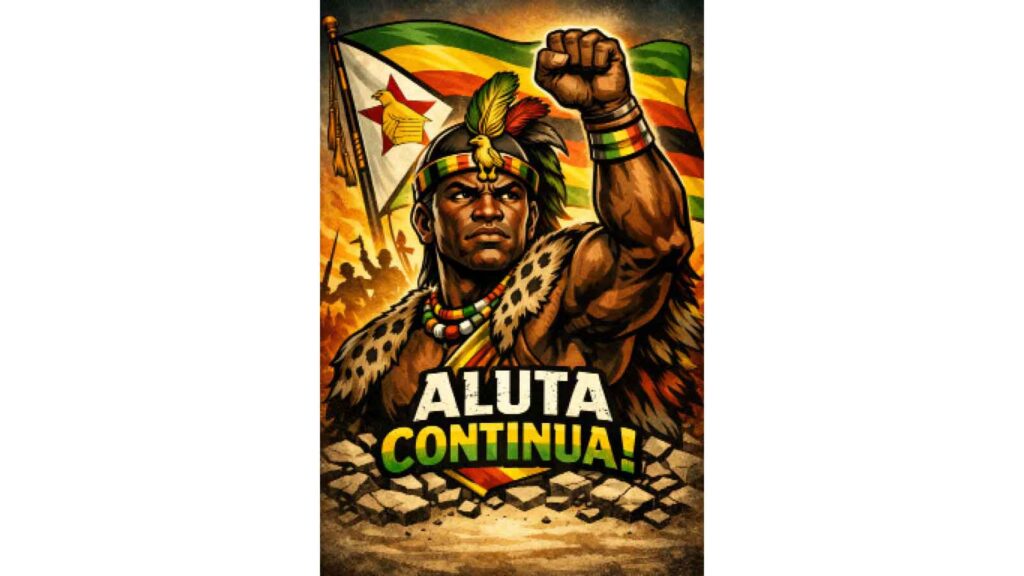
A luta continua, vitória é certa!
Bishop out!