Online Reporter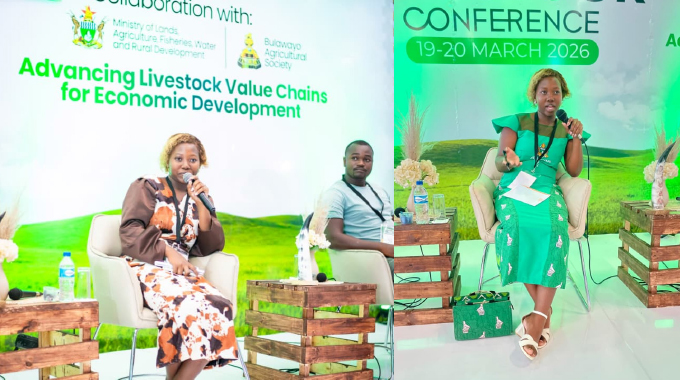
Nqobile Bhebhe, [email protected]
AT just 20 years old and already a chief executive officer of her own firm, she is sharing national platforms with renowned agricultural experts — a space typically dominated by seasoned industry players. She stands out with confidence, composure and a clear sense of purpose, embodying the bold, progressive spirit shaping a new generation of female entrepreneurs in Zimbabwe’s agriculture sector.
What could easily have been an overwhelming moment instead became a defining statement of courage, innovation and ambition. She demonstrated that neither age nor experience should be viewed as barriers to meaningful impact.
Fittingly, she achieved this feat during International Women’s Month.
During the recent national strategic Zimbabwe International Trade Fair Company Livestock Conference in Bulawayo, young entrepreneur Ms Phumzile Praise Ntonisani held her own.
Delivering a presentation that drew admiration across the sector, she reinforced a growing reality — the girl child has a firm and rightful place in Zimbabwe’s agricultural value chain.
Ms Ntonisani is the founder of Visionary Innovation for Sustainability in Technology and Agriculture, an organisation she established after identifying a critical gap: many young people in agriculture possess ideas and passion, but lack innovation skills, business knowledge and structured guidance.
Her entrepreneurial journey began early, shaped by responsibility and necessity.
“I started by selling chocolates when I was in Form One (2019) because I had to help my mum and grandfather.
There were both paying fees for me and buying uniforms . . . so my responsibility now was to cover my transport fees and other basic needs,” she said.
Life presented further challenges, but she refused to let adversity define her.
“Even when I got pregnant at the age of 16, and the father of the child rejected the baby, I never faced any challenges in supporting my baby because I was already in business. So at A-level, I was now selling cream doughnuts and chocolates, and that’s when I ventured into horticulture. I was selling at school and outside school,” said Ms Ntonisani.
Climate-related challenges later disrupted her horticulture business, pushing her towards innovation and diversification.
“Because of climate change, I faced challenges in my horticulture business and that’s when I decided to venture into value addition.”
That transition proved pivotal.
“That’s when I discovered my strength. I started by making fruit jams, dried fruits, and now I have biltong and fruit soaps.”
Soon to begin her studies in Sustainable Food Production at the National University of Science and Technology, Ms Ntonisani now runs a value addition-focused enterprise, Cowgirl Naturals, with a strong emphasis on food innovation.
“My company is into value addition. As the food innovator in my company, I saw a big gap in biltong production. Supermarkets are full of beef biltong. Where is chicken biltong? Where is liver biltong? Where is pork biltong? Where is chicken intestines biltong?”
Her ambition is to produce premium, unconventional products.
“I love producing premium products. I want to introduce products which I have never seen in the supermarkets. For example, I had never seen liver biltong in my entire life. But I have produced it myself.”
Her participation in the Livestock Conference marked an important step in her confidence and public profile.
“Presenting at the Livestock Conference was the best thing ever. At first, I thought my presentation was a bit off, but after presenting, people were really shocked, especially Nust students. They were really inspired. Now I don’t take myself lightly.”
Ms Ntonisani presented on “Strengthening Youth Involvement in Livestock Production and Value Chains.”
The experience reshaped her outlook on what is possible.
“Now I can see the potential I have. I have gained confidence. Now I have hope that I can become the Minister of Agriculture in the future, possibly the first woman.”
She believes agriculture offers vast, untapped opportunities for young people, particularly in value addition and agro processing.
“Opportunities are there, especially for value addition. Youths in leather have a big opportunity. When I was preparing for the Livestock Conference, I inquired within my circles whether there is a company in Zimbabwe selling cow hide fabric because I wanted to prepare my outfit for the Livestock Conference, but I couldn’t get any,” she said.
She ended up sourcing materials from across the border.
“I ended up buying in South Africa. So youths should be innovative enough to even manufacture those chemicals used when processing leather. Youths in leather can also start manufacturing cowboy and cowgirl boots, belts and export to countries where cowboys and cowgirls are found.”
Ms Ntonisani also highlighted barriers limiting youth participation in agriculture.
“As someone in value addition, I think young people lack information. Personally, I believe funding is there for young people; the problem is accessing it. I believe young people should be given more opportunities and platforms to showcase their talent to people who have those funds for youths,” she said.
She emphasised the urgency of digital literacy and emerging technologies.
“Young people should also be taught how to use the internet the right way. How to take advantage of artificial intelligence in any sector.”
Reflecting on past discouragement, she shared:
“I remember four years back, there was someone close to me who said, ‘You can never be the Minister of Agriculture in Zimbabwe because women are not good with farming’.”
Her response has been to challenge such limitations.
“So, I encourage women to let men focus on keeping livestock, and we add value to the livestock. Let’s focus on leather processing, biltong making and soap making, and let’s take advantage of artificial intelligence.
“I believe an empowered woman is an empowered nation. Women should also learn how to use drones,” said Ms Ntonisani.
Through her organisation, she intends to transform youth participation in agriculture via structured innovation hubs.
“I am the founder of an organisation called Visionary Innovation for Sustainability in Technology and Agriculture.
The reason why I started it was that I saw a gap in supporting youths who have a passion for agriculture or who are already in agriculture, but they don’t know how to be innovative in their businesses.”
She envisions national collaboration between Government and the private sector.
“We want to work with the Government and open innovation hubs in each school across the country where young people will be learning value addition, coding, how to use drones, livestock production, financial literacy and artificial intelligence.
“The community and private sector can partner with us and we transform young lives, then we will see whether or not we will continue crying about drug and substance abuse as a nation,” she said.
She credits several national platforms for shaping her entrepreneurial growth.
“The ZimTrade prestigious Eagles’ Nest Agri Challenge and Confederation of Zimbabwe Industries (CZI) workshops have been shaping my entrepreneurial path in a mighty way and even now, they are still adding value to my life. As the youngest member of the CZI, I am benefiting a lot. They call me their baby girl.
“The Eagles Nest helped me with improving my branding and packaging in the business; they also taught me digital marketing. Now I get customers from Facebook. With regards to CZI, I meet influential people and potential investors at their workshops. CZI is also helping me build my profile,” she said.
Her story reflects a growing reality in Zimbabwe’s agricultural landscape: young people — particularly young women — are no longer merely participants, but innovators, value chain builders and future leaders shaping the industry’s transformation from the ground up.