Chronicle Editor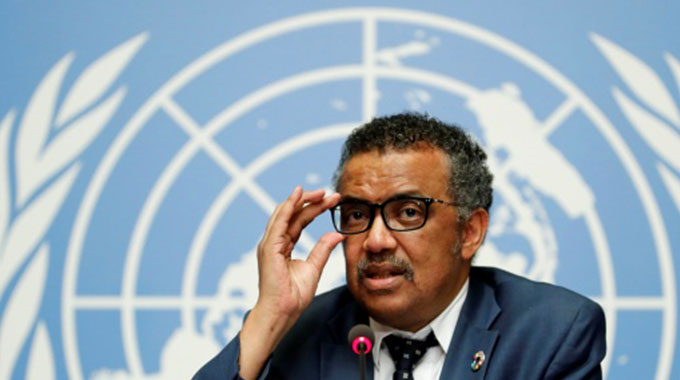
Noel Munzabwa
World Health Organisation (WHO) Director-General Tedros Ghebreyesus last week warned countries that lifting existing restrictions in the fight against Covid-19 could result in deadly resurgence of the virus.
The warning coincided with most African states entering the second or third week of their national lockdowns. Zimbabwe is in the third week of its lockdown and it is unclear if it would be extended. Already South Africa has just announced a two-week extension so as to maximise on the positives scored in the bid to curb new infections.
There’s no guarantee this will be the last extension given that the various countries are running the same process but on a different days. For example there is a three-day lag between South Africa and Zimbabwe meaning at some stage the periods may have to be synchronised.
Judging by the cycle of infection the continent has entered probably its most critical phase.
“I know that some countries are already planning the transition out of stay-at-home restrictions, WHO wants to see restrictions lifted as much as anyone. At the same time, lifting restrictions too quickly could lead to a deadly resurgence, the way down can be dangerous as the way up if not managed properly,” Ghebreyesus cautioned.
It is an indisputable fact that the coronavirus has been slow to spread across Africa but it is possible cases can rise so governments, their people as well as health-care workers are better off bracing up than expecting a subtle end.
The continent should not be too relaxed that infection numbers are not as high as, say, those of the United States. Every country with Covid-19 had a period when outbreaks looked contained, but cases later spiked rapidly. This can happen in Africa. If the spread seems slow to develop, that may be because no African country has the same volume of international travel as the countries elsewhere that are already suffering.
The Covid-19 strategy in most of the developed world has been to “flatten the curve”—spread out the infections across a long period, so that at any given time, enough ventilators and ICU beds are available to accommodate everyone who is sick. If you flatten the curve enough, the tail end might even get vaccinated and avoid infection altogether.
With most African countries now in lockdowns, the continent enters the most critical Covid-19 phase and the next two weeks could decisively be important for both authorities and citizens given the expected worst or peak of the coronavirus challenge.
It is very much possible that post the peak, the nations could flatten the curve but for that to be scored full adherence to measures put in place is a must as anything else outside could further postpone or worsen the peak.
Many have had to make difficult choices and sacrifices, but all have been determined that these choices and sacrifices are absolutely necessary if our country is to emerge stronger from this disaster given that the continent has never experienced a crisis of this scale and magnitude such as this one caused by Covid-19.
Behavioural changes are necessary and to borrow from South Africa’s President Cyril Ramaphosa, “there is no doubt in my mind that we will prevail…If we work together, we will beat this disease”
United Nations Economic Commission for Africa Executive Secretary Vera Songwe agreed that it was possible to flatten the curve.
“If we want to have a fighting chance, we need it immediately,” she said. “In the next two to three weeks, if we act really decisively, we may be able to flatten the curve and then when the storm comes it will be not be as brutal as we see in Europe,” Songwe was quoted by one of the international publications.
She said by and large it called for a concerted global effort .
“A coordinated global effort is required to assist countries and if there is one African country or one country anywhere in the world that still has the coronavirus, the whole world has it. We’ve seen the speed of contamination and how quickly it can re-spread,” Songwe said.
WHO spokesperson, Dr Margaret Harris, says that people must continue to maintain social distancing, keep hands clean and identify cases quickly.
“Africa has an advantage and understands the importance of surveillance. While the rest of the world was taken by surprise, my feeling is Africa is better placed in many ways. It is still relatively early. There is still time to flatten the curve.”
Dr Harris believes Africa is likely to deal with Covid-19 much better than the rest of the world.
She says the continent’s experience with other outbreaks will help. Also, having relatively few international connections has given Africa some time to prepare.
Rwanda, for example, shut its borders when it still had only a few cases.
Yet another factor why the disease could have less impact in Africa than elsewhere is that the continent enjoys the advantage of youth. The disease mainly kills old people but Africa’s population is generally young with an average age of 18.9. In the US and China, the average age is 38. -@NoelMunzabwa



 Online Reporter