Chronicle Editor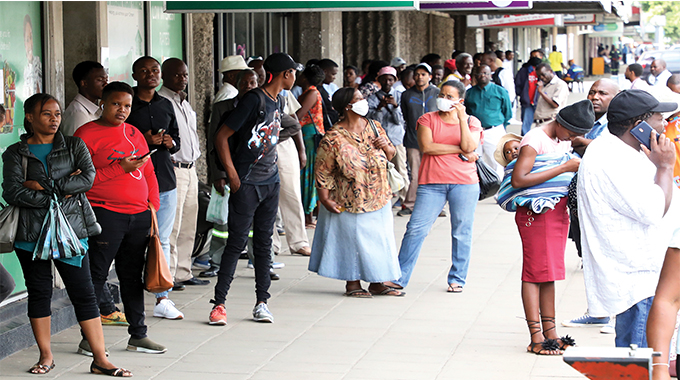
Nqobile Tshili, Chronicle Reporter
REMITTANCES from relatives abroad are proving to be a lifeline for local families as they are bringing food to the table in many homes during the lockdown aimed at stopping the spread of Covid-19.
From the jobless to those gainfully employed, who have seen their salaries being eroded by inflation, the funds are proving to be a source of livelihoods.
Due to the huge sums involved, remittances are now being recognised as an important contributor to the country’s growth and development and in their path, they are lessening the burden on families during difficulties brought about by the lockdown.
A Chronicle news crew has observed that since Government ordered international money transfer agents to reopen banking halls last week, long queues have been the order of the day as people get their funds.
President Mnangagwa said international money transfer agents were providing an essential service and needed to be kept operational.
Diaspora remittance beneficiaries who spoke to Chronicle yesterday said without receiving funds from the diaspora, life was increasingly becoming difficult.
One of the beneficiaries, Mr Edwin Zvavame, a pensioner, said he depends on funds sent to him by his daughter, a nurse working in a European country.
Mr Zvavame said even though he appreciates the support from his daughter working in a foreign land, he was concerned for her safety as she was in the frontline in the fight against Covid-19 as Europe is one of the hard-hit areas by the virus.
He said his local pension allocation was $600 which cannot buy groceries to support him and his six dependents locally.
“If we are not getting these diaspora remittances we will starve to death. I am a former National Railways of Zimbabwe (NRZ) employee so the pension I’m getting cannot support my family. I stay with some of my children and grandchildren so with the prices of basic commodities, we cannot survive without getting the funds,” he said.
Mr Zvavame said his daughter sends the money every month to enable him to buy groceries, pay for services among other things.
A commuter omnibus operator Mr Fanuel Nsingo, said it was his first time to get a remittance as he was forced to seek for help by the prevailing restrictions.
He said the lockdown left him desperate and he had to ask for money from a niece who lives in South Africa.
“I have a wife and two children. I operate a kombi and normally it was giving almost enough to feed my family but due to the lockdown we are grounded. I had to ask for money from my niece who sent me just enough to push us for a week or so. After that we would be left with nothing and I don’t know where I would get the money to feed my family. I am in a very tight spot,” he said.
Mrs Precious Ngwenya, who used to work at a local restaurant before it shut down due to the lockdown, said what worries her is that her husband might fail to send the money in the coming months.
“I was working and also involved in cross border trading business to supplement my salary and support my family but as it stands, both have closed down. I have no other source of income. I have to depend on my husband who works in South Africa for survival. But my concern is that the lockdown has affected him as well.
“Most companies are saying that without working people will not be paid. I don’t even know whether I would be able to have the money next month, meaning our sources of livelihood are also threatened,” said Mrs Ngwenya.
Similar concerns were raised by Mr Sigola from Emakhandeni, an NRZ employee, who said if diasporans stop sending money home it will be catastrophic.
“We just hope they are not laid off in their jobs. I work but my salary is not enough to sustain my family. I can’t even imagine what will happen if the money we are getting from diasporans is cut off. It will be too difficult for some of us. Basic commodities are just too expensive,” said Mr Sigola.
The funds sent by relatives in foreign countries also act as a source of forex in the country’s economy.
Zimbabwe’s Diaspora remittances grew by 2,6 percent to US$635 million in 2019 from US$619 million recorded in 2018, according to the Reserve Bank of Zimbabwe.
There are, however, suspicions that the country could be receiving millions more in remittances sent through informal channels. This is evidenced by the rampant operations of illegal money transfer agencies and use of cross-border transporters. -@nqotshili.


 Online Reporter