Online Reporter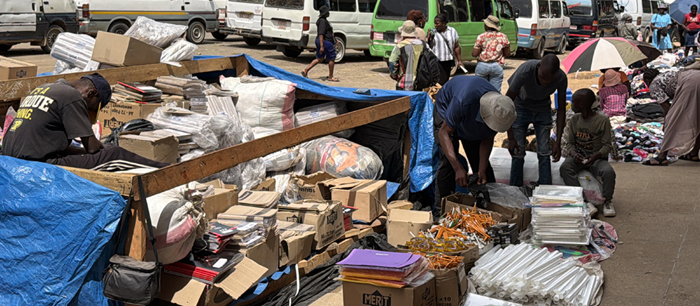
Tendai Gukutikwa
Post Reporter
WITH school bells set to ring next Tuesday, Mutare’s Central Business District (CBD) has been engulfed by a wave of shoppers—parents clutching stationery bundles, children trying on uniforms, and vendors cashing in on the annual back-to-school frenzy.
Pavements, ranks, and road edges have turned into bustling marketplaces, bringing congestion, frustration, and a surge in illegal vending structures.
Ordinary walkways have effectively become makeshift shops, with vendors spilling onto pedestrian paths and forcing people onto the road, further straining the city’s already congested CBD.
The sheer volume of shoppers this year is striking, but what stands out even more is the scale and boldness of illegal vending operations that have mushroomed across the city.
Unlike the usual plastic sheets spread on pavements, vendors have erected semi-permanent structures, particularly around high-density suburb ranks. At D Avenue, popularly known as Chikanga Rank, a large blue tent pitched directly on the pavement mimics a fully-fledged retail shop.
Stacked high with stationery boxes, the tent is manned by at least three men at any given time, a testament to its popularity among parents hunting for affordable school supplies.
Inside, the vendors—now favourites among many parents—sell everything from exercise books and pens to satchels and school jerseys. Their appeal lies in low prices, but the operations run without signage, licensing, or visible municipal approval.
Similar setups have sprung up along E Avenue and across the downtown area, where tented stalls and vendors trading from the backs of vehicles have become a common sight.
The back-to-school rush has always been a defining feature of January in Mutare, but this year’s surge highlights the growing challenge of balancing affordability for struggling families with the need for order in the city’s CBD. As parents scramble to prepare their children for the new term, the streets tell a story of resilience, improvisation, and the city’s ongoing struggle to regulate informal trade.
“This is no longer vending, it is a shop. Tomorrow everyone will copy it and we will have these blue tents all over town,” remarked a resident, Mr Nixon Muchigwa.
For vendors operating such structures, however, the back-to-school season represents a rare economic opportunity.
“This is our harvest time. When schools open, business slows, so we must make money now,” said one downtown vendor who requested anonymity.
The vendor admitted that the structure was illegal, but defended it as a survival strategy.
“We are not thieves, we are just selling books. If council comes, we remove it and pretend we are waiting for a vehicle to collect the stationery, because this is a rank after all,” he said.
However, the semi-permanent nature of the tents, wooden poles, covered sides, and extended displays, suggests growing confidence among vendors that enforcement will be minimal during peak shopping periods.
Commenting on the situation, Mutare City Council spokesperson, Mr Charles Sadondo said operations targeting illegal street vending are ongoing and that council is leaving no stone unturned, as street vending violates municipal by-laws.
“We have not stopped bringing order to the CBD. Our municipal police are always at work, and confiscate goods daily. However, vendors keep returning, but we will not tire, we will continue removing them,” he said.
Mr Sadondo said concerns now extend beyond traditional vendors to include licensed shop owners who are illegally displaying and selling their wares outside their premises.
“It appears they are now competing with vendors. Instead of displaying goods inside shops, they are crowding pavements, with some blocking both sides, leaving pedestrians with little walking space. This is mainly happening in the downtown area, and we urge them to stop. Failure to comply will result in confiscation and fines,” he said, adding that vendors often exploit the fact that municipal police knock off at 5pm, pitching their tents after working hours.
To attract customers, many stationery shops have also placed loudspeakers outside their premises, playing music at maximum volume or advertising prices.
Mr Sadondo said this practice also contravenes council by-laws.
“Our health inspectors will fine offenders and confiscate equipment being used to disturb public peace,” he warned.
From early morning, parents clutching lengthy school requirement lists weave through crowds along Herbert Chitepo Street and avenues such as D Avenue, hopping between shops, flea markets, and illegal stalls erected almost overnight.
For many, the task is simple yet exhausting, finding affordable uniforms, exercise books, pens, mathematical sets, and school shoes before the first day of term.
Parents say convenience and price often outweigh legality.
“I know it is not allowed, but where else do we go? Town shops are expensive, and here I can bargain. If council wants to remove them, they must give people alternatives. I have been moving up and down since morning. Every school wants something different. One child wants 20 books, another wants 15, and then there is uniform on top of that. January is always hard,” said Mrs Memory Tanyanyiwa.
While alternatives exist through formal stationery shops, many parents say affordability remains a challenge.
Tempers flare as shoppers scramble for the last affordable sizes of shoes and uniforms, with January traditionally being a financially tight month following festive-season spending.
“I am not even done paying school fees. Now the children want books, uniforms, and shoes. It feels like the pressure never ends, and that is why we end up at these illegal vendors because we buy more for less,” said Mr Patrick Mangena.
Some parents expressed mixed feelings about the illegal vending stalls in the CBD selling stationery.
“We do not like this chaos, but legal shops are expensive. Here I can buy five books for the price of three in the so-called legal shops,” said Mrs Agnes Muyamuri.
Others raised safety concerns.
“These tents block visibility. If there is a fire or stampede, people will be trapped. Children are everywhere,” said Mr Mangena.
Parents also blamed increasingly bloated and specific requirement lists by schools.
“The schools want specific colours of books, specific pens, and even files. If you miss something, the child is sent back home, and these tents have everything,” said Mr Mangena, adding that parents are pressured to comply.
“You do not want your child to be the only one without a uniform, so you push yourself even when the money is not there,” he said.
For long-time Mutare residents, the scenes are familiar, though many say the scale is increasing.
“Every January it is the same, chaos, shouting, pushing, vendors everywhere. Then schools open, and the city calms down again, but the tents are new. Before it was just plastic sheets on pavements; now it is structures,” said Mr Mangena.
With less than a week before schools reopen, pressure and illegality in the CBD is expected to intensify.